Department of Rheumatology, University Hospital of Saint-Étienne, INSERM U1059, Lyon University, Saint-Etienne, France.
Department of Public Health, Centre de Pharmacoépidémiologie (Cephepi), Sorbonne University, INSERM, Institut Pierre Louis d'Epidémiologie et de Santé Publique, AP-HP, Pitié Salpêtrière Hospital, Paris, France.
J Bone Miner Res. 2022 Oct;37(10):1811-1822. doi: 10.1002/jbmr.4720. Epub 2022 Oct 17.
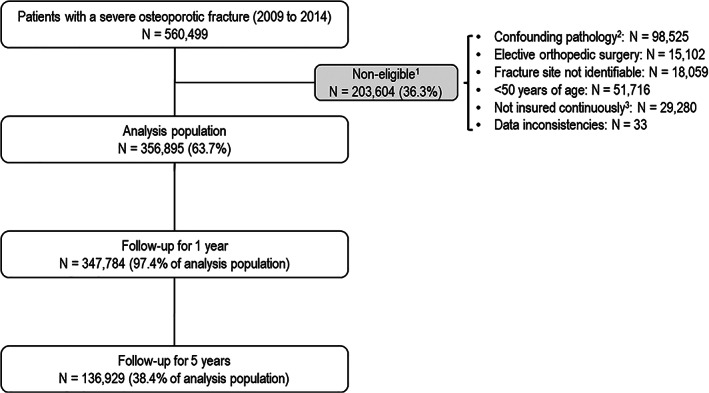
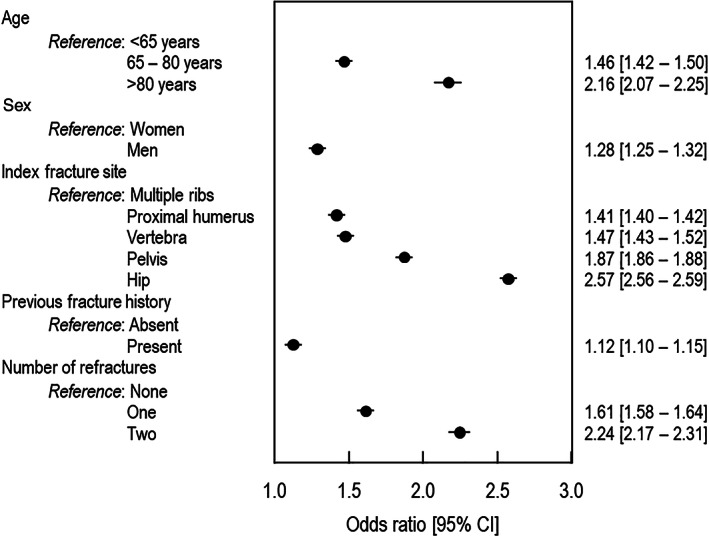
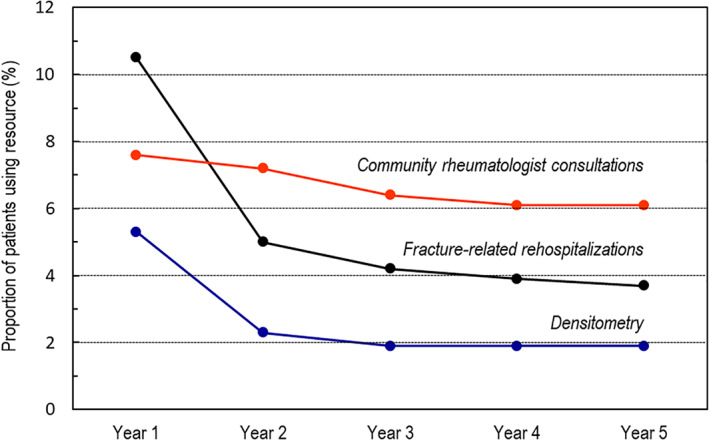
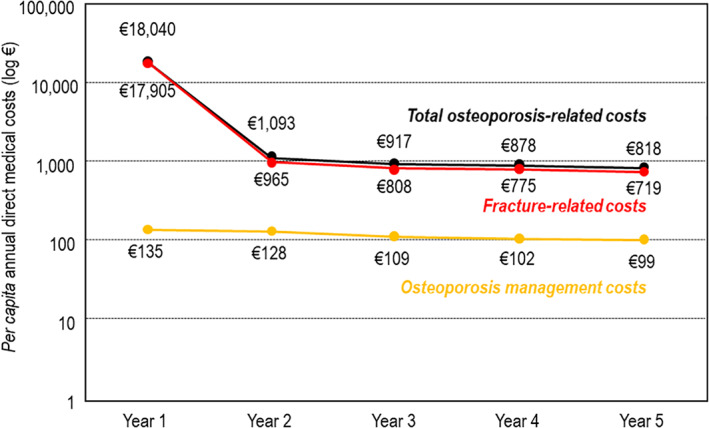
Osteoporosis carries a high medical, economic, and societal burden principally because of the risk of severe fractures. The objective of this cost-of-illness study was to describe health resource utilization and associated costs in all patients aged ≥50 years hospitalized for a severe osteoporotic fracture over a 6-year period (2009 to 2014) in France. Data were extracted from the French national healthcare database (SNDS) on all health care resource utilization between the index date (date of hospitalization for first fracture during the enrollment period) and study end (December 31, 2016) or until the patient died. Costing was restricted to direct costs and determined from the payer perspective. Variables related to costs were identified through multivariate logistic regression analysis. A total of 356,895 patients were included (median follow-up 39.1 months). In the year after the index fracture, 36,622 patients (10.5%) were rehospitalized for a fracture-related reason. Only 18,474 (5.3%) underwent bone densitometry and 58,220 (16.7%) received a specific treatment. The total annual per capita osteoporosis-related cost in the year after the index severe osteoporotic fracture was €18,040 (from €8598 for multiple ribs to €21,085 for hip fracture) of which €17,905 was incurred by fracture-related costs. The cost incurred by management of osteoporosis was €135. Over years 2 to 5, the mean annual per capita costs of fracture treatment (€806, mostly attributable to the treatment of refractures) continued to dominate those of osteoporosis management (€99). Total annual cost of care was €1260 million (year 2014). Variables associated with higher cost were older age, male sex, site of fracture, a history of prior osteoporotic fracture, and the number of refracture events. The 5-year cost of severe osteoporotic fractures to the French health care system is high and mostly attributable to the treatment of refractures. Improved fracture prevention measures in patients with osteoporosis is crucial to reduce the economic burden of the disease. © 2022 The Authors. Journal of Bone and Mineral Research published by Wiley Periodicals LLC on behalf of American Society for Bone and Mineral Research (ASBMR).
骨质疏松症带来了高昂的医疗、经济和社会负担,主要是因为严重骨折的风险。本疾病经济负担研究的目的是描述 6 年内(2009 年至 2014 年)所有≥50 岁因严重骨质疏松性骨折住院的患者的健康资源利用情况和相关费用。数据从法国国家医疗保健数据库(SNDS)中提取,包括从索引日期(纳入期内首次骨折住院日期)到研究结束(2016 年 12 月 31 日)或直至患者死亡之间的所有医疗资源利用情况。成本仅限于直接成本,并从支付者的角度确定。通过多变量逻辑回归分析确定与成本相关的变量。共纳入 356895 例患者(中位随访 39.1 个月)。在索引骨折后 1 年内,有 36622 例(10.5%)因骨折相关原因再次住院。只有 18474 例(5.3%)进行了骨密度检查,58220 例(16.7%)接受了特定治疗。索引严重骨质疏松性骨折后 1 年内,与骨质疏松症相关的人均年度总费用为 18040 欧元(从多发性肋骨的 8598 欧元到髋部骨折的 21085 欧元),其中骨折相关费用为 17905 欧元。骨质疏松症管理费用为 135 欧元。在第 2 至 5 年期间,骨折治疗的年均人均费用(806 欧元,主要归因于再骨折的治疗)继续超过骨质疏松症管理费用(99 欧元)。总护理年度费用为 1.26 亿欧元(2014 年)。与更高成本相关的变量是年龄较大、男性、骨折部位、既往骨质疏松性骨折史和再骨折次数。法国卫生保健系统治疗严重骨质疏松性骨折的 5 年成本很高,主要归因于再骨折的治疗。改善骨质疏松症患者的骨折预防措施对于降低疾病的经济负担至关重要。