Choi Namkee G, Marti C Nathan, Choi Bryan Y
Steve Hicks School of Social Work, University of Texas at Austin, Austin, TX, 78712, USA.
Department of Emergency Medicine, Philadelphia College of Osteopathic Medicine and BayHealth, Dover, DE, 19901, USA.
SSM Popul Health. 2022 Sep 28;19:101243. doi: 10.1016/j.ssmph.2022.101243. eCollection 2022 Sep.
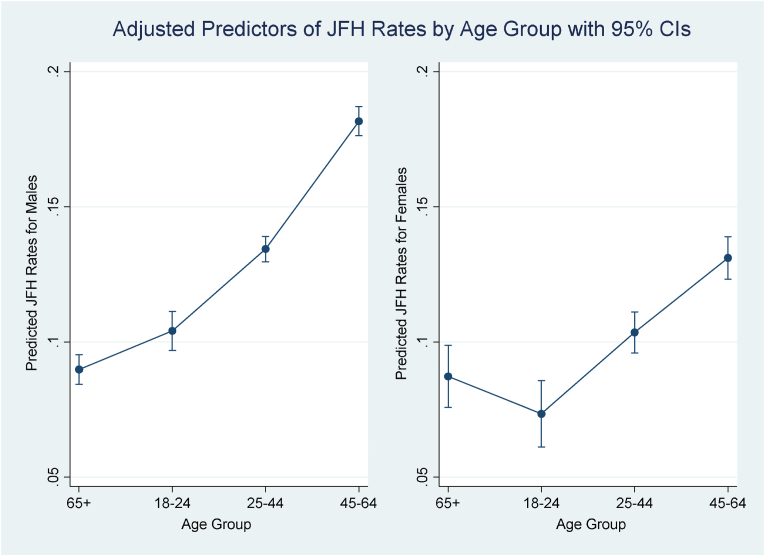
Previous research has shown that job loss, financial strain, and/or loss of housing (JFH) in midlife elevate suicide risk. In this study based on the 2017-2019 National Violent Death Reporting System, we examined other suicide precipitants and contributors of decedents whose suicide was in part precipitated by JFH and the circumstances under which they died. First, we examined all adult decedents (N = 94,454; 74,042 males [78.4%] and 20,412 females [21.6%]) and then focused on decedents age 45-64 (N = 34,208; 25,640 males [75%] and 8568 females [25.0%]). The 45-64 age group had the highest rate of JFH (22.0% for males and 15.1% for females) as a suicide precipitant. The results of generalized linear models for all adult suicide decedents of both sexes showed that the 45-64 age group (IRR = 2.02, 95% CI = 1.89-2.16), compared to 65+ age group, and relationship problems, mental disorders, and alcohol problems were associated with significantly higher risk of JFH-precipitated suicide. In male decedents age 45-64, JFH was positively associated with depressed mood (IRR = 1.95, 95% CI = 1.85-2.06), alcohol problems (IRR = 1.14, 95% CI = 1.07-1.21), and number of crises (IRR = 1.48, 95% CI = 1.43-1.53). In female decedents age 45-64, JFH was positively associated with relationship problems (IRR = 1.19, 95% CI = 1.05-1.35), legal problems (IRR = 1.27, 95% CI = 1.06-1.54), depressed mood (IRR = 1.78, 95% CI = 1.59-1.99), and number of crises (IRR = 1.58, 95% CI = 1.48-1.68). In both sexes, the risk of JFH was also positively associated with a college education. In female decedents, JFH risk was higher among divorced or never-married individuals. Coroner/medical examiner and law enforcement agency reports show that some experienced depression and started misusing alcohol and/or other substances following a job loss, but others had these problems throughout life, which caused/contributed to JFH. These findings show the significance of suicide prevention approaches at both systemic (generous unemployment insurance, housing subsidies) and individual (treatment of depression and alcohol/substance misuse problems and social support/connection) levels.
先前的研究表明,中年时期的失业、经济压力和/或失去住房(JFH)会增加自杀风险。在这项基于2017 - 2019年国家暴力死亡报告系统的研究中,我们调查了自杀部分由JFH引发的死者的其他自杀诱因和促成因素,以及他们死亡时的情况。首先,我们研究了所有成年死者(N = 94,454;74,042名男性[78.4%]和20,412名女性[21.6%]),然后重点关注45 - 64岁的死者(N = 34,208;25,640名男性[75%]和8568名女性[25.0%])。45 - 64岁年龄组中,作为自杀诱因的JFH发生率最高(男性为22.0%,女性为15.1%)。对所有成年男女自杀死者进行的广义线性模型分析结果显示,与65岁及以上年龄组相比,45 - 64岁年龄组(风险比[IRR] = 2.02,95%置信区间[CI] = 1.89 - 2.16)、人际关系问题、精神障碍和酒精问题与JFH引发的自杀风险显著更高相关。在45 - 64岁的男性死者中;JFH与情绪低落(IRR = 1.95,95% CI = 1.85 - 2.06)、酒精问题(IRR = 1.14,95% CI = 1.07 - 1.21)和危机数量(IRR = 1.48,95% CI = 1.43 - 1.53)呈正相关。在45 - 64岁的女性死者中,JFH与人际关系问题(IRR = 1.19,95% CI = 1.05 - 1.35)、法律问题(IRR = 1.27,95% CI = 1.06 - 1.54)、情绪低落(IRR = 1.78,95% CI = 1.59 - 1.99)和危机数量(IRR = 1.58,95% CI = 1.48 - 1.68)呈正相关。在男女两性中,JFH风险也与大学教育呈正相关。在女性死者中,离婚或未婚个体中的JFH风险更高。验尸官/法医和执法机构的报告显示,一些人在失业后经历了抑郁并开始滥用酒精和/或其他物质,但另一些人一生都有这些问题,这些问题导致了JFH。这些发现表明了在系统层面(慷慨的失业保险、住房补贴)和个人层面(治疗抑郁症和酒精/物质滥用问题以及社会支持/联系)预防自杀方法的重要性。