Chen Jierong, Lu Lianghe, Qu Chunhua, A Gari, Deng Fangqi, Cai Muyan, Chen Wei, Zheng Lie, Chen Jiewei
State Key Laboratory of Oncology in South China, Collaborative Innovation Center for Cancer Medicine, Sun Yat-sen University Cancer Center, Guangzhou, China.
Department of Pathology, Sun Yat-sen University Cancer Center, Guangzhou, China.
Front Med (Lausanne). 2022 Sep 20;9:981001. doi: 10.3389/fmed.2022.981001. eCollection 2022.
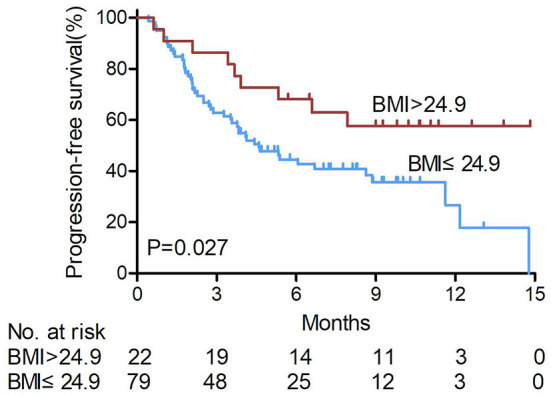
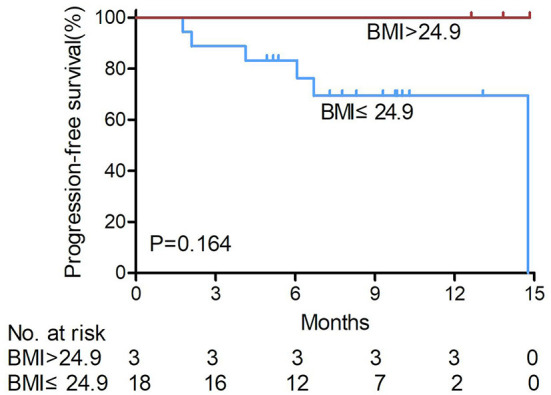
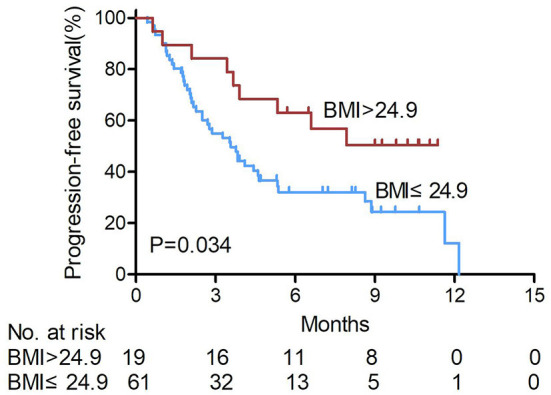
Immunocheckpoint inhibitors have shown significant efficacy in the treatment of hepatocellular carcinoma (HCC), but there are individual differences. The aim of this study was to explore body mass index (BMI) as a predictor of anti-PD-1 efficacy in patients with HCC. We retrospectively analyzed 101 HCC patients who treated with anti-PD-1 at Sun Yat-sen University Cancer Center from July 2018 to November 2019 and divided them into overweight (BMI > 24.9) and non-overweight (BMI ≤ 24.9) groups based on baseline BMI levels. BMI > 24.9 accounted for 22 cases (21.8%) and BMI ≤ 24.9 accounted for 79 cases (78.2%) in the study cohort. Overweight patients had higher disease control rates than non-overweight patients ( = 0.019, respectively). The mean progression-free survival (PFS) in overweight patients (10.23 months) was significantly longer than that of non-overweight patients (6.85 months; = 0.027). Among patients with immune-related adverse events (irAEs), the mean PFS was also significantly longer in overweight patients (7.72 months) than in non-overweight patients (5.31 months, = 0.034). Multivariate analysis showed that BMI was an independent prognostic factor for PFS in HCC patients treated with anti-PD-1 (hazard ratio: 0.47, = 0.044). Thus, higher BMI predicts a better prognosis among HCC patients treated with anti-PD-1. In clinical practice, patients' BMI can provide a useful tool for predicting the efficacy of anti-PD-1 therapy.
免疫检查点抑制剂在肝细胞癌(HCC)治疗中已显示出显著疗效,但存在个体差异。本研究旨在探讨体重指数(BMI)作为HCC患者抗PD-1疗效预测指标的作用。我们回顾性分析了2018年7月至2019年11月在中山大学肿瘤防治中心接受抗PD-1治疗的101例HCC患者,并根据基线BMI水平将其分为超重(BMI>24.9)和非超重(BMI≤24.9)组。研究队列中,BMI>24.9的患者有22例(21.8%),BMI≤24.9的患者有79例(78.2%)。超重患者的疾病控制率高于非超重患者(分别为 = 0.019)。超重患者的平均无进展生存期(PFS)(10.23个月)显著长于非超重患者(6.85个月; = 0.027)。在发生免疫相关不良事件(irAEs)的患者中,超重患者的平均PFS(7.72个月)也显著长于非超重患者(5.31个月, = 0.034)。多因素分析显示,BMI是接受抗PD-1治疗的HCC患者PFS的独立预后因素(风险比:0.47, = 0.044)。因此,较高的BMI预示着接受抗PD-1治疗的HCC患者预后较好。在临床实践中,患者的BMI可为预测抗PD-1治疗疗效提供有用工具。