Meng Danyang, Zhou Xuyou, Hu Tianye, Zheng Jialian, Jin Tingyu, Gao Han, Hu Jin
Department of Neurology, Affiliated Hospital of Jiaxing University, Jiaxing, China.
Department of Traditional Chinese Medicine and Acupuncture, Affiliated Hospital of Jiaxing University, Jiaxing, China.
Front Neurosci. 2022 Sep 20;16:986860. doi: 10.3389/fnins.2022.986860. eCollection 2022.
In this study, clinical data from vestibular migraine (VM) patients and healthy control populations were collected to analyze the clinical data of VM patients, especially the history of motion sickness, and to understand their clinical characteristics.
According to VM diagnostic criteria, 140 patients diagnosed with confirmed VM (cVM) and probable VM (pVM) who attended the outpatient and inpatient ward of Jiaxing First Hospital between August 2017 and June 2021, as well as 287 healthy check-ups in the health management center, were analyzed and compared in terms of age, gender, and previous history of motion sickness.
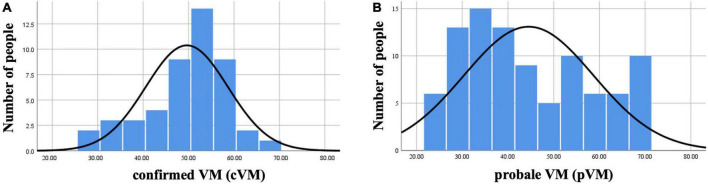
A comparison of clinical data related to VM patients and the control population showed that there were more women in the VM group ( < 0.01) and that patients in the VM group were older ( < 0.05) and had a higher prevalence of history of motion sickness history ( < 0.01). Analysis after matching gender and age revealed that patients in the cVM group were older than those in the pVM group ( < 0.05), but the proportion of motion sickness was lower than in the pVM group ( < 0.05). The age of the patients in the cVM group was mainly distributed around 50 years of age, following a normal distribution, whereas the age distribution of the patients in the pVM group did not have a significant trend of age concentration and was distributed at all ages.
The history of motion sickness is significant in patients with VM and may be a potential suggestive factor for the diagnosis of VM.
本研究收集前庭性偏头痛(VM)患者和健康对照人群的临床资料,分析VM患者的临床资料,尤其是晕动病史,以了解其临床特征。
根据VM诊断标准,对2017年8月至2021年6月期间在嘉兴市第一医院门诊和住院病房就诊的140例确诊为确诊VM(cVM)和可能VM(pVM)的患者,以及健康管理中心的287例健康体检者的年龄、性别和既往晕动病史进行分析比较。
VM患者与对照人群的临床资料比较显示,VM组女性更多(<0.01),VM组患者年龄更大(<0.05),晕动病史患病率更高(<0.01)。在匹配性别和年龄后分析发现,cVM组患者比pVM组患者年龄更大(<0.05),但晕动病比例低于pVM组(<0.05)。cVM组患者年龄主要分布在50岁左右,呈正态分布,而pVM组患者年龄分布无明显年龄集中趋势,各年龄段均有分布。
晕动病史在VM患者中具有重要意义,可能是VM诊断的潜在提示因素。