Li Guanlin, Cortez Michael H, Dushoff Jonathan, Weitz Joshua S
Interdisciplinary Graduate Program in Quantitative Biosciences, Georgia Institute of Technology, Atlanta, GA 30332, USA.
School of Physics, Georgia Institute of Technology, Atlanta, GA 30332, USA.
Virus Evol. 2020 May 22;6(2):veaa042. doi: 10.1093/ve/veaa042. eCollection 2020 Jul.
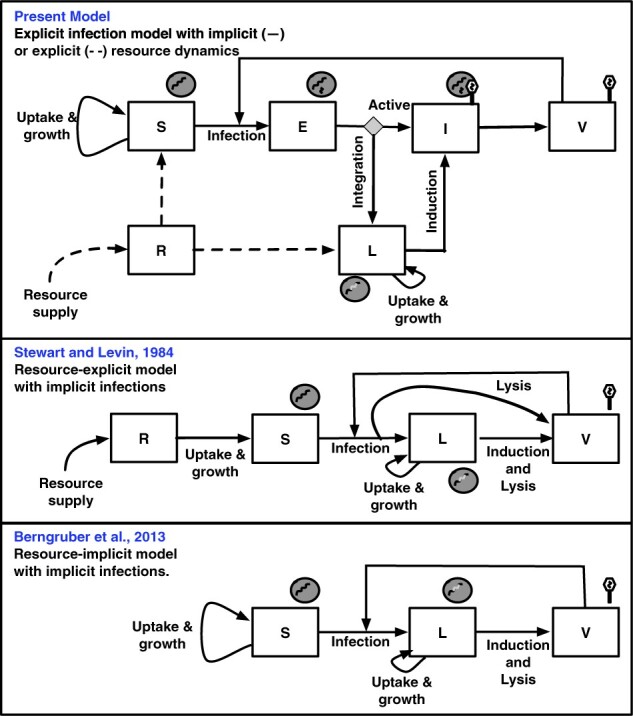
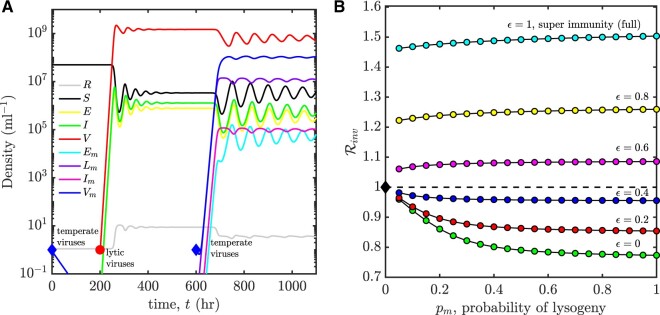
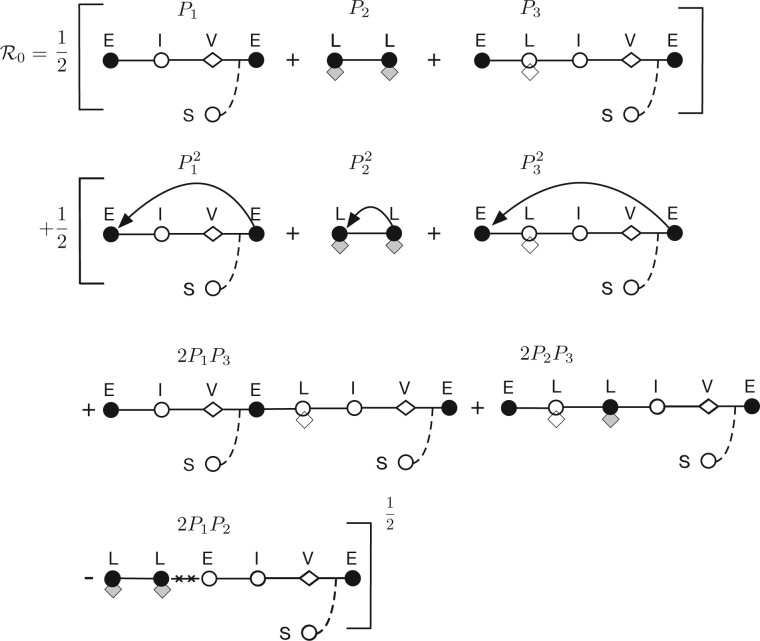
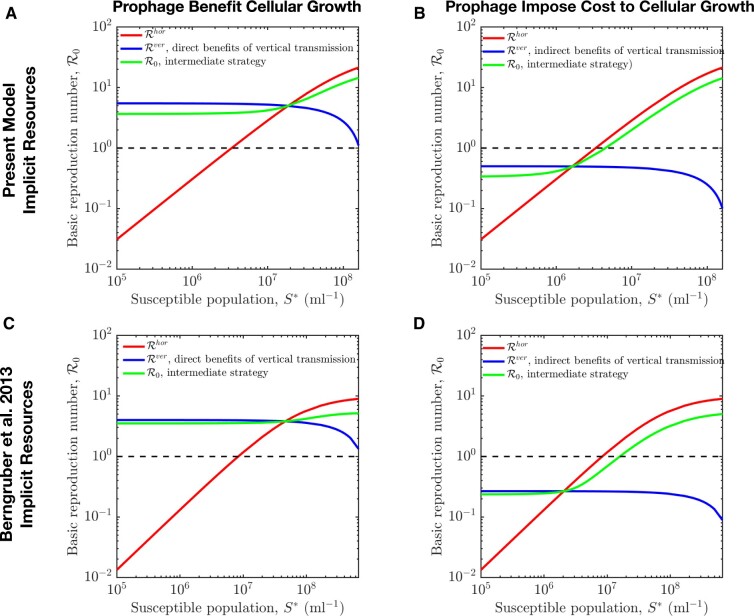
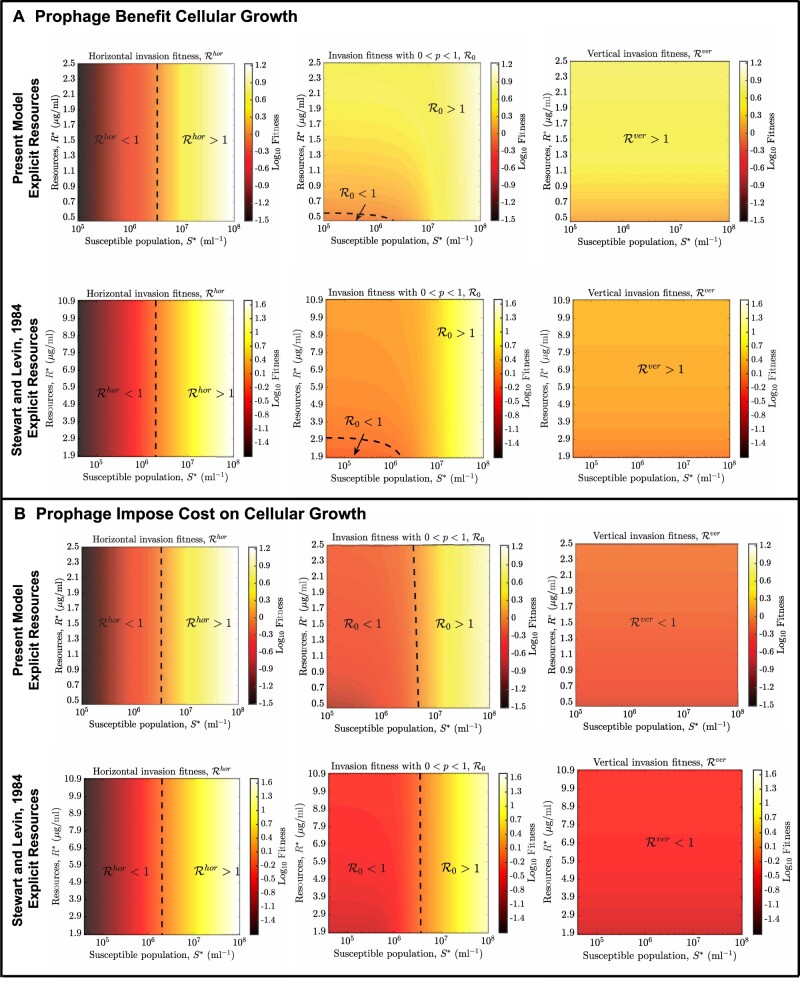
Bacterial viruses, that is 'bacteriophage' or 'phage', can infect and lyse their bacterial hosts, releasing new viral progeny. In addition to the lytic pathway, certain bacteriophage (i.e. 'temperate' bacteriophage) can also initiate lysogeny, a latent mode of infection in which the viral genome is integrated into and replicated with the bacterial chromosome. Subsequently, the integrated viral genome, that is the 'prophage', can induce and restart the lytic pathway. Here, we explore the relationship among infection mode, ecological context, and viral fitness, in essence asking: when should viruses be temperate? To do so, we use network loop analysis to quantify fitness in terms of network paths through the life history of an infectious pathogen that start and end with infected cells. This analysis reveals that temperate strategies, particularly those with direct benefits to cellular fitness, should be favored at low host abundances. This finding applies to a spectrum of mechanistic models of phage-bacteria dynamics spanning both explicit and implicit representations of intra-cellular infection dynamics. However, the same analysis reveals that temperate strategies, in and of themselves, do not provide an advantage when infection imposes a cost to cellular fitness. Hence, we use evolutionary invasion analysis to explore when temperate phage can invade microbial communities with circulating lytic phage. We find that lytic phage can drive down niche competition amongst microbial cells, facilitating the subsequent invasion of latent strategies that increase cellular resistance and/or immunity to infection by lytic viruses-notably this finding holds even when the prophage comes at a direct fitness cost to cellular reproduction. Altogether, our analysis identifies broad ecological conditions that favor latency and provide a principled framework for exploring the impacts of ecological context on both the short- and long-term benefits of being temperate.
细菌病毒,即“噬菌体”,能够感染并裂解其细菌宿主,释放出新的病毒后代。除了裂解途径外,某些噬菌体(即“温和”噬菌体)还可引发溶原状态,这是一种潜伏性感染模式,病毒基因组会整合到细菌染色体中并随其一起复制。随后,整合的病毒基因组,即“原噬菌体”,可诱导并重新启动裂解途径。在此,我们探讨感染模式、生态环境与病毒适应性之间的关系,本质上是在问:病毒何时应处于温和状态?为此,我们使用网络回路分析,根据感染性病原体生命历程中的网络路径(以受感染细胞开始和结束)来量化适应性。该分析表明,在宿主丰度较低时,温和策略,尤其是那些对细胞适应性有直接益处的策略,应更受青睐。这一发现适用于一系列噬菌体-细菌动力学的机制模型,涵盖细胞内感染动力学的显式和隐式表示。然而,同样的分析表明,当感染对细胞适应性造成代价时,温和策略本身并不会带来优势。因此,我们使用进化入侵分析来探究温和噬菌体何时能够入侵存在循环裂解噬菌体的微生物群落。我们发现,裂解噬菌体可降低微生物细胞之间的生态位竞争,从而促进潜伏策略的后续入侵,这些策略可增强细胞对裂解病毒感染的抗性和/或免疫力——值得注意的是,即使原噬菌体对细胞繁殖直接造成适应性代价,这一发现依然成立。总之,我们的分析确定了有利于潜伏的广泛生态条件,并为探索生态环境对处于温和状态的短期和长期益处的影响提供了一个有原则性的框架。