Li Wenjing, Jin Kehan, Luo Jichang, Xu Wenlong, Wu Yujie, Zhou Jia, Wang Yilin, Xu Ran, Jiao Liqun, Wang Tao, Yang Ge
Laboratory of Computational Biology and Machine Intelligence, National Laboratory of Pattern Recognition, Institute of Automation, Chinese Academy of Sciences, Beijing, China.
School of Artificial Intelligence, University of Chinese Academy of Sciences, Beijing, China.
Front Cardiovasc Med. 2022 Sep 20;9:988266. doi: 10.3389/fcvm.2022.988266. eCollection 2022.
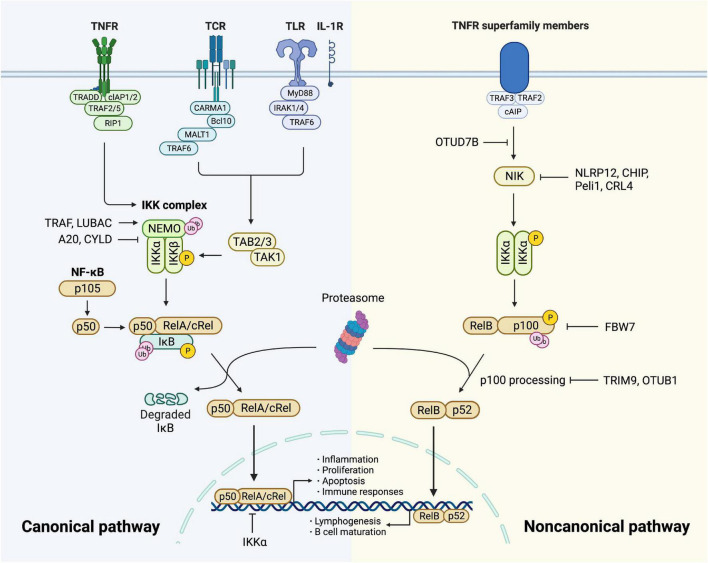
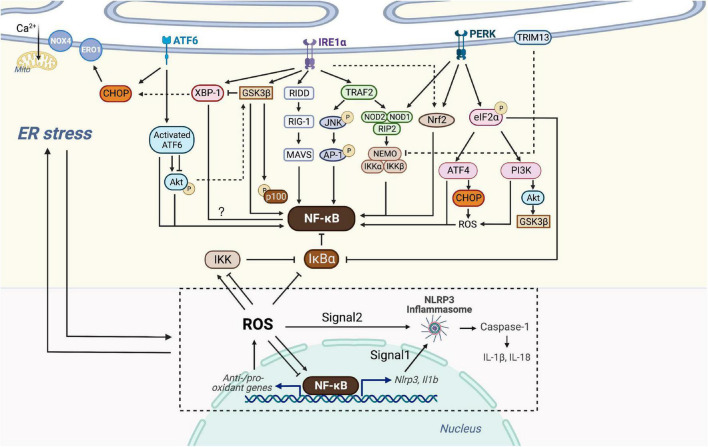
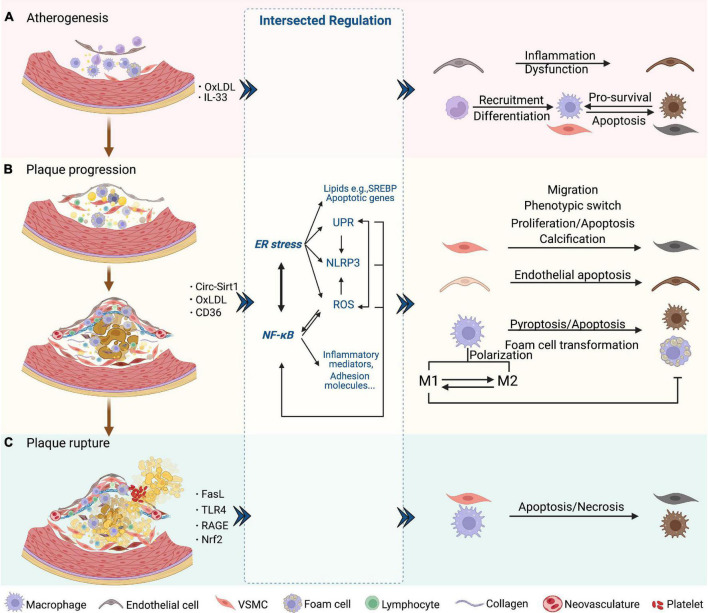
Atherosclerosis (AS) is a common cardiovascular disease with complex pathogenesis, in which multiple pathways and their interweaving regulatory mechanism remain unclear. The primary transcription factor NF-κB plays a critical role in AS modulating the expression of a series of inflammatory mediators under various stimuli such as cytokines, microbial antigens, and intracellular stresses. Endoplasmic reticulum (ER) stress, caused by the disrupted synthesis and secretion of protein, links inflammation, metabolic signals, and other cellular processes the unfolded protein response (UPR). Both NF-κB and ER stress share the intersection regarding their molecular regulation and function and are regarded as critical individual contributors to AS. In this review, we summarize the multiple interactions between NF-κB and ER stress activation, including the UPR, NLRP3 inflammasome, and reactive oxygen species (ROS) generation, which have been ignored in the pathogenesis of AS. Given the multiple links between NF-κB and ER stress, we speculate that the integrated network contributes to the understanding of molecular mechanisms of AS. This review aims to provide an insight into these interactions and their underlying roles in the progression of AS, highlighting potential pharmacological targets against the atherosclerotic inflammatory process.
动脉粥样硬化(AS)是一种常见的心血管疾病,其发病机制复杂,多种途径及其相互交织的调控机制仍不明确。主要转录因子NF-κB在AS中起着关键作用,在细胞因子、微生物抗原和细胞内应激等各种刺激下调节一系列炎症介质的表达。内质网(ER)应激由蛋白质合成和分泌紊乱引起,它将炎症、代谢信号和其他细胞过程与未折叠蛋白反应(UPR)联系起来。NF-κB和ER应激在分子调控和功能方面存在交集,均被视为AS的关键独立促成因素。在本综述中,我们总结了NF-κB与ER应激激活之间的多种相互作用,包括UPR、NLRP3炎性小体和活性氧(ROS)生成,这些在AS发病机制中一直被忽视。鉴于NF-κB与ER应激之间的多种联系,我们推测这个整合网络有助于理解AS的分子机制。本综述旨在深入探讨这些相互作用及其在AS进展中的潜在作用,突出针对动脉粥样硬化炎症过程的潜在药理学靶点。