Koziara Karolina, Mijas Magdalena E, Galbarczyk Andrzej, Wycisk Jowita, Pliczko Mateusz P, Krzych-Miłkowska Karolina, Grabski Bartosz
Department of Epidemiology and Population Studies, Faculty of Health Sciences, Jagiellonian University Medical College, Krakow, Poland.
Department of Environmental Health, Faculty of Health Sciences, Jagiellonian University Medical College, Krakow, Poland.
Front Psychol. 2022 Sep 20;13:958601. doi: 10.3389/fpsyg.2022.958601. eCollection 2022.
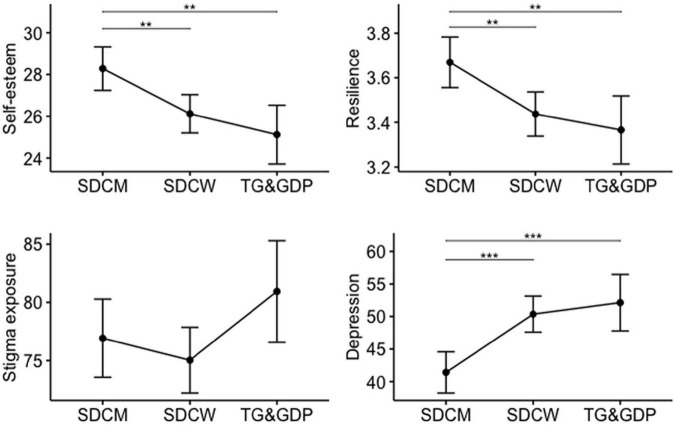
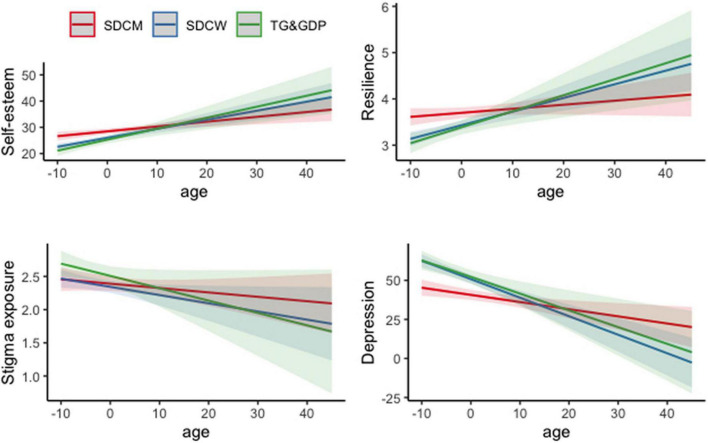
Lesbian, gay, bisexual, transgender, and queer populations are disproportionately affected by chronic stress associated with stigma which contributes to health adversities including depression. Negative impact of stigma on health can be alleviated by factors such as resilience. Little is known however on how exposure to stigma, protective factors and mental health change with age among gender and sexually diverse persons. Our study aimed at investigating this issue. Our sample consisted of (i) 245 sexually diverse cisgender women, (ii) 175 sexually diverse cisgender men, and (iii) 98 transgender and gender diverse persons. We collected data through a web-based survey. Linear regression models were performed to investigate the interactions of age and each group of participants for resilience, stigma exposure, and mental health indicators (depression and self-esteem). We hypothesized that resilience and mental health indicators will be positively associated with age in all distinguished groups despite the continued exposure to minority stress. The analysis yielded no significant relationships between stigma exposure and age among study participants. However, we observed significant interaction effects of distinguished groups of participants and age in case of self-esteem, depression, and resilience. Self-esteem and resilience were related positively, and depression was negatively associated with age in all study groups. Additionally, we observed that sexually diverse cisgender men demonstrated significantly increased resilience, reduced depression and higher self-esteem compared to other groups. Although the exposure to stigma did not decrease with age, resilience and self-esteem increased, suggesting that LGBTQ persons manage to thrive despite adversities.
女同性恋、男同性恋、双性恋、跨性别者和酷儿群体受到与污名相关的慢性压力的影响尤为严重,这种压力会导致包括抑郁症在内的健康问题。污名对健康的负面影响可以通过复原力等因素得到缓解。然而,对于性别和性取向多元的人群,污名暴露、保护因素和心理健康如何随年龄变化却知之甚少。我们的研究旨在调查这个问题。我们的样本包括:(i)245名性取向多元的顺性别女性,(ii)175名性取向多元的顺性别男性,以及(iii)98名跨性别者和性别多元者。我们通过网络调查收集数据。进行线性回归模型分析,以研究年龄与每组参与者在复原力、污名暴露以及心理健康指标(抑郁和自尊)方面的相互作用。我们假设,尽管持续暴露于少数群体压力之下,但在所有不同群体中,复原力和心理健康指标都将与年龄呈正相关。分析结果显示,研究参与者中污名暴露与年龄之间没有显著关系。然而,在自尊、抑郁和复原力方面,我们观察到不同参与者群体与年龄之间存在显著的相互作用效应。在所有研究组中,自尊和复原力呈正相关,抑郁与年龄呈负相关。此外,我们观察到,与其他群体相比,性取向多元的顺性别男性表现出显著增强的复原力、更低的抑郁水平和更高的自尊。尽管污名暴露并没有随着年龄的增长而减少,但复原力和自尊却有所提高,这表明 LGBTQ 人群尽管面临逆境仍能茁壮成长。