Pfizer Japan Inc., Tokyo, Japan.
INTAGE Healthcare Inc., Tokyo, Japan.
Adv Ther. 2022 Dec;39(12):5327-5350. doi: 10.1007/s12325-022-02321-z. Epub 2022 Oct 7.
In light of the lack of an agreed international standard for how to conduct cost-effectiveness analyses (CEAs), including cost-utility analyses (CUAs) from a societal perspective, there is uncertainty regarding to what extent the inclusion of productivity losses/gains in economic evaluations can affect cost-effectiveness results and subsequently decisions on whether to recommend new health technologies. To investigate this, we conducted a systematic review of CEAs and CUAs of drug-based therapies for a set of chronic immune-mediated disorders to understand how cost elements and calculation methods related to productivity losses/gains are used, examine the impact on the incremental cost-effectiveness ratio (ICER) of including productivity costs, and explore factors that affect the inclusion of productivity loss.
Databases (MEDLINE In-process, MEDLINE, Embase and Cochrane Library) were searched from January 2010 to October 2020 by two independent reviewers for all CEAs and CUAs in adults with any of the following conditions: ankylosing spondylitis, chronic idiopathic urticaria, Crohn's disease, fibromyalgia, juvenile idiopathic arthritis, psoriasis, rheumatoid arthritis, systemic lupus erythematosus and ulcerative colitis. Relevant study data were extracted and evidence was synthesized for both qualitative and quantitative analysis. Productivity cost elements including absenteeism, presenteeism, unemployment/early retirement, premature mortality and informal care were extracted, along with the method used to determine them. A multivariate analysis was performed to identify factors associated with the inclusion of productivity loss.
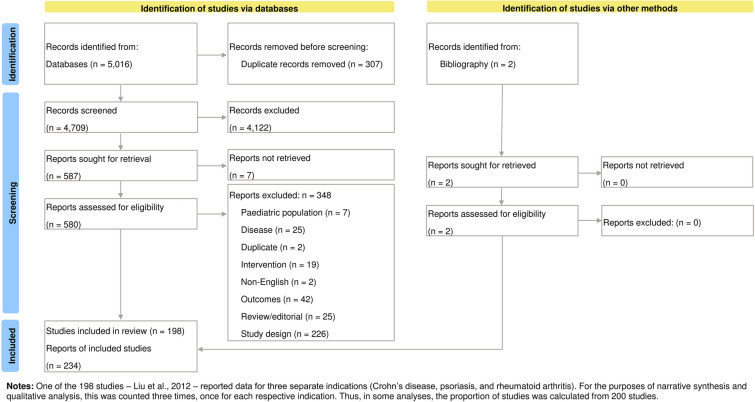
Our searches identified 5016 records, culminating in 198 unique studies from 234 publications following screening. Most of the studies investigated rheumatoid arthritis (37.0%) or psoriasis (32.0%). The majority were CUAs, with some including both a CEA and a CUA (73.0%). Most studies used a payer perspective only (28.5%) or a societal perspective only (21.0%). Of the 49 studies incorporating productivity losses/gains, 42 reported the type of cost element used; all of these used patient absenteeism, either alone or in addition with other elements. Only 16 studies reported the method used to value productivity changes, of which eight used a human capital approach, four used a friction cost approach and four used both approaches. Twenty-eight of the 49 studies (57.1%) reported inclusion of productivity losses/gains as contributing to more favourable cost-effectiveness outcomes and ICERs, while 12 (24.5%) reported no substantial impact. On the basis of a multivariate analysis, rheumatoid arthritis as the target disease had a statistically significant association with the inclusion of productivity loss compared with psoriasis and inflammatory bowel disease.
The results of our review suggest that incorporating productivity cost elements may positively affect cost-effectiveness outcomes in evaluations of therapeutics for immune-mediated disorders. Our work highlights the continued need for clarity when reporting how CEAs and CUAs in this disease area are conducted, in order to better inform healthcare decision-making.
鉴于缺乏关于如何进行成本效益分析(CEAs)的国际共识,包括从社会角度进行成本效用分析(CUAs),因此对于纳入经济评估中的生产力损失/收益在多大程度上会影响成本效益结果以及是否推荐新的卫生技术存在不确定性。为了研究这个问题,我们对一组慢性免疫介导性疾病的药物治疗进行了基于成本效果分析和成本效用分析的系统评价,以了解与生产力损失/收益相关的成本要素和计算方法的使用情况,检验纳入生产效率成本对增量成本效果比(ICER)的影响,并探讨影响纳入生产力损失的因素。
两名独立审查员从 2010 年 1 月至 2020 年 10 月对 MEDLINE In-process、MEDLINE、Embase 和 Cochrane Library 数据库进行了检索,以获取所有成人患有以下任何一种疾病的 CEAs 和 CUAs 的研究:强直性脊柱炎、慢性特发性荨麻疹、克罗恩病、纤维肌痛、青少年特发性关节炎、银屑病、类风湿关节炎、系统性红斑狼疮和溃疡性结肠炎。提取了与生产力相关的成本要素,包括旷工、在职病假、失业/提前退休、过早死亡和非正式护理,并提取了确定这些要素的方法。进行了多元分析以确定与纳入生产力损失相关的因素。
我们的检索共确定了 5016 条记录,经过筛选后,最终从 234 篇出版物中确定了 198 项独特的研究。大多数研究调查了类风湿关节炎(37.0%)或银屑病(32.0%)。大多数研究是成本效用分析,其中一些同时包括成本效果分析和成本效用分析(73.0%)。大多数研究仅从支付者角度(28.5%)或社会角度(21.0%)进行研究。在纳入生产力损失/收益的 49 项研究中,有 42 项报告了使用的成本要素类型;所有这些都使用了患者旷工,要么单独使用,要么与其他要素一起使用。只有 16 项研究报告了用于衡量生产力变化的方法,其中 8 项使用了人力资本方法,4 项使用了摩擦成本方法,4 项同时使用了这两种方法。49 项研究中有 28 项(57.1%)报告纳入生产力损失/收益会导致更有利的成本效益结果和增量成本效果比,而 12 项(24.5%)报告没有实质性影响。基于多元分析,与银屑病和炎症性肠病相比,类风湿关节炎作为目标疾病与纳入生产力损失具有统计学显著关联。
我们的综述结果表明,在评估免疫介导性疾病的治疗方法时,纳入生产力成本要素可能会对成本效益结果产生积极影响。我们的工作强调了在报告如何进行该疾病领域的成本效果分析和成本效用分析时继续需要明确报告,以便更好地为医疗保健决策提供信息。
