Department of Neurology, Dongtan Sacred Heart Hospital, Hallym University College of Medicine, Keun Jae Bong-gil 7, Hwaseong, Gyeonggi-do, 18450, South Korea.
Department of Neurology, Nowon Eulji Medical Center, Eulji University School of Medicine, Daejeon, South Korea.
J Headache Pain. 2022 Oct 8;23(1):132. doi: 10.1186/s10194-022-01505-w.
Galcanezumab of 300 mg monthly is the FDA approved preventive medication for cluster headache (CH) during the cluster period. Compared to the 120 mg galcanezumab syringe for the treatment of migraines, the 100 mg syringe for CH has globally not been as widely available. The aim of our study was to investigate the preventive efficacy and tolerability of two 120 mg galcanezumab doses for episodic CH in clinical practices.
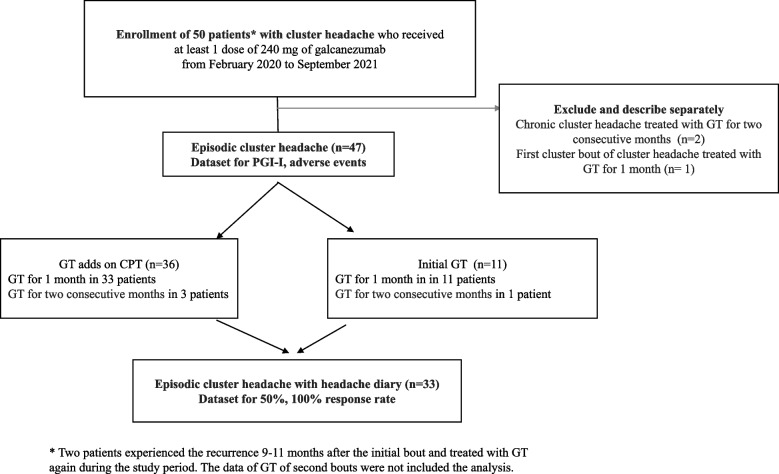
We evaluated patients with CH who received at least 1 dose of 240 mg (2 prefilled syringe of 120 mg) of galcanezumab in the 3 university hospitals from February 2020 to September 2021. In the patients with episodic CH, the efficacy and safety data of galcanezumab were analyzed regarding to the presence of the conventional preventive therapy at the timing of therapy of galcanezumab. The data of other subtypes of CH were separately described.
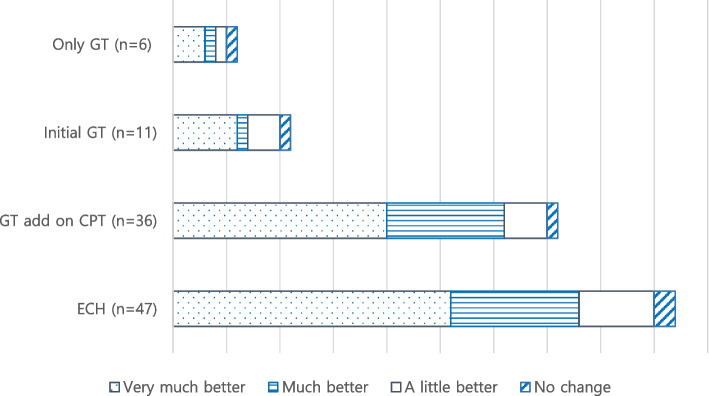
In 47 patients with episodic CH, galcanezumab was started median 18 days after the onset of current bout (range 1-62 days) and 4 patients (10.8%) received second dose of galcanezumab. The median time to the first occurrence of 100% reduction from baseline in CH attacks per week after galcanezumab therapy was 17 days (25% to 75% quartile range: 5.0 ~ 29.5) in all patients with episodic CH, 15.5 days (3.8 ~ 22.1) in 36 patients with galcanezumab therapy add-on conventional preventive therapy, 21.0 days (12.0 ~ 31.5) in 11 patients started galcanezumab as initial preventive therapy. Among 33 patients with headache diary, the proportion of patients with 50% or more reduction in weekly CH attacks at week 3 from baseline were 78.8%. There was no significant difference in the proportion of patients with a reduction of at least 50% in weekly frequency of CH attacks at week 3 between 24 patients received galcanezumab therapy add-on conventional preventive therapy and 9 patient who received initial galcanezumab therapy. (83.3%, vs 66.7%, p = 0.36). There were no significant differences in proportion of "very much better or "much better" between 36 patients received galcanezumab therapy add-on conventional preventive therapy and 11 patient who received initial GT (86.1%, vs 63.6%, p = 0.18).
One 240 mg dose of galcanezumab with/without conventional therapy for the prevention of CH is considered effective and safe in clinical practices, as seen in the clinical trial of galcanezumab.
每月 300 毫克加巴喷丁是美国食品药品监督管理局批准的用于治疗丛集性头痛(CH)的预防药物,在丛集期使用。与用于治疗偏头痛的 120 毫克加巴喷丁注射器相比,全球范围内用于 CH 的 100 毫克注射器的应用并不广泛。我们研究的目的是调查两种剂量的 120 毫克加巴喷丁在临床实践中对发作性 CH 的预防效果和耐受性。
我们评估了自 2020 年 2 月至 2021 年 9 月在 3 所大学医院接受至少 1 剂 240 毫克(2 剂 120 毫克预充注射器)加巴喷丁治疗的 CH 患者。对于发作性 CH 患者,根据加巴喷丁治疗时是否存在常规预防性治疗,分析加巴喷丁的疗效和安全性数据。其他类型 CH 的数据单独描述。
在 47 例发作性 CH 患者中,加巴喷丁治疗开始于当前发作后中位 18 天(范围 1-62 天),4 例(10.8%)患者接受了第二剂加巴喷丁。在所有发作性 CH 患者中,加巴喷丁治疗后每周 CH 发作次数从基线减少 100%的中位时间为 17 天(25%75%四分位距:5.029.5),在 36 例加巴喷丁联合常规预防性治疗的患者中为 15.5 天(3.822.1),在 11 例初始加巴喷丁作为预防性治疗的患者中为 21.0 天(12.031.5)。在 33 例有头痛日记的患者中,第 3 周从基线开始每周 CH 发作次数减少 50%或更多的患者比例为 78.8%。在接受加巴喷丁联合常规预防性治疗的 24 例患者和接受初始加巴喷丁治疗的 9 例患者中,第 3 周每周 CH 发作频率减少至少 50%的患者比例无显著差异(83.3%,vs 66.7%,p=0.36)。接受加巴喷丁联合常规预防性治疗的 36 例患者和接受初始 GT 治疗的 11 例患者中,“非常好”或“好很多”的比例无显著差异(86.1%,vs 63.6%,p=0.18)。
在临床试验中,加巴喷丁与/或不与常规治疗联合用于预防 CH 被认为是有效和安全的,这与加巴喷丁的临床试验结果一致。