Pepose Vision Institute, St. Louis, MO, USA.
Department of Ophthalmology and Visual Sciences, Washington University School of Medicine, St. Louis, MO, USA.
BMC Ophthalmol. 2022 Oct 8;22(1):402. doi: 10.1186/s12886-022-02621-6.
Dim light vision disturbances (DLD) comprise a wide range of symptoms affecting the quality of vision at low illumination including glare, halos, and starbursts. This exploratory study investigated 1.0% phentolamine mesylate ophthalmic solution (PMOS) as a treatment to improve vision and image quality for patients with DLD.
In this placebo-controlled, randomized, double-masked clinical trial, 24 adult patients with severe DLD were randomized in a 2:1 ratio to receive either one dose of PMOS or placebo. Subjects were eligible if they reported experiencing severe night vision difficulty that was not eliminated by distance spectacle correction and scored ≥0.3 log units below the normal range of contrast sensitivity assessed under mesopic conditions with glare at ≥2 spatial frequencies. Key efficacy outcomes were change from baseline in pupil diameter, contrast sensitivity, and visual acuity. Safety measures including intraocular pressure, conjunctival hyperemia, and systemic effects were also assessed.
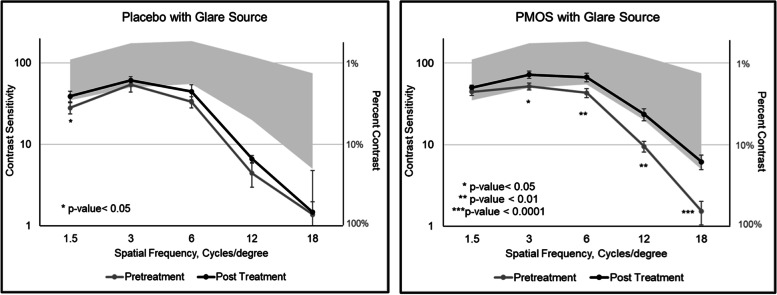
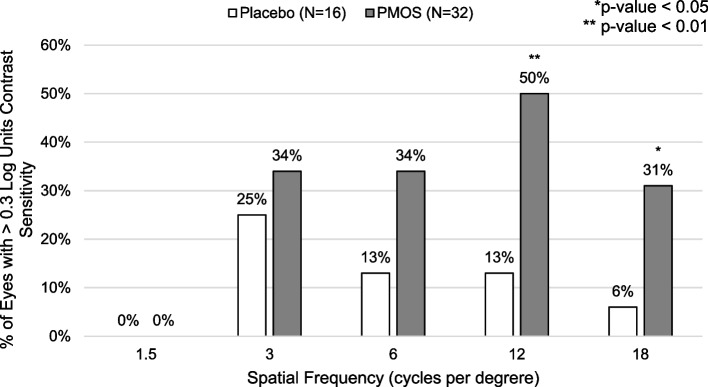
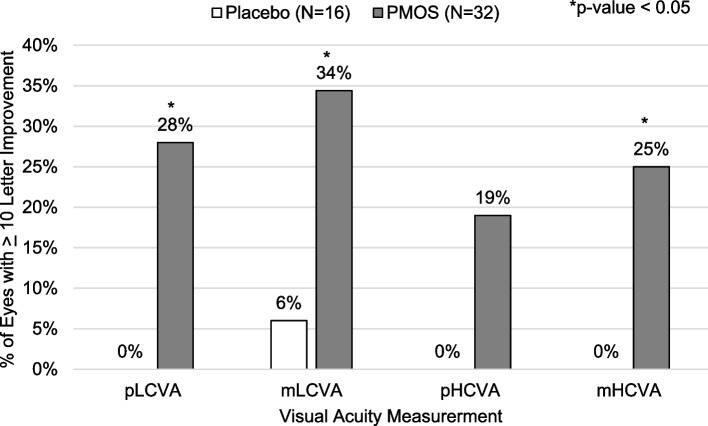
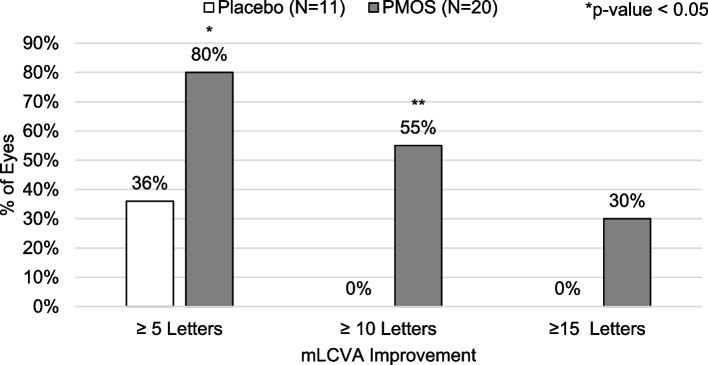
Eight subjects were randomized to placebo (63% female; mean age 47 years) and 16 were randomized to PMOS (75% female; mean age 42 years). Mean (SD) pupil diameter of PMOS-treated subjects decreased significantly - 1.3 mm (0 to - 2.8 mm) with p < 0.0001. Mean contrast sensitivity with glare in PMOS-treated subjects improved significantly post-treatment at spatial frequencies 3, 6, 12, and 18 cycles per degree (p ≤ 0.03). PMOS also demonstrated improvements in the numbers of letters read for mesopic and photopic, high- and low-contrast visual acuity (LCVA). Importantly, a statistically greater proportion of PMOS-treated eyes registered mesopic LCVA 5 letter (69% vs. 31%, p = 0.029) and 10 letter (34% vs. 6%, p = 0.04) improvement, with a trend at 15 letters (19% vs. 0%, p = 0.16). PMOS was well tolerated with the only reported side effect being a mild increase in conjunctival hyperemia.
PMOS was well tolerated and effectively reduced pupil size with improvements in contrast sensitivity and visual acuity in adults with severe DLD. Future Phase 3 studies should be conducted to further evaluate its potential to treat DLD.
The trial registration number is NCT04004507 (02/07/2019). Retrospectively registered.
暗光视觉障碍(DLD)包括一系列影响低照度下视觉质量的症状,包括眩光、晕影和星爆。这项探索性研究调查了 1.0%甲磺酸苯肾上腺素滴眼液(PMOS)作为改善 DLD 患者视力和图像质量的治疗方法。
在这项安慰剂对照、随机、双盲临床试验中,24 名患有严重 DLD 的成年患者按 2:1 的比例随机接受 PMOS 或安慰剂一剂。如果患者报告夜间视力严重困难,且距离矫正眼镜无法消除,且在眩光下中值条件下的对比度敏感度评估中得分低于正常范围 0.3 对数单位以上,至少有 2 个空间频率,则符合入组标准。主要疗效结局为从基线开始瞳孔直径、对比敏感度和视力的变化。还评估了安全性措施,包括眼压、结膜充血和全身效应。
8 名患者被随机分配至安慰剂组(63%为女性;平均年龄 47 岁),16 名患者被随机分配至 PMOS 组(75%为女性;平均年龄 42 岁)。PMOS 治疗组的平均(SD)瞳孔直径显著减小-1.3mm(0 至-2.8mm),p<0.0001。PMOS 治疗组在空间频率为 3、6、12 和 18 周/度时,眩光下的对比度敏感度在治疗后显著改善(p≤0.03)。PMOS 还改善了中值和光值、高对比度和低对比度视力(LCVA)的字母读数。重要的是,PMOS 治疗眼的中值 LCVA 5 个字母(69%比 31%,p=0.029)和 10 个字母(34%比 6%,p=0.04)的改善比例显著更高,15 个字母(19%比 0%,p=0.16)有改善趋势。PMOS 耐受性良好,唯一报告的副作用是结膜充血轻度增加。
PMOS 耐受性良好,能有效缩小瞳孔大小,提高成年人严重 DLD 的对比敏感度和视力。应进行进一步的 3 期研究,以评估其治疗 DLD 的潜力。
该试验的注册号为 NCT04004507(2019 年 7 月 2 日)。回顾性注册。