Biostatistics Center, Milken Institute School of Public Health, George Washington University, Rockville, MD.
Department of Emergency Medicine, Atrium Health, Charlotte, NC.
Am J Infect Control. 2023 Mar;51(3):261-267. doi: 10.1016/j.ajic.2022.09.027. Epub 2022 Oct 7.
Wearing a face mask is a primary public health method to reduce SARS-CoV-2 transmission.
We performed a nested case-control analysis within the North Carolina COVID-19 Community Research Partnership (NC-CCRP) of adults who completed daily surveillance surveys, April 2020 - February 2022. We assessed the association between self-reported mask wearing behavior during nonhousehold interactions and COVID-19 infection during 3 pandemic periods using conditional logistic regression models of risk of infection that were adjusted for demographics, vaccination status, and recent known exposure to COVID-19.
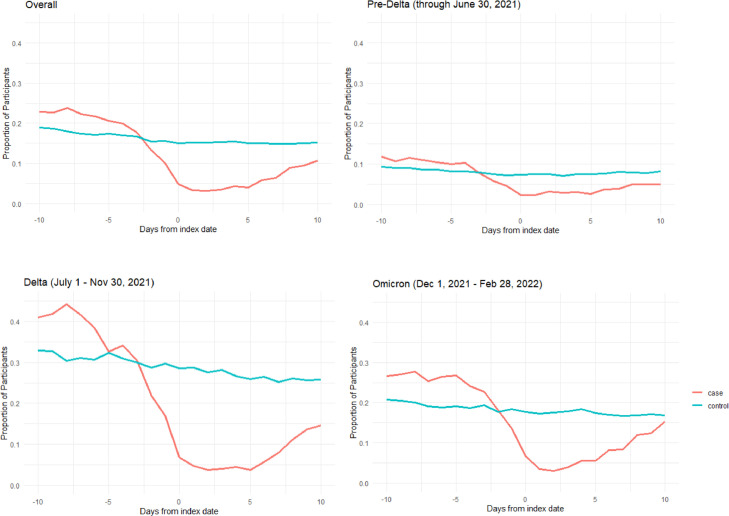
Among 3,901 cases and 27,813 date-matched controls, there was a significant interaction between mask use and time period (P < .001). Prior to July 2021, the odds of a reported infection were 66% higher (aOR = 1.66, 95% CI = 1.43-1.91) among participants reporting ≥1 day not wearing a mask compared to those who reported no days (1,592 cases, 11,717 controls). During the Delta-predominant period, the results were similar (aOR = 1.53, 95% CI = 1.23-1.89; 659 cases, 4,649 controls). This association was attenuated during the Omicron-predominant period, where odds of an infection was 16% higher (aOR = 1.16, 95% CI = 1.03-1.32; 1,563 cases, 10,960 controls).
While the effect of not wearing a mask remains significant, during the Omicron-predominant period we observed a decrease in the association between self-reported mask wearing and risk of SARS-CoV-2 infection.
佩戴口罩是减少 SARS-CoV-2 传播的主要公共卫生方法。
我们对参与北卡罗来纳州 COVID-19 社区研究伙伴关系(NC-CCRP)的成年人进行了嵌套病例对照分析,这些成年人完成了每日监测调查,时间为 2020 年 4 月至 2022 年 2 月。我们使用感染风险的条件逻辑回归模型评估了在三个大流行期间,非家庭互动期间自我报告的口罩佩戴行为与 COVID-19 感染之间的关联,这些模型调整了人口统计学、疫苗接种状况和最近已知的 COVID-19 暴露情况。
在 3901 例病例和 27813 名日期匹配的对照中,口罩使用与时间段之间存在显著交互作用(P<0.001)。在 2021 年 7 月之前,与报告没有佩戴口罩天数的参与者相比,报告至少有一天未佩戴口罩的参与者感染的可能性高 66%(优势比[aOR]=1.66,95%可信区间[CI]=1.43-1.91)(1592 例病例,11717 名对照)。在 Delta 主导时期,结果相似(aOR=1.53,95%CI=1.23-1.89;659 例病例,4649 名对照)。在 Omicron 主导时期,这种关联减弱,感染的可能性高 16%(aOR=1.16,95%CI=1.03-1.32;1563 例病例,10960 名对照)。
虽然不佩戴口罩的效果仍然显著,但在 Omicron 主导时期,我们观察到自我报告的口罩佩戴与 SARS-CoV-2 感染风险之间的关联减弱。