Abhyankar Nikit, Lin Jiang, Kahrl Fritz, Yin Shengfei, Paliwal Umed, Liu Xu, Khanna Nina, Luo Qian, Wooley David, O'Boyle Mike, Ashmoore Olivia, Orvis Robbie, Solomon Michelle, Phadke Amol
Electricity Market and Policy Department, Lawrence Berkeley National Laboratory, Berkeley, CA 94720, USA.
National School of Development, Peking University, Beijing 100871, China.
iScience. 2022 Sep 22;25(10):105180. doi: 10.1016/j.isci.2022.105180. eCollection 2022 Oct 21.
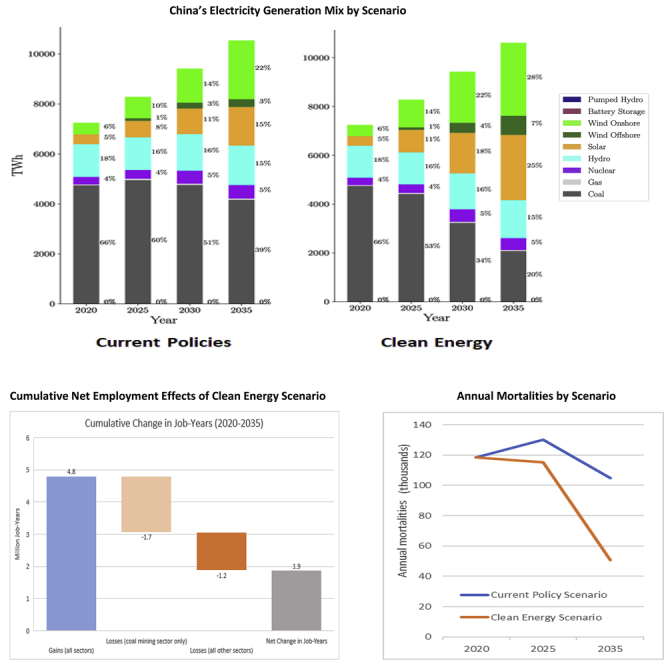
Dramatic reductions in solar, wind, and battery storage costs create new opportunities to reduce emissions and costs in China's electricity sector, beyond current policy goals. This study examines the cost, reliability, emissions, public health, and employment implications of increasing the share of non-fossil fuel ("carbon free") electricity generation in China to 80% by 2035. The analysis uses state-of-the-art modeling with high resolution load, wind, and solar inputs. The study finds that achieving an 80% carbon-free electricity system in China by 2035 could reduce wholesale electricity costs, relative to a current policy baseline, while maintaining high levels of reliability, reducing deaths from air pollution, and increasing employment. In our 80% scenario, wind and solar generation capacity reach 3 TW and battery storage capacity reaches 0.4 TW by 2035, implying a rapid scale up in these resources that will require changes in policy targets, markets and regulation, and land use policies.
太阳能、风能和电池储能成本的大幅下降为中国电力部门带来了新机遇,有助于在中国现行政策目标之外进一步降低排放和成本。本研究探讨了到2035年将中国非化石燃料(“无碳”)发电占比提高至80%对成本、可靠性、排放、公众健康和就业的影响。分析采用了具有高分辨率负荷、风能和太阳能输入的先进建模方法。研究发现,到2035年在中国实现80%的无碳电力系统,相对于当前政策基线而言,可降低批发电成本,同时保持高可靠性水平,减少空气污染导致的死亡人数,并增加就业。在我们设定的80%的情景中,到2035年风能和太阳能发电装机容量将达到3太瓦,电池储能容量将达到0.4太瓦,这意味着这些资源将迅速扩大规模,而这需要政策目标、市场与监管以及土地使用政策做出改变。