Department of Hematology, University Medical Center Groningen, University of Groningen, Groningen, The Netherlands.
Department of Laboratory Medicine, Laboratory of Hematology, Radboud University Medical Center, Nijmegen, The Netherlands.
Blood Adv. 2023 Apr 11;7(7):1269-1278. doi: 10.1182/bloodadvances.2022007497.
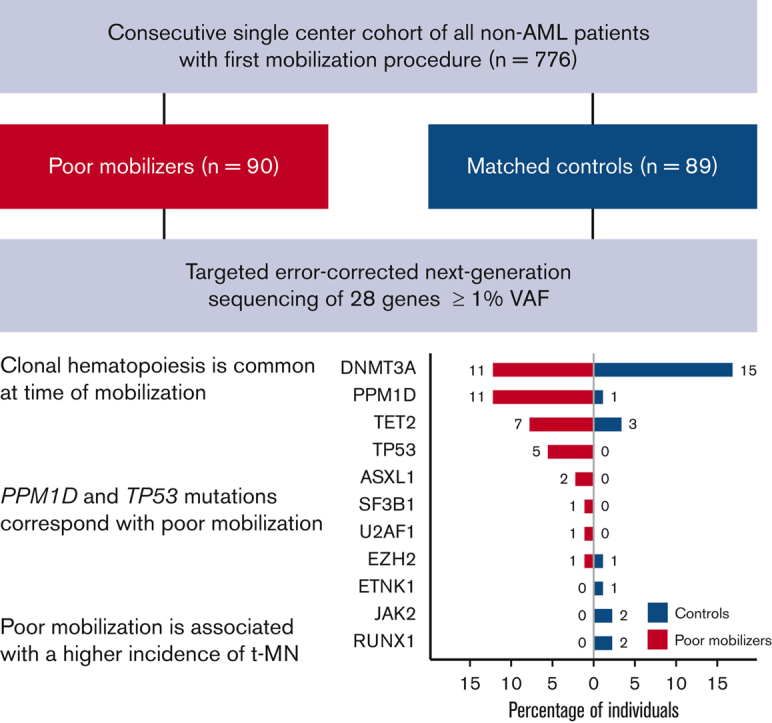
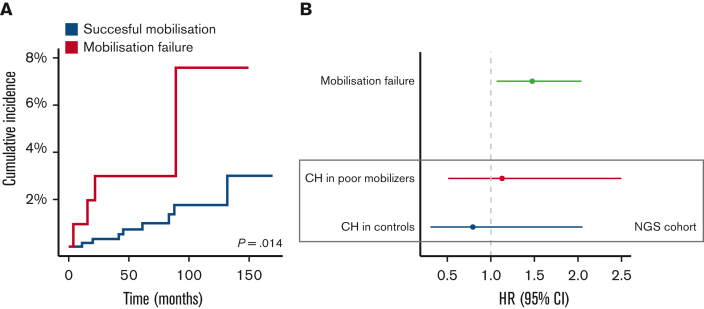
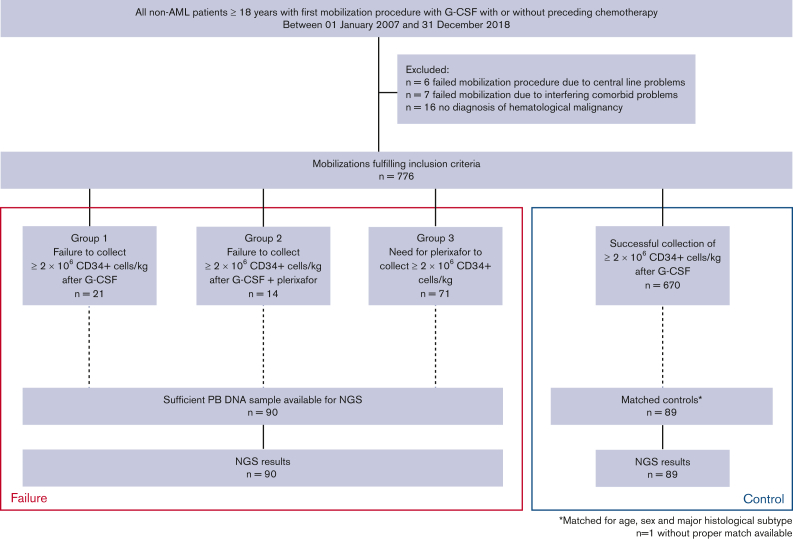
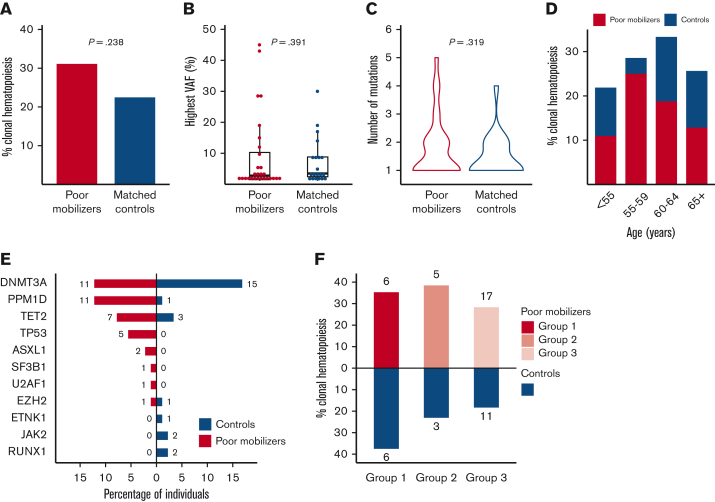
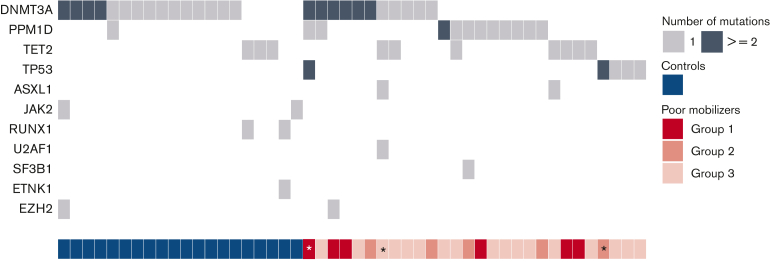
Inadequate mobilization of peripheral blood progenitor cells (PBPCs) is a limiting factor to proceeding with autologous hematopoietic cell transplantation (auto-HCT). To assess the impact of clonal hematopoiesis (CH) on mobilization failure of PBPC for auto-HCT, we investigated the characteristics of poor mobilizers (with a total PBPC collection <2 × 10⁶ CD34+ cells per kg) in a consecutive single-center cohort of 776 patients. Targeted error-corrected next-generation sequencing of 28 genes was performed in a nested case-control cohort of 90 poor mobilizers and 89 matched controls. CH was detected in 48 out of 179 patients (27%), with most patients carrying a single mutation. The presence of CH (detected at variant allele frequency [VAF] ≥ 1%) did not associate with poor mobilization potential (31% vs 22% in controls, odds ratio, 1.55; 95% confidence interval, 0.76-3.23; P = .238). PPM1D mutations were detected more often in poor mobilizers (P = .005). In addition, TP53 mutations in this cohort were detected exclusively in patients with poor mobilization potential (P = .06). The incidence of therapy-related myeloid neoplasms (t-MN) was higher among patients with mobilization failure (P = .014). Although poor mobilizers experienced worse overall survival (P = .019), this was not affected by the presence of CH. We conclude that CH at low VAF (1%-10%) is common at the time of stem cell mobilization. TP53 mutations and PPM1D mutations are associated with poor mobilization potential and their role in subsequent development of t-MN in these individuals should be established.
外周血祖细胞 (PBPC) 动员不足是进行自体造血细胞移植 (auto-HCT) 的限制因素。为了评估克隆性造血 (CH) 对 PBPC 动员失败的影响,我们对连续的单中心 776 例患者队列中的不良动员者(总 PBPC 采集量<每公斤 2×10⁶ CD34+细胞)的特征进行了研究。在一个嵌套病例对照队列中,对 90 名不良动员者和 89 名匹配对照者进行了 28 个基因的靶向纠错下一代测序。在 179 例患者中有 48 例(27%)检测到 CH,大多数患者携带单一突变。CH 的存在(在变异等位基因频率 [VAF] ≥ 1%时检测到)与不良动员潜力无关(对照组为 31%,对照组为 22%,优势比,1.55;95%置信区间,0.76-3.23;P=0.238)。在不良动员者中更常检测到 PPM1D 突变(P=0.005)。此外,在这个队列中,TP53 突变仅在动员潜力差的患者中检测到(P=0.06)。动员失败患者的治疗相关髓系肿瘤 (t-MN) 发生率更高(P=0.014)。尽管不良动员者的总生存率较差(P=0.019),但这并未受到 CH 的影响。我们得出结论,在干细胞动员时,低 VAF(1%-10%)的 CH 很常见。TP53 突变和 PPM1D 突变与动员潜力差相关,其在这些个体中随后发展为 t-MN 的作用应得到确定。