Department of Hematology, University of Groningen, University Medical Center Groningen, Groningen, The Netherlands.
Department of Laboratory Medicine, Laboratory of Hematology, Radboud University Medical Center, Nijmegen, The Netherlands.
Blood Adv. 2021 Apr 27;5(8):2115-2122. doi: 10.1182/bloodadvances.2020004062.
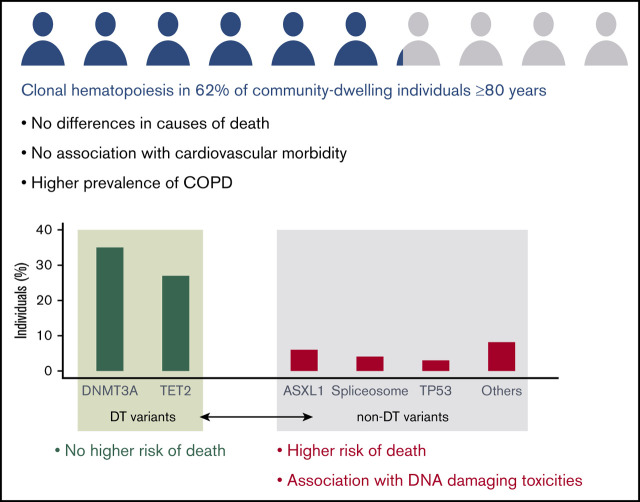
Clonal hematopoiesis (CH), characterized by a fraction of peripheral blood cells carrying an acquired genetic variant, emerges with age. Although in general CH is associated with increased mortality and morbidity, no higher risk of death was observed for individuals ≥80 years. Here, we investigated CH in 621 individuals aged ≥80 years from the population-based LifeLines cohort. Sensitive error-corrected sequencing of 27 driver genes at a variant allele frequency ≥1% revealed CH in the majority (62%) of individuals, independent of gender. The observed mutational spectrum was dominated by DNMT3A and TET2 variants, which frequently (29%) displayed multiple mutations per gene. In line with previous results in individuals ≥80 years, the overall presence of CH did not associate with a higher risk of death (hazard ratio, 0.91; 95% confidence interval, 0.70-1.18; P = .48). Being able to assess the causes of death, we observed no difference between individuals with or without CH, except for deaths related to hematological malignancies. Interestingly, comparison of mutational spectra confined to DNMT3A and TET2 vs spectra containing other mutated genes, showed a higher risk of death when mutations other than DNMT3A or TET2 were present (hazard ratio, 1.48; 95% confidence interval, 1.06-2.08; P = .025). Surprisingly, no association of CH with cardiovascular morbidity was found, irrespective of clone size. Further, CH associated with chronic obstructive pulmonary disease. Data on estimated exposure to DNA damaging toxicities (ie, smoking, a history of cancer [as a proxy for previous genotoxic therapy], and job-related pesticide exposure) showed an association with spliceosome and ASXL1 variants, but not with DNMT3A and TET2 variants.
克隆性造血 (CH) 是指外周血中存在携带获得性基因突变的细胞,其随年龄增长而出现。虽然一般来说,CH 与死亡率和发病率增加相关,但 80 岁以上的个体并未观察到更高的死亡风险。在这里,我们调查了来自基于人群的 LifeLines 队列的 621 名 80 岁以上个体的 CH。对 27 个驱动基因突变的敏感纠错测序,其等位基因变异频率≥1%,结果显示大多数(62%)个体存在 CH,与性别无关。观察到的突变谱以 DNMT3A 和 TET2 变异为主,这些基因的每个基因中经常出现(29%)多个突变。与之前在 80 岁以上个体中观察到的结果一致,CH 的总体存在与更高的死亡风险无关(风险比,0.91;95%置信区间,0.70-1.18;P =.48)。由于能够评估死亡原因,我们在有或没有 CH 的个体之间没有观察到差异,除了与血液恶性肿瘤相关的死亡。有趣的是,将 DNMT3A 和 TET2 突变谱与包含其他突变基因的突变谱进行比较时,当存在除 DNMT3A 或 TET2 以外的突变时,死亡风险更高(风险比,1.48;95%置信区间,1.06-2.08;P =.025)。令人惊讶的是,无论克隆大小如何,CH 与心血管发病率均无关联。此外,CH 与慢性阻塞性肺疾病相关。关于 DNA 损伤毒性(即吸烟、癌症史[作为先前遗传毒性治疗的替代物]和与工作相关的农药暴露)的估计暴露数据显示与剪接体和 ASXL1 变异相关,但与 DNMT3A 和 TET2 变异无关。