Department of Internal Medicine, Hallym University Dongtan Sacred Heart Hospital, Hallym University College of Medicine, Hwaseong, Korea.
Department of Internal Medicine, Asan Medical Center, University of Ulsan College of Medicine, Seoul, Korea.
Endocrinol Metab (Seoul). 2022 Oct;37(5):791-799. doi: 10.3803/EnM.2022.1533. Epub 2022 Oct 11.
In this study, we evaluated the recent changes in the standardized, age-specific, stage-specific incidence rates (IRs) of thyroid cancer in Korea and compared them with the incidence data reported by the Surveillance, Epidemiology, and End Results Program.
The analysis was conducted using the incidence data (2005 to 2018) from the Statistics Korea and Korea Central Cancer Registry.
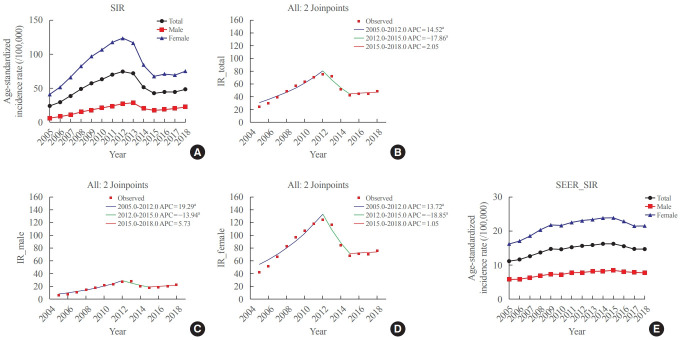
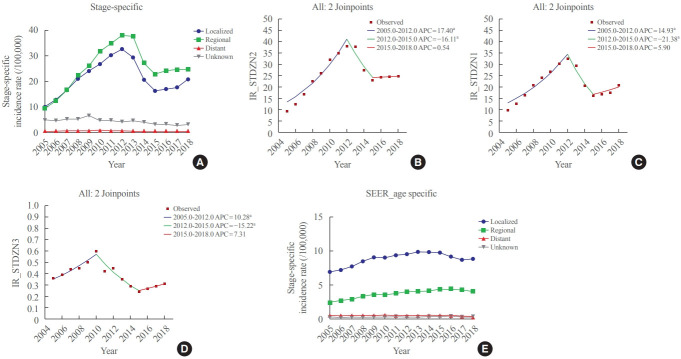
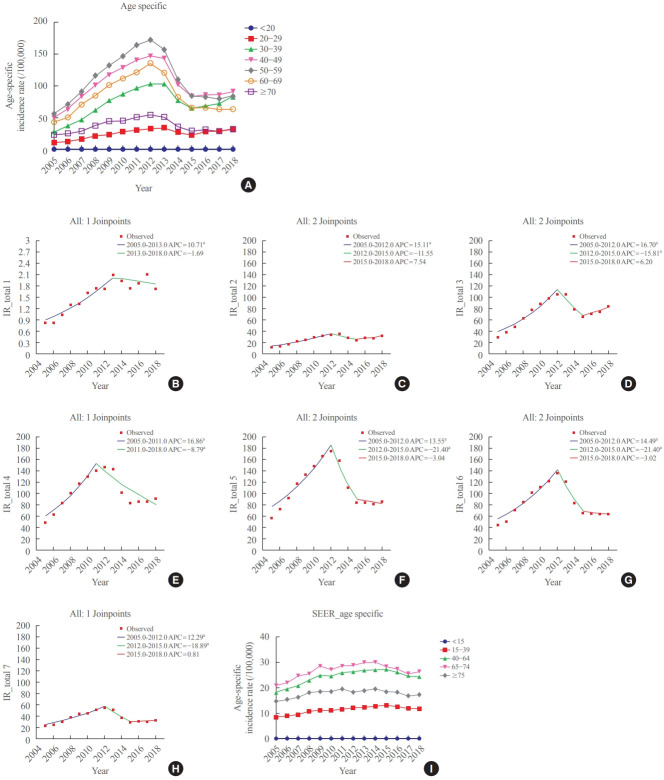
The age-standardized IR (SIR) of thyroid cancer increased from 24.09 per 100,000 in 2005 to 74.83 in 2012 (annual percent change [APC], 14.5). From 2012 to 2015, the SIR decreased to 42.52 (APC, -17.9) and then remained stable until 2018 (APC, 2.1). This trend was similar in both men and women. Regarding age-specific IRs, the IRs for ages of 30 years and older showed a trend similar to that of the SIR; however, for ages below 30 years, no significant reduction was observed from the vertex of IR in 2015. Regarding stage-specific IRs, the increase was more prominent in those with regional disease (APC, 17.4) than in those with localized disease until 2012; then, the IR decreased until 2015 (APC, -16.1). The average APC from 2005 to 2018 increased in men, those under the age of 30 years, and those with regional disease.
The SIR in Korea peaked in 2012 and decreased until 2015 and then remained stable until 2018. However, in young individuals under the age of 30 years, the IR did not significantly decrease but tended to increase again. In terms of stage-specific IRs, the sharpest increase was seen among those with regional disease.
本研究评估了韩国近年来甲状腺癌标准化年龄特异性和分期特异性发病率(IR)的变化,并将其与监测、流行病学和结果计划报告的发病率数据进行了比较。
使用来自韩国统计局和韩国中央癌症登记处的发病率数据(2005 年至 2018 年)进行了分析。
甲状腺癌的年龄标准化发病率(SIR)从 2005 年的 24.09/100,000 增加到 2012 年的 74.83(APC,14.5%)。从 2012 年到 2015 年,SIR 下降到 42.52(APC,-17.9),然后直到 2018 年保持稳定(APC,2.1%)。这种趋势在男性和女性中相似。关于年龄特异性 IR,30 岁及以上年龄的 IR 趋势与 SIR 相似;然而,对于 30 岁以下的年龄,从 2015 年 IR 顶点开始,没有观察到明显的下降。关于分期特异性 IR,直到 2012 年,局部疾病患者的增加更为明显(APC,17.4%);然后,IR 直到 2015 年下降(APC,-16.1%)。从 2005 年到 2018 年,男性、30 岁以下和局部疾病患者的平均 APC 增加。
韩国的 SIR 在 2012 年达到峰值,直到 2015 年下降,然后直到 2018 年保持稳定。然而,在 30 岁以下的年轻人群中,IR 并没有显著下降,反而有再次上升的趋势。在分期特异性 IR 方面,区域性疾病患者的增幅最大。