Division of Hematology, Department of Medicine, Brigham and Women's Hospital, Boston, MA 02115, USA.
Harvard Medical School, Boston, MA 02115, USA.
Sci Adv. 2022 Oct 14;8(41):eabo5224. doi: 10.1126/sciadv.abo5224. Epub 2022 Oct 12.
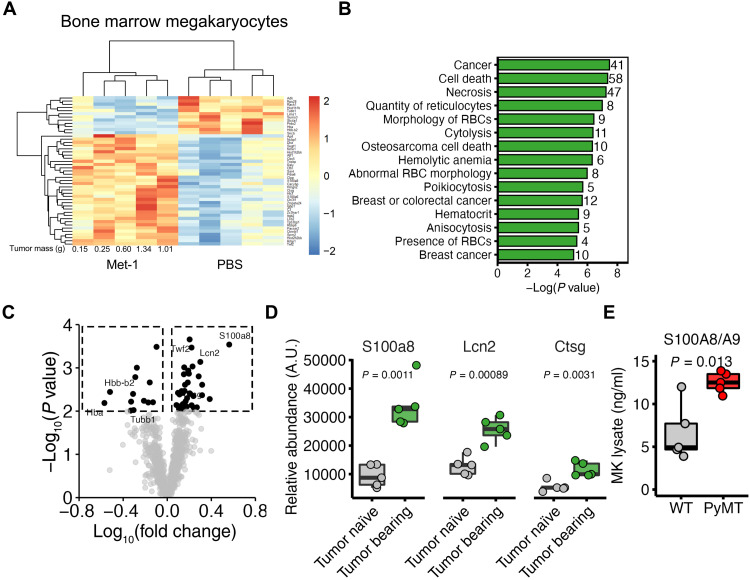
Despite abundant research demonstrating that platelets can promote tumor cell metastasis, whether primary tumors affect platelet-producing megakaryocytes remains understudied. In this study, we used a spontaneous murine model of breast cancer to show that tumor burden reduced megakaryocyte number and size and disrupted polyploidization. Single-cell RNA sequencing demonstrated that megakaryocytes from tumor-bearing mice exhibit a pro-inflammatory phenotype, epitomized by increased , , , and transcripts. Protein S100A8/A9 and lipocalin-2 levels were also increased in platelets, suggesting that tumor-induced alterations to megakaryocytes are passed on to their platelet progeny, which promoted in vitro tumor cell invasion and tumor cell lung colonization to a greater extent than platelets from wild-type animals. Our study is the first to demonstrate breast cancer-induced alterations in megakaryocytes, leading to qualitative changes in platelet content that may feedback to promote tumor metastasis.
尽管有大量研究表明血小板可以促进肿瘤细胞转移,但原发性肿瘤是否会影响产生血小板的巨核细胞仍研究不足。在这项研究中,我们使用了一种自发的乳腺癌小鼠模型,表明肿瘤负担减少了巨核细胞的数量和大小,并破坏了多倍体化。单细胞 RNA 测序表明,来自荷瘤小鼠的巨核细胞表现出促炎表型,特征是增加了 、 、 和 转录本。血小板中的蛋白 S100A8/A9 和脂钙素-2 水平也增加,表明肿瘤诱导的巨核细胞改变被传递给它们的血小板后代,这促进了体外肿瘤细胞侵袭和肿瘤细胞肺定植,程度超过了来自野生型动物的血小板。我们的研究首次证明了乳腺癌诱导的巨核细胞改变,导致血小板内容物的质量变化,可能反馈促进肿瘤转移。