Palathumpattu Binoy, Pieper-Fürst Ursula, Acikel Cengizhan, Sahin Hacer, Allekotte Silke, Singh Jaswinder, Hess Mark, Sager Angelika, Müller Thomas, Mösges Ralph
Institute of Medical Statistics and Computational Biology Faculty of Medicine University of Cologne Cologne Germany.
ClinCompetence Cologne GmbH Cologne Germany.
Clin Transl Allergy. 2022 Oct 5;12(10):e12191. doi: 10.1002/clt2.12191. eCollection 2022 Oct.
The European Academy of Allergy and Clinical Immunology recommended the Combined Symptom and Medication Score (CSMS) as primary endpoint in clinical trials on allergen-specific immunotherapy (AIT) in allergic rhinoconjunctivitis. Here, the correlation between the CSMS and the validated standardised Rhinoconjunctivitis Quality of Life Questionnaire (RQLQ(S)), Rhinitis Control Assessment Test (RCAT) and Visual Analogue Scale (VAS) was analysed.
Two prospective, multicentre, non-interventional studies on tree pollen, grass pollen and house dust mite allergic patients were performed. The first study comprised 167 patients receiving AIT (AIT population), and the second included 56 patients treated with symptomatic medication only (control population). For up to two seasons (pollen)/exposure periods (house dust mites), participants documented their symptoms and medication intake in a CSMS diary, including VAS. In addition, the standardised RQLQ(S) and the RCAT were completed during study visits.
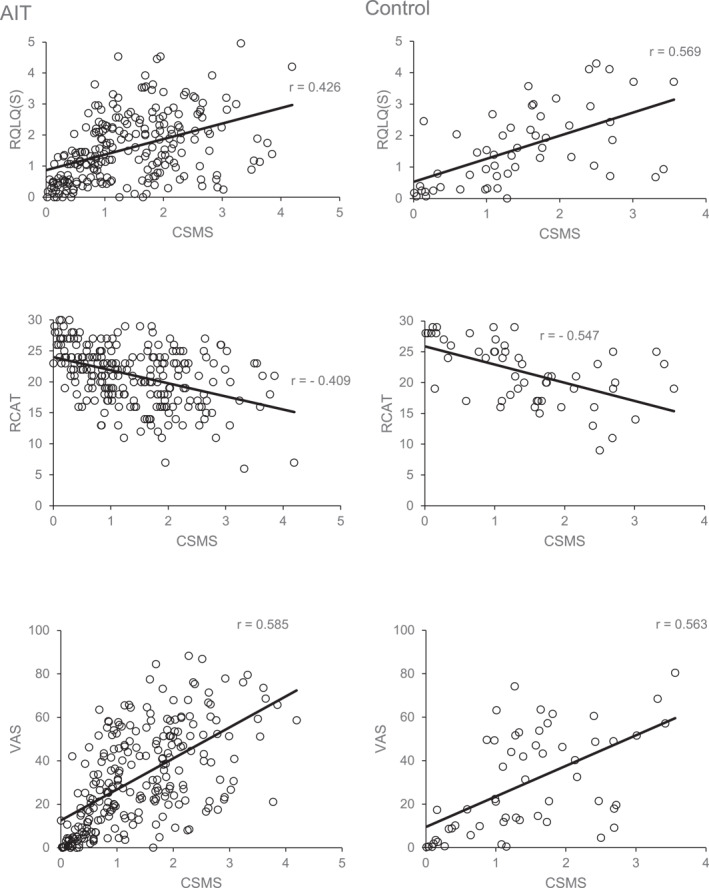
Comparison between CSMS and RQLQ(S) revealed a positive correlation in the AIT population ( = 0.426) and in the control population ( = 0.569). For CSMS and RCAT, a negative correlation with = -0.409 (AIT) and = -0.547 (control) was shown. Positive correlation between CSMS and VAS was also demonstrated with = 0.585 (AIT) and = 0.563 (control).
These results support the assumption that the CSMS correlates with quality of life, symptom severity and symptom control on the one hand, while the moderate strength of correlations on the other hand mirrors distinctions of the CSMS compared to the assessments used here.
欧洲过敏与临床免疫学会推荐将综合症状与药物评分(CSMS)作为变应性鼻结膜炎变应原特异性免疫治疗(AIT)临床试验的主要终点。在此,分析了CSMS与经过验证的标准化鼻结膜炎生活质量问卷(RQLQ(S))、鼻炎控制评估测试(RCAT)和视觉模拟量表(VAS)之间的相关性。
对树花粉、草花粉和屋尘螨过敏患者进行了两项前瞻性、多中心、非干预性研究。第一项研究包括167例接受AIT的患者(AIT人群),第二项研究包括56例仅接受对症药物治疗的患者(对照人群)。在长达两个季节(花粉)/暴露期(屋尘螨)内,参与者在CSMS日记中记录他们的症状和药物摄入情况,包括VAS。此外,在研究访视期间完成标准化的RQLQ(S)和RCAT。
CSMS与RQLQ(S)的比较显示,AIT人群(r = 0.426)和对照人群(r = 0.569)呈正相关。对于CSMS和RCAT,显示出负相关,AIT人群r = -0.409,对照人群r = -0.547。CSMS与VAS之间也呈正相关,AIT人群r = 0.585,对照人群r = 0.563。
这些结果支持以下假设,即CSMS一方面与生活质量、症状严重程度和症状控制相关,而另一方面,相关性的中等强度反映了CSMS与这里使用的评估方法之间的差异。