Zhang Xiaofang, Feng Qi, Cao Jianjun, Biswas Asim, Su Haohai, Liu Wei, Qin Yanyan, Zhu Meng
Key Laboratory of Ecohydrology of Inland River Basin, Northwest Institute of Eco-Environment and Resources, Chinese Academy of Sciences, Lanzhou, China.
University of Chinese Academy of Sciences, Beijing, China.
Front Plant Sci. 2022 Sep 26;13:941357. doi: 10.3389/fpls.2022.941357. eCollection 2022.
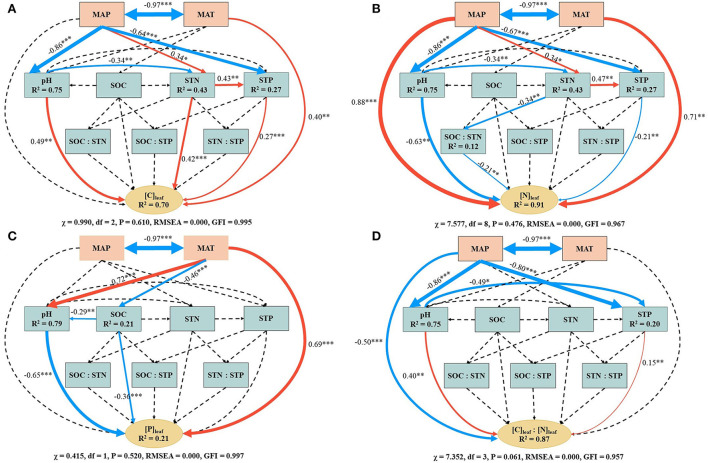
Plants adapt to changes in elevation by regulating their leaf ecological stoichiometry. L. that grows rapidly under poor or even bare soil conditions has become an important ground cover plant for ecological restoration. However, its leaf ecological stoichiometry has been given little attention, resulting in an insufficient understanding of its environmental adaptability and growth strategies. The objective of this study was to compare the leaf stoichiometry of at different elevations (2,400, 2,600, 2,800, 3,000, 3,200, 3,500, and 3,800 m) in the middle eastern part of Qilian Mountains. With an increase in elevation, leaf carbon concentration [(C)] significantly decreased, with the maximum value of 446.04 g·kg (2,400 m) and the minimum value of 396.78 g·kg (3,500 m). Leaf nitrogen concentration [(N)] also increased with an increase in elevation, and its maximum and minimum values were 37.57 g·kg (3,500 m) and 23.71 g·kg (2,800 m), respectively. Leaf phosphorus concentration [(P)] was the highest (2.79 g·kg) at 2,400 m and the lowest (0.91 g·kg) at 2,800 m. The [C]/[N] decreased with an increase in elevation, while [N]/[P] showed an opposite trend. The mean annual temperature, mean annual precipitation, soil pH, organic carbon, nitrogen, and phosphorus at different elevations mainly affected [C], [N], and [P]. The growth of in the study area was mainly limited by P, and this limitation was stronger with increased elevation. Progressively reducing P loss at high elevation is of great significance to the survival of in this specific region.
植物通过调节叶片生态化学计量比来适应海拔变化。在贫瘠甚至裸露的土壤条件下生长迅速的某植物已成为生态恢复的重要地被植物。然而,其叶片生态化学计量比却很少受到关注,导致对其环境适应性和生长策略的了解不足。本研究的目的是比较祁连山中东部不同海拔(2400、2600、2800、3000、3200、3500和3800米)处该植物的叶片化学计量比。随着海拔升高,叶片碳浓度[C]显著降低,最大值为446.04克·千克(2400米),最小值为396.78克·千克(3500米)。叶片氮浓度[N]也随海拔升高而增加,其最大值和最小值分别为37.57克·千克(3500米)和23.71克·千克(2800米)。叶片磷浓度[P]在2400米处最高(2.79克·千克),在2800米处最低(0.91克·千克)。[C]/[N]随海拔升高而降低,而[N]/[P]则呈相反趋势。不同海拔的年平均温度、年平均降水量、土壤pH值、有机碳、氮和磷主要影响[C]、[N]和[P]。研究区域内该植物的生长主要受磷限制,且随着海拔升高这种限制更强。在高海拔地区逐步减少磷流失对该植物在这一特定区域的生存具有重要意义。