Faculty of Pharmaceutical Sciences, The University of British Columbia, Vancouver, Canada.
Sci Rep. 2022 Oct 13;12(1):17192. doi: 10.1038/s41598-022-20854-9.
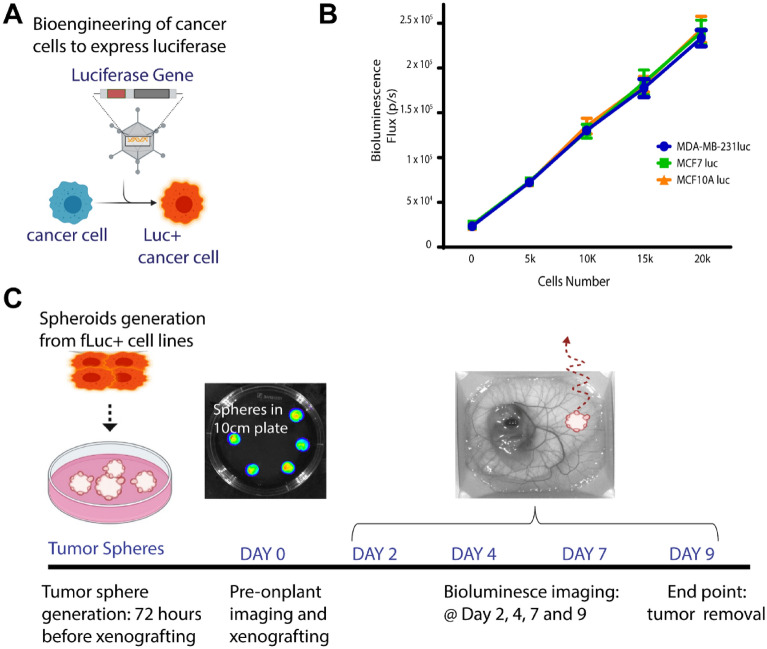
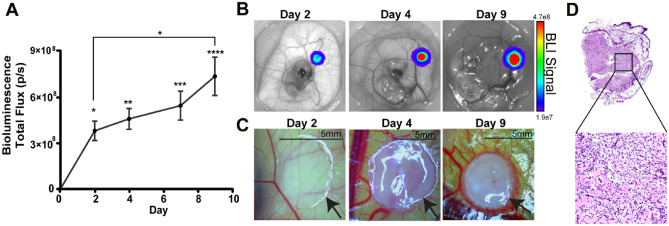
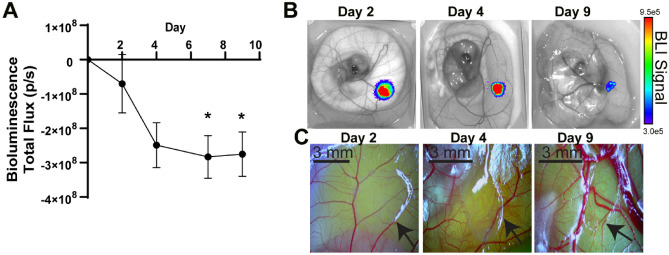
The development of successful treatment regimens for breast cancer requires strong pre-clinical data generated in physiologically relevant pre-clinical models. Here we report the development of the chick embryo chorioallantoic membrane (CAM) model to study tumor growth and angiogenesis using breast cancer cell lines. MDA-MB-231 and MCF7 tumor cell lines were engrafted onto the chick embryo CAM to study tumor growth and treatment response. Tumor growth was evaluated through bioluminescence imaging and a significant increase in tumor size and vascularization was found over a 9-day period. We then evaluated the impact of anti-angiogenic drugs, axitinib and bevacizumab, on tumor growth and angiogenesis. Drug treatment significantly reduced tumor vascularization and size. Overall, our findings demonstrate that the chick embryo CAM is a clinically relevant model to monitor therapeutic response in breast cancer and can be used as a platform for drug screening to evaluate not only gross changes in tumor burden but physiological processes such as angiogenesis.
成功治疗乳腺癌的方案需要在生理相关的临床前模型中生成强大的临床前数据。在这里,我们报告了鸡胚绒毛尿囊膜(CAM)模型的开发,用于使用乳腺癌细胞系研究肿瘤生长和血管生成。将 MDA-MB-231 和 MCF7 肿瘤细胞系移植到鸡胚 CAM 上,以研究肿瘤生长和治疗反应。通过生物发光成像评估肿瘤生长,发现肿瘤大小和血管生成在 9 天内显著增加。然后,我们评估了抗血管生成药物 axitinib 和 bevacizumab 对肿瘤生长和血管生成的影响。药物治疗显著减少了肿瘤血管生成和大小。总体而言,我们的研究结果表明,鸡胚 CAM 是一种临床相关的模型,可用于监测乳腺癌的治疗反应,并可用作药物筛选的平台,不仅可以评估肿瘤负担的总体变化,还可以评估血管生成等生理过程。