School of Health Sciences, University of Southampton, Southampton, UK.
The Oak Centre for Children and Young People, The Royal Marsden NHS Foundation Trust, Downs Road, Sutton, SM2 5PT, Surrey, UK.
BMC Pediatr. 2022 Oct 14;22(1):595. doi: 10.1186/s12887-022-03635-1.
Parents of children who are diagnosed with a poor-prognosis cancer want to be involved in making treatment-related decisions for their child. They often make repeated decisions depending on their child's response to treatment and can experience decisional regret as a consequence. Understanding parent values and preferences when making treatment-related decisions may help enhance discussions with healthcare professionals and identify additional ways of providing support to this parent population.
To explore parent values and preferences underpinning treatment decision-making for children receiving cancer-directed therapy for a poor prognosis cancer.
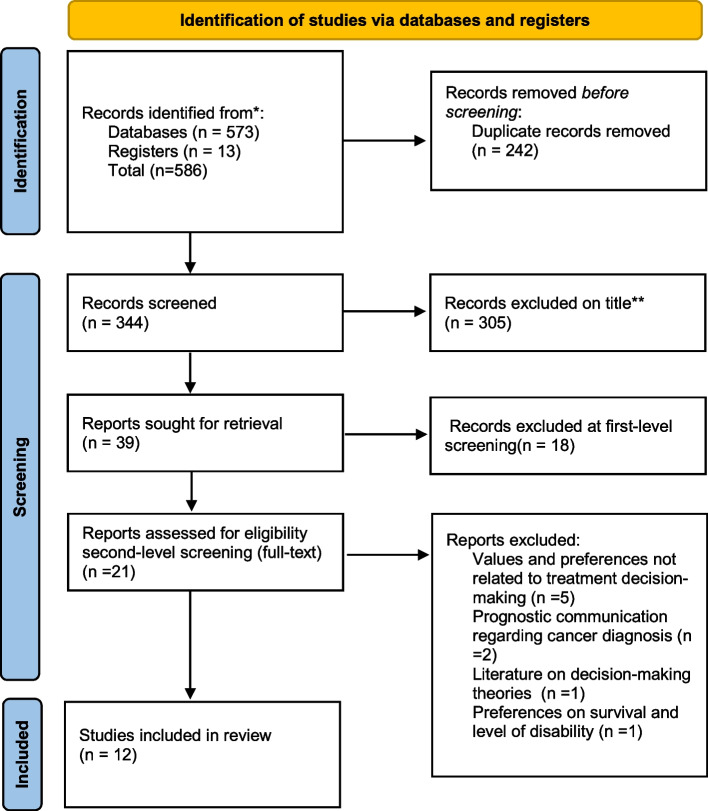
A scoping review of research literature and systematic reviews from qualitative, quantitative, and mixed methods studies was conducted following Joanna Briggs Institute methodology. Articles which included parents of a child who received cancer-directed therapy for a poor-prognosis childhood cancer, under the age of eighteen years were considered. Four electronic databases were searched (CINAHL, Medline, PsychINFO, Web of Science Core Collections). Reference and citation lists of all included full-text articles were also searched. Summative content analysis was used to synthesise findings and develop themes.
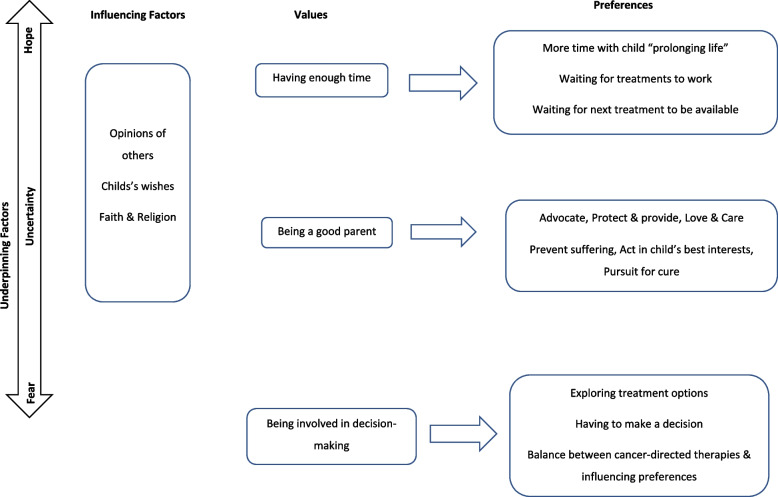
Twelve articles were included. Parent decision-making was affected by underpinning factors: hope for a cure, fear of their child dying and uncertainty. Influencing factors: opinions of others, child's wishes, and faith and religion had the potential to inform decision-making processes. Parents valued having enough time, being a good parent and being involved in decision-making. Preferences within these values varied resulting in the potential for conflict and 'trade-offs' in making decisions.
Parent decision-making in poor-prognosis childhood cancer is complex and extends beyond values and preferences. Underpinning factors and values are consistent through the decision-making process with influencing factors and preferences varying between parents. Preferences can conflict when parents want to continue cancer-directed therapy whilst maintaining their child's quality of life or can change depending on a parents' cognitive state as they realise cure might be unlikely.
被诊断患有预后不良癌症的儿童的父母希望参与为其孩子做出与治疗相关的决策。他们经常根据孩子对治疗的反应反复做出决定,因此可能会感到决策后悔。了解父母在做出与治疗相关的决策时的价值观和偏好,可以帮助加强与医疗保健专业人员的讨论,并确定为这一父母群体提供额外支持的其他方式。
探讨为接受预后不良癌症定向治疗的儿童做出治疗决策时父母的价值观和偏好。
采用循证卫生保健国际合作组织( Joanna Briggs Institute )方法,对定性、定量和混合方法研究的研究文献和系统评价进行了范围综述。纳入了接受癌症定向治疗的预后不良儿童癌症的儿童的父母的文章,年龄在 18 岁以下。在四个电子数据库( CINAHL 、 Medline 、 PsychINFO 、 Web of Science Core Collections )中进行了搜索。还搜索了所有纳入的全文文章的参考文献和引文列表。使用总结性内容分析来综合研究结果并开发主题。
共纳入 12 篇文章。父母的决策受到潜在因素的影响:治愈的希望、对孩子死亡的恐惧和不确定性。影响因素:他人的意见、孩子的意愿以及信仰和宗教,有可能为决策过程提供信息。父母重视有足够的时间、做一个好父母并参与决策。这些价值观中的偏好因人而异,导致在做出决策时存在潜在的冲突和“权衡”。
预后不良儿童癌症的父母决策复杂,不仅限于价值观和偏好。在决策过程中,潜在因素和价值观是一致的,而影响因素和偏好因父母而异。当父母希望继续癌症定向治疗同时维持孩子的生活质量,或者当父母意识到治愈的可能性不大时,偏好可能会发生冲突,或者偏好可能会根据父母的认知状态而改变。