Bartoszewska Sylwia, Collawn James F, Bartoszewski Rafal
Department of Inorganic Chemistry, Medical University of Gdansk, 80-416 Gdansk, Poland.
Department of Cell, Developmental and Integrative Biology, University of Alabama at Birmingham, Birmingham, AL 35294, USA.
Cancers (Basel). 2022 Oct 5;14(19):4870. doi: 10.3390/cancers14194870.
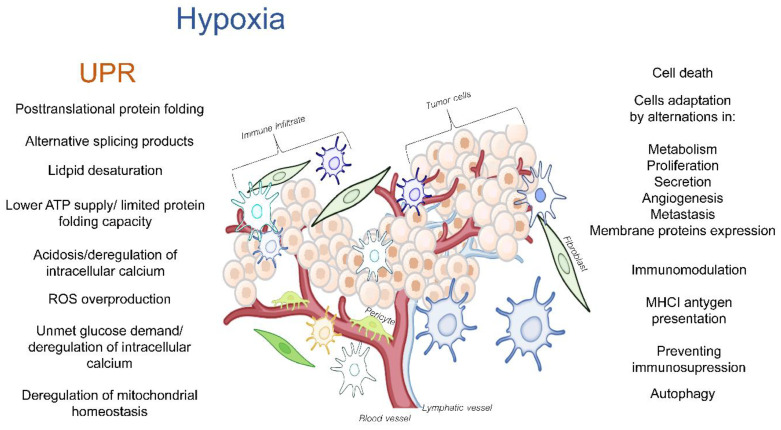
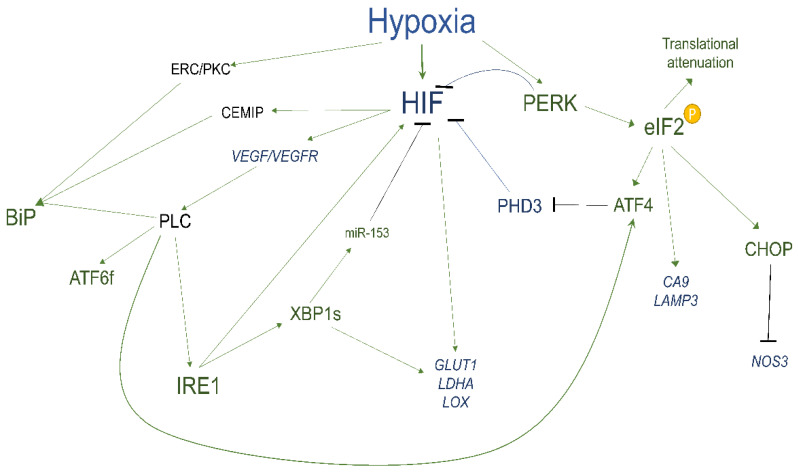
Despite our understanding of the unfolded protein response (UPR) pathways, the crosstalk between the UPR and the complex signaling networks that different cancers utilize for cell survival remains to be, in most cases, a difficult research barrier. A major problem is the constant variability of different cancer types and the different stages of cancer as well as the complexity of the tumor microenvironments (TME). This complexity often leads to apparently contradictory results. Furthermore, the majority of the studies that have been conducted have utilized two-dimensional in vitro cultures of cancer cells that were exposed to continuous hypoxia, and this approach may not mimic the dynamic and cyclic conditions that are found in solid tumors. Here, we discuss the role of intermittent hypoxia, one of inducers of the UPR in the cellular component of TME, and the way in which intermittent hypoxia induces high levels of reactive oxygen species, the activation of the UPR, and the way in which cancer cells modulate the UPR to aid in their survival. Although the past decade has resulted in defining the complex, novel non-coding RNA-based regulatory networks that modulate the means by which hypoxia influences the UPR, we are now just to beginning to understand some of the connections between hypoxia, the UPR, and the TME.
尽管我们对未折叠蛋白反应(UPR)途径有所了解,但在大多数情况下,UPR与不同癌症用于细胞存活的复杂信号网络之间的相互作用仍是一个难以突破的研究障碍。一个主要问题是不同癌症类型、癌症不同阶段的持续变异性以及肿瘤微环境(TME)的复杂性。这种复杂性常常导致明显相互矛盾的结果。此外,大多数已开展的研究利用了暴露于持续低氧环境的癌细胞的二维体外培养,而这种方法可能无法模拟实体瘤中存在的动态和周期性条件。在此,我们讨论间歇性低氧(TME细胞成分中UPR的诱导因素之一)的作用,以及间歇性低氧诱导高水平活性氧、激活UPR的方式,还有癌细胞调节UPR以帮助其存活的方式。尽管在过去十年中已确定了基于新型非编码RNA的复杂调控网络,这些网络调节低氧影响UPR的方式,但我们现在才刚刚开始了解低氧、UPR和TME之间的一些联系。