Faculty of Health Sciences, University of Leon, 24071 León, Spain.
Department of Health Sciences, European University Miguel de Cervantes, 47012 Valladolid, Spain.
Int J Environ Res Public Health. 2022 Oct 5;19(19):12747. doi: 10.3390/ijerph191912747.
The relationship between fragility and neurological diseases is extensive and affects many patients with multiple sclerosis (MS), whose risk factors are related to fragility.
To study the effects of exercise and transcranial direct current stimulation (tDCS) in MS patients with fatigue from four dimensions: functional mobility, balance, fatigue, and depression.
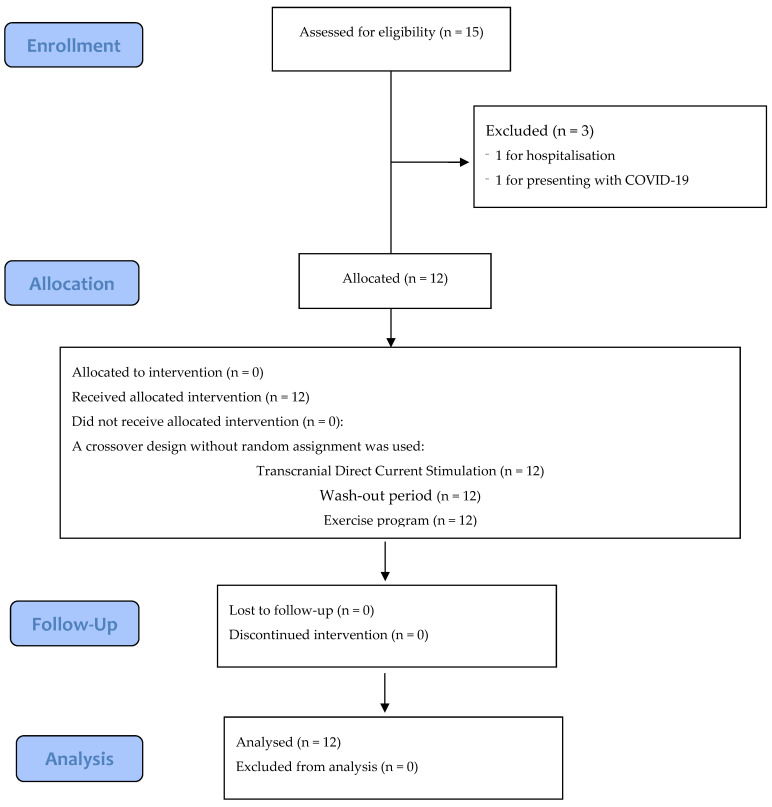
A total of 12 patients who belonged to two associations of people with physical disabilities participated. Functional mobility, depression, balance, and fatigue were assessed before and after the intervention. Transcranial direct current stimulation and the exercise program were carried out over a 4-week period with a wash-out period of 5 months.
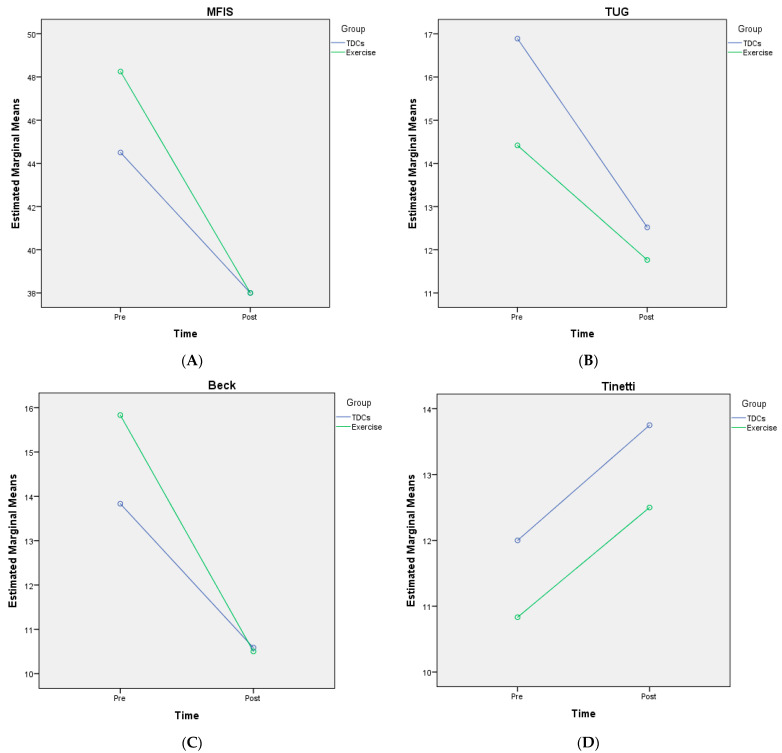
After the application of tDCS, we found significant improvements in balance ( < 0.05, g = 0.632), depression ( < 0.05, g = 0.402), functional mobility ( < 0.05, g = 0.297), and fatigue ( < 0.05, g = 0.526). After the exercise program, significant improvements were shown in balance ( < 0.01, g = 0.418), depression ( < 0.001, g = 0.540), functional mobility ( < 0.01, g = 0.262), and fatigue ( < 0.01, g = 0.742). Two-way mixed-measures ANOVA showed that all variables improved in both groups, with significant differences over time but not between groups. Secondary analysis showed significant correlations between balance and functional mobility (r = 0.671, = 0.017), depression and fatigue (r = 0.586, = 0.044) and between intensity of rehabilitation and balance (r = 0.622, = 0.031).
Participating in an exercise program and receiving tDCS separately improved the variables of depression, balance, mobility, and fatigue.
脆性与神经疾病的关系广泛,影响到许多多发性硬化症(MS)患者,其危险因素与脆性有关。
从四个方面研究运动和经颅直流电刺激(tDCS)对 MS 患者疲劳的影响:功能性移动、平衡、疲劳和抑郁。
共有 12 名属于两个残疾人协会的患者参与了研究。在干预前后评估了功能性移动、抑郁、平衡和疲劳。在 4 周的时间内进行 tDCS 和运动计划,并在 5 个月的洗脱期后进行评估。
应用 tDCS 后,我们发现平衡( < 0.05,g = 0.632)、抑郁( < 0.05,g = 0.402)、功能性移动( < 0.05,g = 0.297)和疲劳( < 0.05,g = 0.526)均有显著改善。在运动计划后,平衡( < 0.01,g = 0.418)、抑郁( < 0.001,g = 0.540)、功能性移动( < 0.01,g = 0.262)和疲劳( < 0.01,g = 0.742)也有显著改善。双向混合措施方差分析显示,两组所有变量均有所改善,且时间差异有统计学意义,但组间无差异。二次分析显示,平衡与功能性移动(r = 0.671, = 0.017)、抑郁与疲劳(r = 0.586, = 0.044)之间以及康复强度与平衡(r = 0.622, = 0.031)之间存在显著相关性。
分别参与运动计划和 tDCS 可改善抑郁、平衡、移动和疲劳等变量。