Harris Dale M, Rantalainen Timo, Muthalib Makii, Johnson Liam, Duckham Rachel L, Smith Stuart T, Daly Robin M, Teo Wei-Peng
Institute for Physical Activity and Nutrition (IPAN), School of Exercise and Nutrition Sciences, Deakin University, Geelong, VIC, Australia.
SilverLine Research Services, Brisbane, QLD, Australia.
Trials. 2018 Jul 16;19(1):387. doi: 10.1186/s13063-018-2773-6.
People with Parkinson's disease (PD) commonly experience postural instability, resulting in poor balance and an increased risk of falls. Exercise-based video gaming (exergaming) is a form of physical training that is delivered through virtual reality technology to facilitate motor learning and is efficacious in improving balance in aged populations. In addition, studies have shown that anodal transcranial direct current stimulation (a-tDCS), when applied to the primary motor cortex, can augment motor learning when combined with physical training. However, no studies have investigated the combined effects of exergaming and tDCS on balance in people with PD.
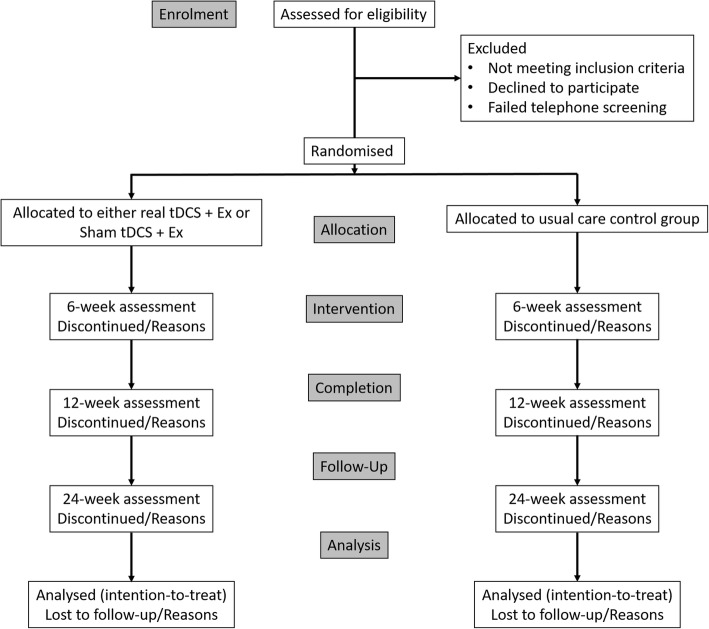
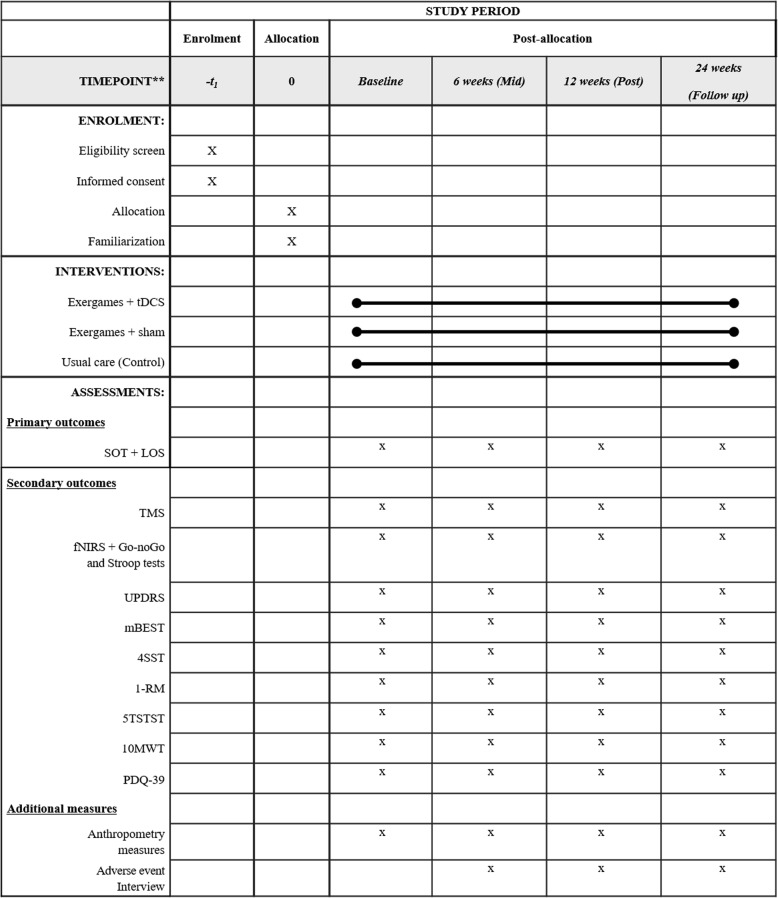
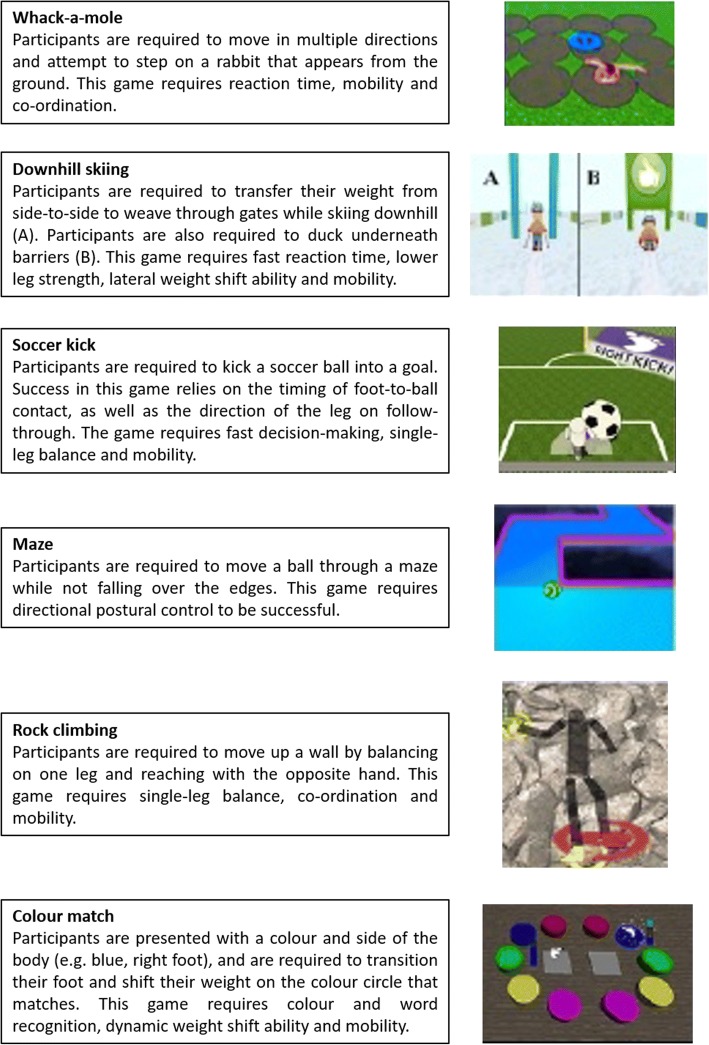
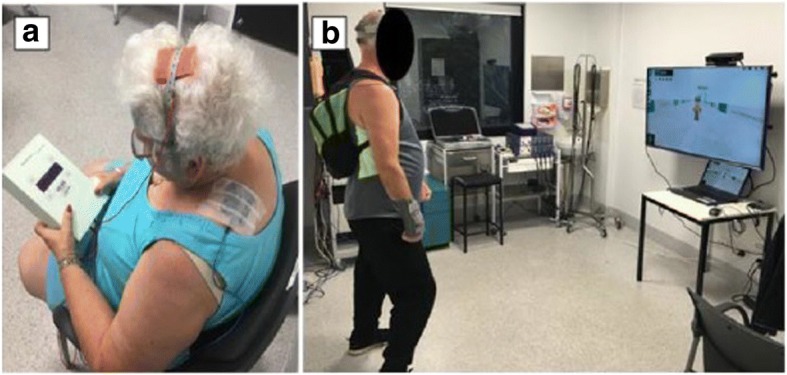
METHODS/DESIGN: Twenty-four people with mild to moderate PD (Hoehn and Yahr scale score 2-4) will be randomly allocated to receive one of three interventions: (1) exergaming + a-tDCS, (2) exergaming + sham a-tDCS or (3) usual care. Participants in each exergaming group will perform two training sessions per week for 12 weeks. Each exergaming session will consist of a series of static and dynamic balance exercises using a rehabilitation-specific software programme (Jintronix) and 20 minutes of either sham or real a-tDCS (2 mA) delivered concurrently. Participants allocated to usual care will be asked to maintain their normal daily physical activities. All outcome measures will be assessed at baseline and at 6 weeks (mid-intervention), 12 weeks (post-intervention) and 24 weeks (3-month follow-up) after baseline. The primary outcome measure will be the Limits of Stability Test. Secondary outcomes will include measures of static balance, leg strength, functional capacity, cognitive task-related cortical activation, corticospinal excitability and inhibition, and cognitive inhibition.
This will be the first trial to target balance in people with PD with combined exergaming and a-tDCS. We hypothesise that improvements in balance, functional and neurophysiological outcome measures, and neurocognitive outcome measures will be greater and longer-lasting following concurrent exergaming and a-tDCS than in those receiving sham tDCS or usual care.
Australian New Zealand Clinical Trials Registry, ACTRN12616000594426 ). Registered on 9 May 2016.
帕金森病(PD)患者常出现姿势不稳,导致平衡能力差且跌倒风险增加。基于运动的视频游戏(健身游戏)是一种通过虚拟现实技术进行的体育训练形式,有助于促进运动学习,对改善老年人群的平衡能力有效。此外,研究表明,阳极经颅直流电刺激(a-tDCS)应用于初级运动皮层时,与体育训练相结合可增强运动学习。然而,尚无研究探讨健身游戏和tDCS对PD患者平衡能力的联合影响。
方法/设计:24名轻度至中度PD患者(Hoehn和Yahr量表评分2 - 4)将被随机分配接受以下三种干预措施之一:(1)健身游戏 + a-tDCS,(2)健身游戏 + 假a-tDCS,或(3)常规护理。每个健身游戏组的参与者将每周进行两次训练,共12周。每次健身游戏训练将包括使用特定康复软件程序(Jintronix)进行的一系列静态和动态平衡练习,以及同时进行的20分钟假刺激或真a-tDCS(2 mA)。分配到常规护理组的参与者将被要求保持正常的日常体育活动。所有结局指标将在基线时以及基线后6周(干预中期)、12周(干预后)和24周(3个月随访)进行评估。主要结局指标将是稳定性极限测试。次要结局将包括静态平衡、腿部力量、功能能力、认知任务相关皮层激活、皮质脊髓兴奋性和抑制以及认知抑制的测量。
这将是第一项针对PD患者平衡能力,采用健身游戏和a-tDCS联合干预的试验。我们假设,与接受假tDCS或常规护理的患者相比,同时进行健身游戏和a-tDCS后,平衡、功能和神经生理学结局指标以及神经认知结局指标的改善将更大且更持久。
澳大利亚新西兰临床试验注册中心,ACTRN12616000594426 。于2016年5月9日注册。