Pilloni Giuseppina, Choi Claire, Coghe Giancarlo, Cocco Eleonora, Krupp Lauren B, Pau Massimiliano, Charvet Leigh E
NYU Langone Health, Department of Neurology, New York, NY, United States.
Department of Mechanical, Chemical and Materials Engineering, University of Cagliari, Cagliari, Italy.
Front Neurol. 2020 May 5;11:310. doi: 10.3389/fneur.2020.00310. eCollection 2020.
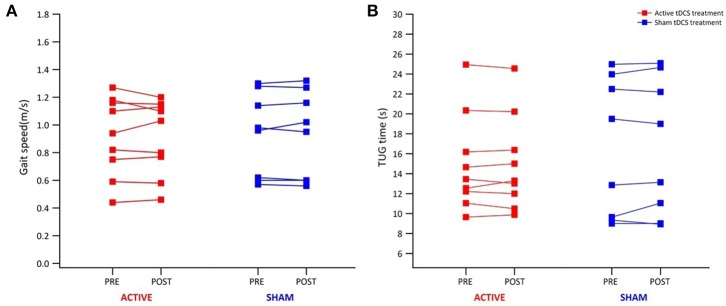
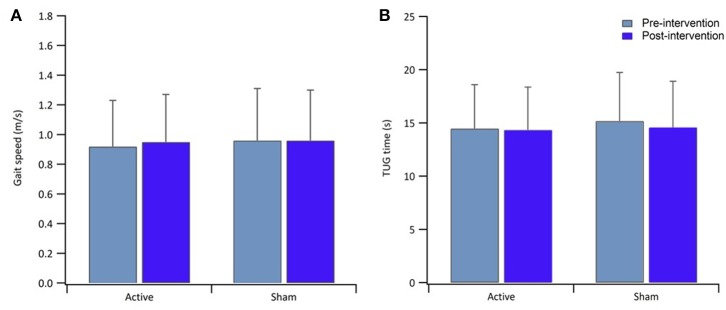
Walking impairments are a debilitating feature of multiple sclerosis (MS) because of the direct interference with daily activity. The management of motor symptoms in those with MS remains a therapeutic challenge. Transcranial direct current stimulation (tDCS) is a type of non-invasive brain stimulation that is emerging as a promising rehabilitative tool but requires further characterization to determine its optimal therapeutic use. In this randomized, sham-controlled proof-of-concept study, we tested the immediate effects of a single tDCS session on walking and functional mobility in those with MS. Seventeen participants with MS completed one 20-min session of aerobic exercise, randomly assigned to be paired with either active (2.5 mA, = 9) or sham ( = 8) tDCS over the primary motor cortex (M1). The groups (active vs. sham) were matched according to gender (50% vs. 60% F), age (52.1 ± 12.85 vs. 54.2 ± 8.5 years), and level of neurological disability (median Expanded Disability Status Scale score 5.5 vs. 5). Gait speed on the 10-m walk test and the Timed Up and Go (TUG) time were measured by a wearable inertial sensor immediately before and following the 20-min session, with changes compared between conditions and time. There were no significant differences in gait speed or TUG time changes following the session in the full sample or between the active vs. sham groups. These findings suggest that a single session of anodal tDCS over M1 is not sufficient to affect walking and functional mobility in those with MS. Instead, behavioral motor response of tDCS is likely to be cumulative, and the effects of multiple tDCS sessions require further study. www.ClinicalTrials.gov, identifier: NCT03658668.
行走障碍是多发性硬化症(MS)的一个使人衰弱的特征,因为它直接干扰日常活动。对MS患者运动症状的管理仍然是一个治疗挑战。经颅直流电刺激(tDCS)是一种非侵入性脑刺激,正成为一种有前景的康复工具,但需要进一步明确其最佳治疗用途。在这项随机、假对照的概念验证研究中,我们测试了单次tDCS治疗对MS患者行走和功能移动性的即时影响。17名MS患者完成了一次20分钟的有氧运动课程,随机分配在初级运动皮层(M1)接受主动tDCS(2.5 mA,n = 9)或假tDCS(n = 8)。两组(主动组与假刺激组)根据性别(50%对60%女性)、年龄(52.1±12.85岁对54.2±8.5岁)和神经功能障碍程度(扩展残疾状态量表中位数评分5.5对5)进行匹配。在20分钟课程前后,通过可穿戴惯性传感器测量10米步行测试中的步态速度和计时起立行走(TUG)时间,并比较不同条件和时间之间的变化。在整个样本中或主动组与假刺激组之间,课程后步态速度或TUG时间变化没有显著差异。这些发现表明,单次M1阳极tDCS不足以影响MS患者的行走和功能移动性。相反,tDCS的行为运动反应可能是累积性的,多次tDCS治疗的效果需要进一步研究。 临床试验注册中心,标识符:NCT03658668。