Applied Biotechnology Group, Universidad Europea de Madrid, Urbanización El Bosque, Calle Tajo, s/n, 28670 Villaviciosa de Odón (Madrid), Spain.
Department of Crystallography and Structural Biology, Institute Rocasolano (CSIC), Serrano 119, 28006 Madrid, Spain.
Int J Mol Sci. 2022 Oct 5;23(19):11806. doi: 10.3390/ijms231911806.
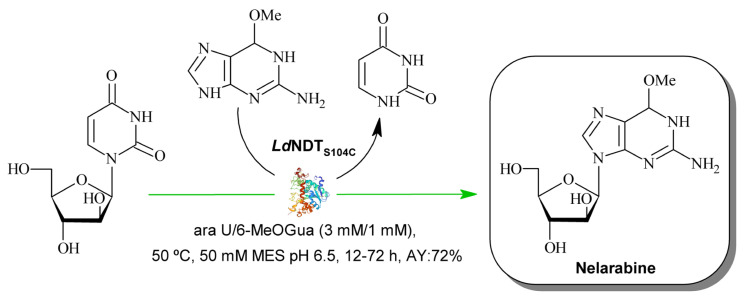
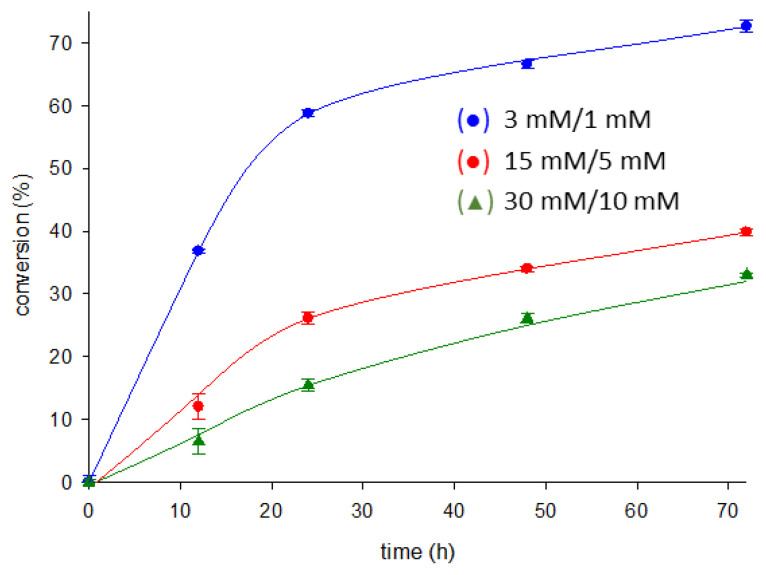
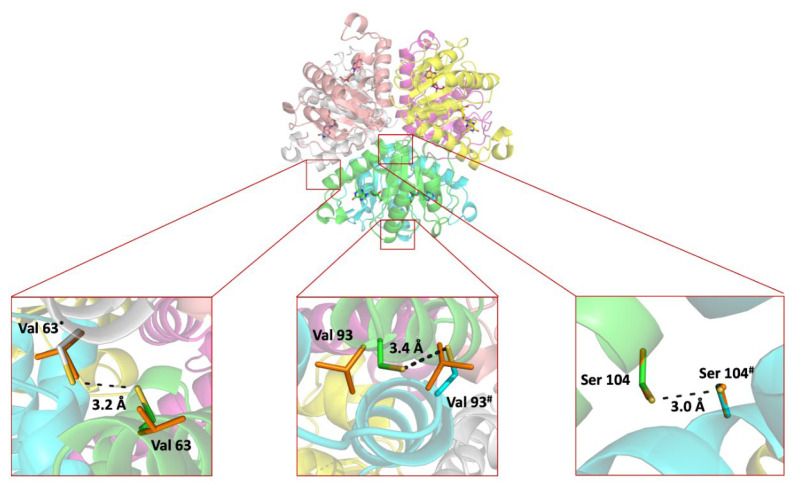
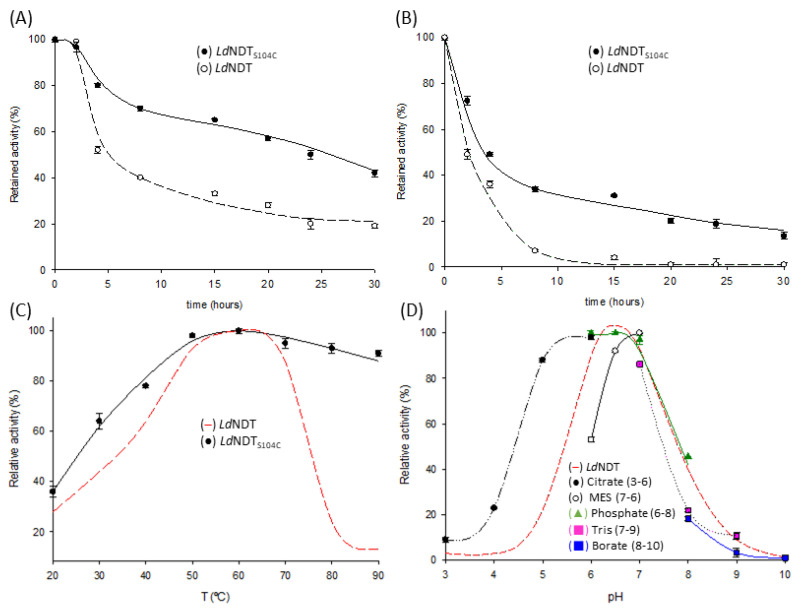
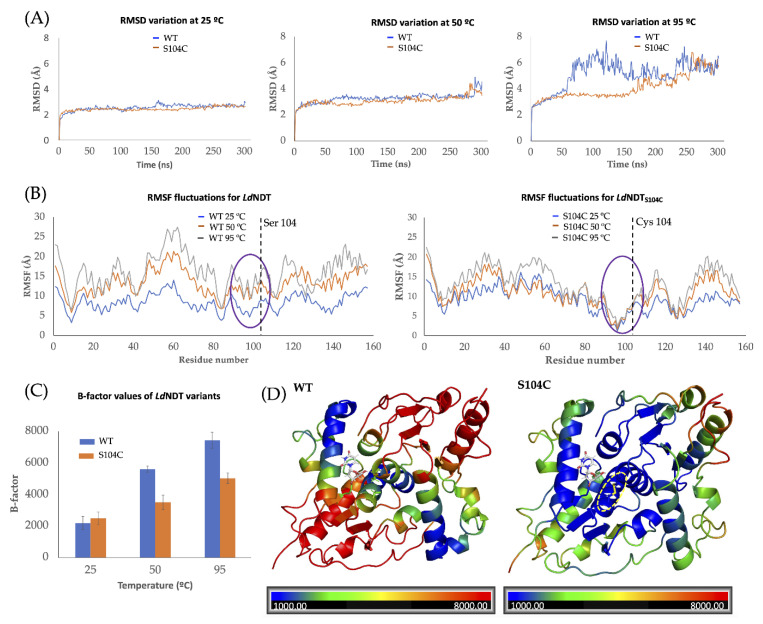
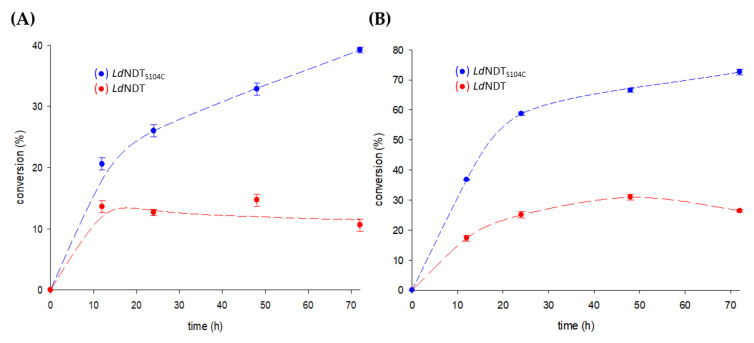
One of the major drawbacks of the industrial implementation of enzymatic processes is the low operational stability of the enzymes under tough industrial conditions. In this respect, the use of thermostable enzymes in the industry is gaining ground during the last decades. Herein, we report a structure-guided approach for the development of novel and thermostable 2′-deoxyribosyltransferases (NDTs) based on the computational design of disulfide bonds on hot spot positions. To this end, a small library of NDT variants from Lactobacillus delbrueckii (LdNDT) with introduced cysteine pairs was created. Among them, LdNDTS104C (100% retained activity) was chosen as the most thermostable variant, displaying a six- and two-fold enhanced long-term stability when stored at 55 °C (t1/255 °C ≈ 24 h) and 60 °C (t1/260 °C ≈ 4 h), respectively. Moreover, the biochemical characterization revealed that LdNDTS104C showed >60% relative activity across a broad range of temperature (30−90 °C) and pH (5−7). Finally, to study the potential application of LdNDTS104C as an industrial catalyst, the enzymatic synthesis of nelarabine was successfully carried out under different substrate conditions (1:1 and 3:1) at different reaction times. Under these experimental conditions, the production of nelarabine was increased up to 2.8-fold (72% conversion) compared with wild-type LdNDT.
酶法工艺在工业上应用的主要缺点之一是酶在苛刻的工业条件下的操作稳定性低。在这方面,在过去几十年中,耐热酶在工业中的应用得到了发展。在此,我们报告了一种基于在热点位置设计二硫键的计算设计来开发新型耐热 2′-脱氧核糖基转移酶 (NDT) 的结构导向方法。为此,我们构建了一个来自德氏乳杆菌 (Lactobacillus delbrueckii) 的具有引入的半胱氨酸对的小文库的 NDT 变体。其中,LdNDTS104C(保留 100%的活性)被选为最耐热的变体,在 55°C(t1/255°C≈24 h)和 60°C(t1/260°C≈4 h)下储存时,其长期稳定性分别提高了六倍和两倍。此外,生化特性表明 LdNDTS104C 在较宽的温度(30-90°C)和 pH 值(5-7)范围内具有>60%的相对活性。最后,为了研究 LdNDTS104C 作为工业催化剂的潜在应用,在不同的底物条件(1:1 和 3:1)和不同的反应时间下成功地进行了奈拉滨的酶法合成。在这些实验条件下,与野生型 LdNDT 相比,奈拉滨的产量增加了 2.8 倍(转化率为 72%)。