Fondazione IRCCS Istituto Nazionale dei Tumori, Milano, Italy.
Medica Scientia Innovation Research (MEDSIR), Barcelona, Spain.
Oncologist. 2023 Jan 18;28(1):23-32. doi: 10.1093/oncolo/oyac205.
Palbociclib has gained a central role in the treatment of hormone receptor-positive (HR+)/human epidermal growth factor receptor 2-negative (HER2-) advanced breast cancer (ABC). Despite its manageable toxicity profile, venous thromboembolism (VTE) or interstitial lung disease (ILD)/pneumonitis may infrequently occur. Therefore, we provide a comprehensive summary of the safety and tolerability of the combination of endocrine therapy and palbociclib among patients included in the randomized phase 2 PARSIFAL study.
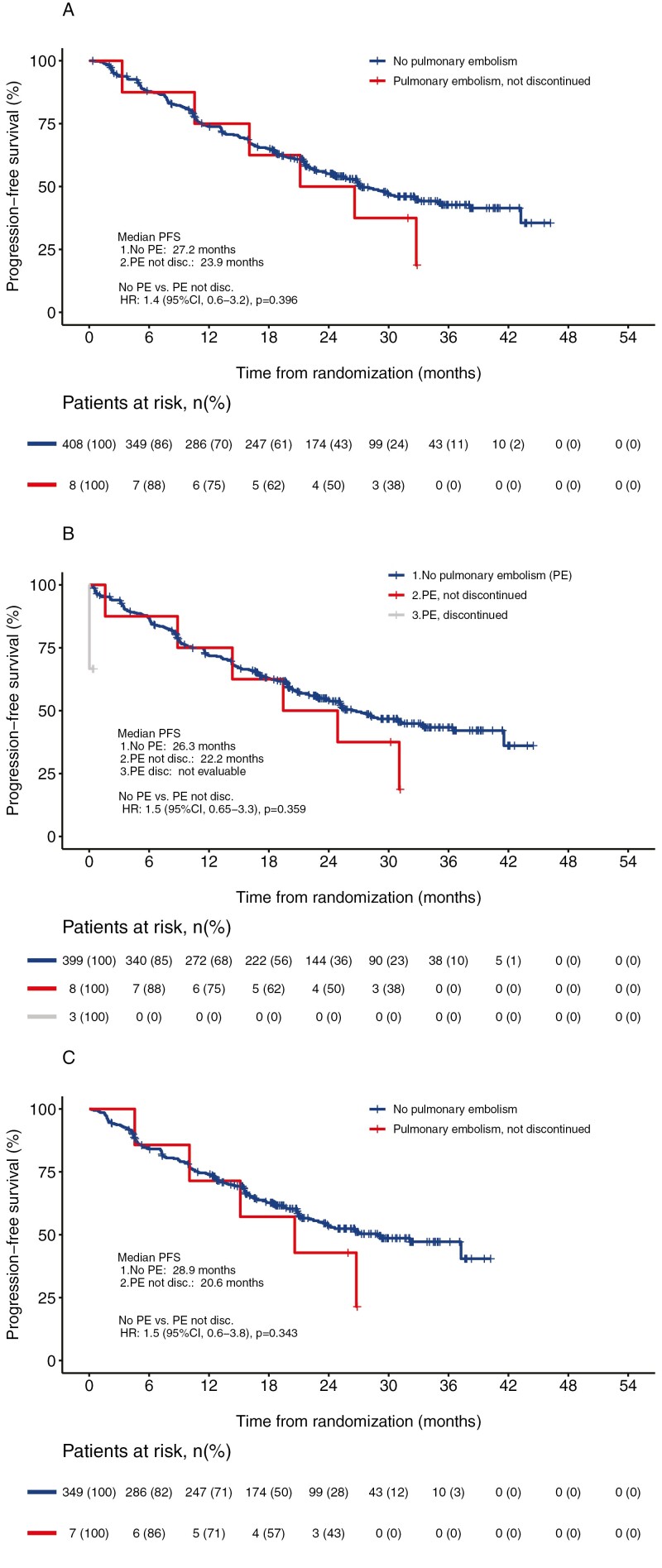
Patients with endocrine-sensitive HR+/HER2- ABC and no prior therapy in an advanced setting (n = 486) were randomly assigned 1:1 to receive fulvestrant-palbociclib (FP) or letrozole-palbociclib (LP). Laboratory tests and the incidence of adverse events (AEs) were recorded at baseline and day 1 of each cycle. Progression-free survival (PFS) was estimated for patients with and without VTE.
A total of 483 patients were analyzed. Neutropenia, leukopenia, anemia, asthenia, arthralgia, fatigue, and diarrhea were the most frequent AEs in both groups. Febrile neutropenia occurred in 3 (1.2%) patients of the FP group and in 1 (0.4%) patient in the LP group. Six (2.5%; 0.4% grade 3) patients in the FP group and 6 patients (2.5%; 0.4% grade 3) in the LP group experienced ILD/pneumonitis. Pulmonary embolism was reported in 12 (5.0%) patients in the FP group and 6 (2.5%) patients in the LP group. Advanced age at baseline was the only factor significantly associated with an increased risk of pulmonary embolism (P < .01).
The PARSIFAL data confirmed the favorable safety profile of both palbociclib regimens. VTE and ILD/pneumonitis were occasionally reported, and their early detection allowed patients to continue treatment effectively without detriment to efficacy.
CLINICALTRIALS.GOV IDENTIFIER: NCT02491983; https://clinicaltrials.gov/ct2/show/NCT02491983).
帕博西尼(Palbociclib)在治疗激素受体阳性(HR+)/人表皮生长因子受体 2 阴性(HER2-)晚期乳腺癌(ABC)方面发挥了核心作用。尽管其毒性谱可管理,但静脉血栓栓塞(VTE)或间质性肺病(ILD)/肺炎仍可能偶尔发生。因此,我们提供了综合总结,包括在随机 2 期 PARSIFAL 研究中纳入的患者中,内分泌治疗联合帕博西尼的安全性和耐受性。
无晚期既往治疗的内分泌敏感 HR+/HER2-ABC 患者(n=486)按 1:1 随机分配接受氟维司群-帕博西尼(FP)或来曲唑-帕博西尼(LP)。在基线和每个周期的第 1 天记录实验室检查和不良事件(AE)的发生率。对有和无 VTE 的患者进行无进展生存期(PFS)估计。
共分析了 483 例患者。中性粒细胞减少症、白细胞减少症、贫血、乏力、关节痛、疲劳和腹泻是两组中最常见的 AE。FP 组有 3 例(1.2%)和 LP 组有 1 例(0.4%)发生发热性中性粒细胞减少症。FP 组有 6 例(2.5%;0.4%为 3 级)和 LP 组有 6 例(2.5%;0.4%为 3 级)发生 ILD/肺炎。FP 组有 12 例(5.0%)和 LP 组有 6 例(2.5%)发生肺栓塞。基线时年龄较大是唯一与肺栓塞风险增加显著相关的因素(P<0.01)。
PARSIFAL 数据证实了两种帕博西尼方案的良好安全性。偶尔报告 VTE 和 ILD/肺炎,早期发现可使患者在不影响疗效的情况下有效继续治疗。
临床试验.gov 标识符:NCT02491983;https://clinicaltrials.gov/ct2/show/NCT02491983)。