Department of Gynecologic Oncology and Reproductive Medicine, The University of Texas MD Anderson Cancer Center, Houston.
Division of Gynecologic Oncology, Department of Obstetrics and Gynecology, Morsani College of Medicine, University of South Florida, Tampa.
JAMA Netw Open. 2022 Oct 3;5(10):e2236626. doi: 10.1001/jamanetworkopen.2022.36626.
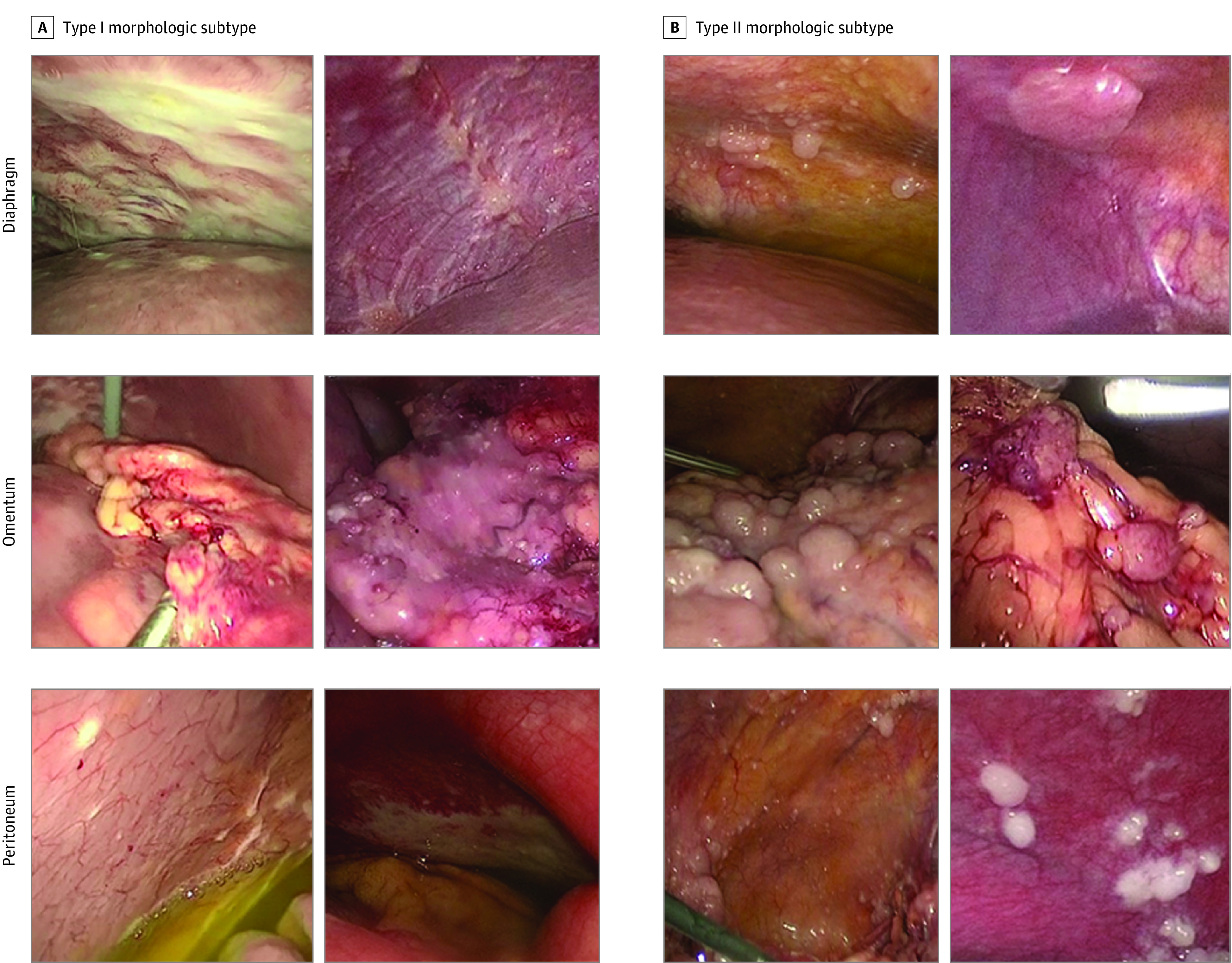
Despite similar histologic appearance among high-grade serous ovarian cancers (HGSOCs), clinical observations suggest vast differences in gross appearance. There is currently no systematic framework by which to classify HGSOCs according to their gross morphologic characteristics.
To develop and characterize a gross morphologic classification system for HGSOC.
DESIGN, SETTING, AND PARTICIPANTS: This cohort study included patients with suspected advanced-stage ovarian cancer who presented between April 1, 2013, and August 5, 2016, to the University of Texas MD Anderson Cancer Center, a large referral center. Patients underwent laparoscopic assessment of disease burden before treatment and received a histopathologic diagnosis of HGSOC. Researchers assigning morphologic subtype and performing molecular analyses were blinded to clinical outcomes. Data analysis was performed between April 2020 and November 2021.
Gross tumor morphologic characteristics.
Clinical outcomes and multiomic profiles of representative tumor samples of type I or type II morphologic subtypes were compared.
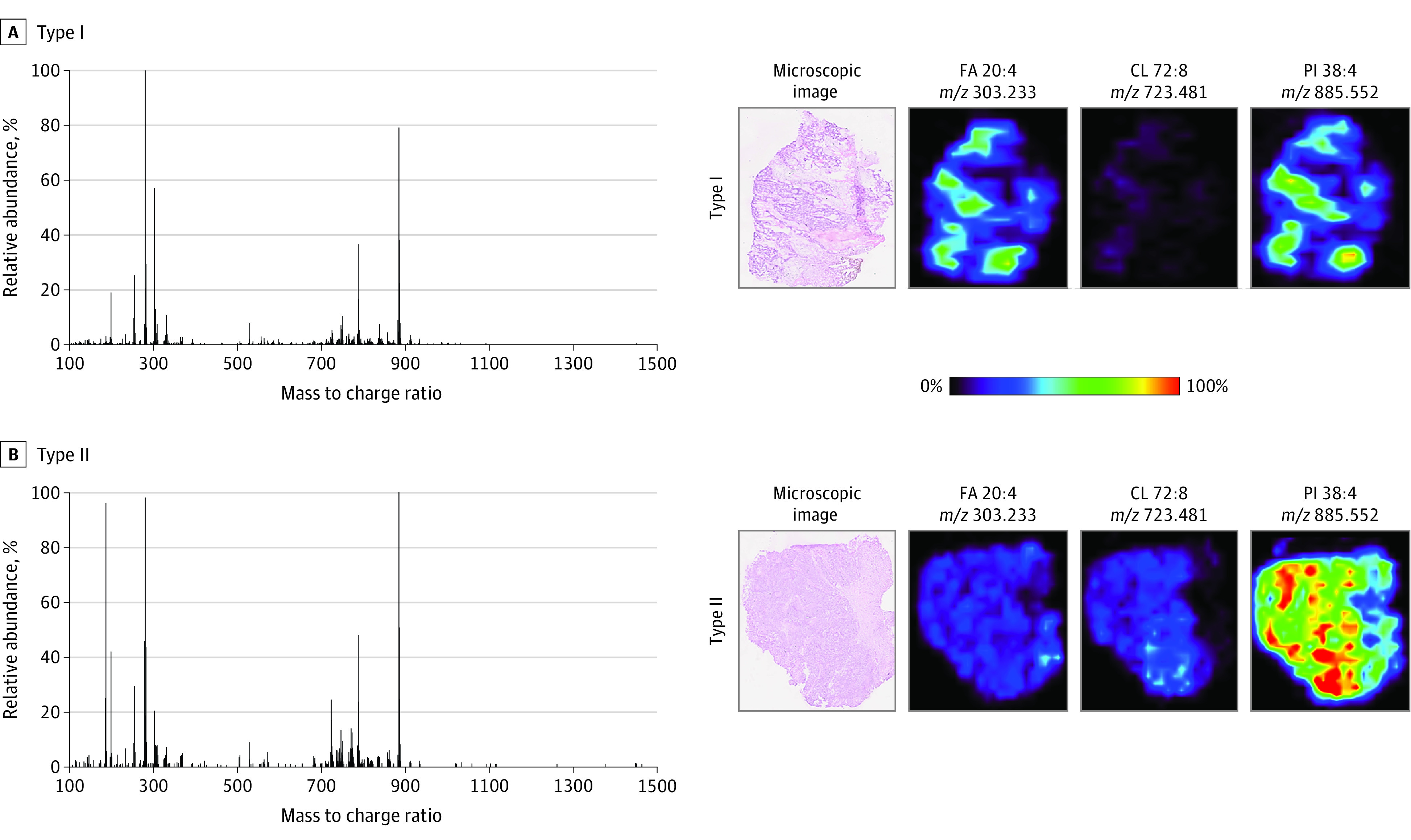
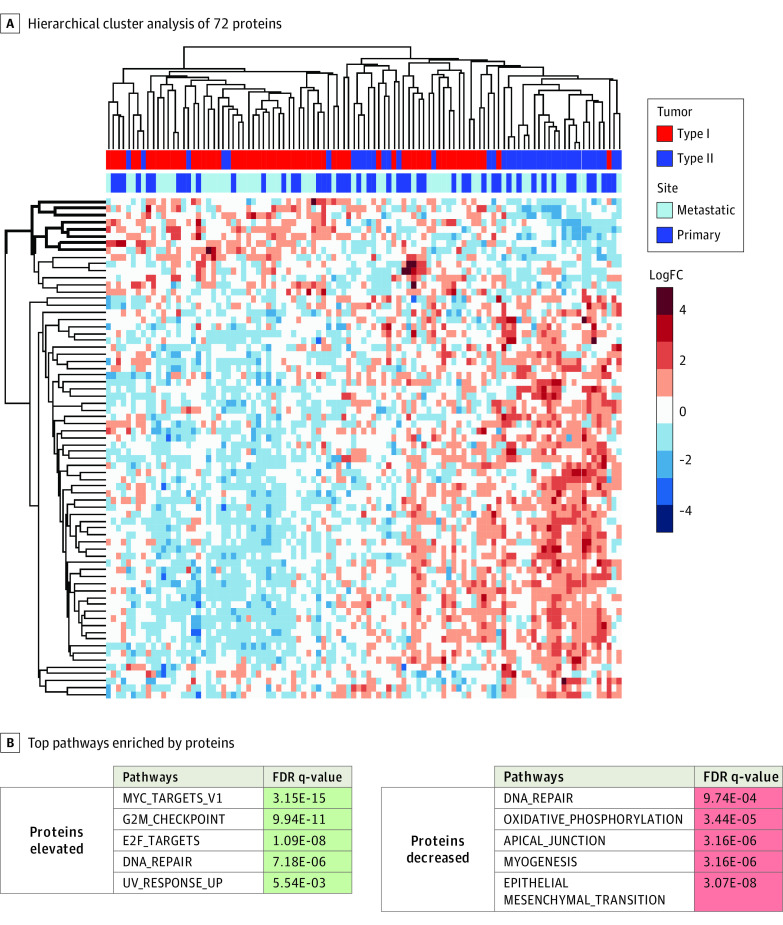
Of 112 women (mean [SD] age 62.7 [9.7] years) included in the study, most patients (84% [94]) exhibited a predominant morphologic subtype and many (63% [71]) had a uniform morphologic subtype at all involved sites. Compared with those with uniform type I morphologic subtype, patients with uniform type II morphologic subtype were more likely to have a favorable Fagotti score (83% [19 of 23] vs 46% [22 of 48]; P = .004) and thus to be triaged to primary tumor reductive surgery. Similarly, patients with uniform type II morphologic subtype also had significantly higher mean (SD) estimated blood loss (639 [559; 95% CI, 391-887] mL vs 415 [527; 95% CI, 253-577] mL; P = .006) and longer mean (SD) operative time (408 [130; 95% CI, 350-466] minutes vs 333 [113; 95% CI, 298-367] minutes; P = .03) during tumor reductive surgery. Type I tumors had enrichment of epithelial-mesenchymal transition (false discovery rate [FDR] q-value, 3.10 × 10⁻²⁴), hypoxia (FDR q-value, 1.52 × 10⁻⁵), and angiogenesis pathways (FDR q-value, 2.11 × 10⁻²), whereas type II tumors had enrichment of pathways related to MYC signaling (FDR q-value, 2.04 × 10⁻⁹) and cell cycle progression (FDR q-value, 1.10 × 10⁻⁵) by integrated proteomic and transcriptomic analysis. Abundances of metabolites and lipids also differed between the 2 morphologic subtypes.
This study identified 2 novel, gross morphologic subtypes of HGSOC, each with unique clinical features and molecular signatures. The findings may have implications for triaging patients to surgery or chemotherapy, identifying outcomes, and developing tailored therapeutic strategies.
尽管高级别浆液性卵巢癌 (HGSOC) 的组织学表现相似,但临床观察表明其大体外观存在巨大差异。目前尚无系统的框架可根据其大体形态特征对 HGSOC 进行分类。
制定和描述 HGSOC 的大体形态分类系统。
设计、地点和参与者:这项队列研究纳入了 2013 年 4 月 1 日至 2016 年 8 月 5 日期间在德克萨斯大学 MD 安德森癌症中心就诊的疑似晚期卵巢癌患者,该中心是一家大型转诊中心。患者在治疗前接受腹腔镜评估疾病负担,并接受 HGSOC 的组织病理学诊断。进行形态亚型分配和进行分子分析的研究人员对临床结果不知情。数据分析于 2020 年 4 月至 2021 年 11 月进行。
肿瘤大体形态特征。
比较了 I 型或 II 型形态亚型的代表性肿瘤样本的临床结果和多组学特征。
在纳入研究的 112 名女性患者(平均 [标准差] 年龄 62.7 [9.7] 岁)中,大多数患者(84%[94%])表现出主要的形态亚型,许多患者(63%[71%])在所有受累部位均具有一致的形态亚型。与具有一致的 I 型形态亚型的患者相比,具有一致的 II 型形态亚型的患者更有可能具有良好的 Fagotti 评分(83%[19/23] vs 46%[22/48];P = .004),因此更有可能接受原发性肿瘤减瘤手术。同样,具有一致的 II 型形态亚型的患者在肿瘤减瘤手术中也具有显著更高的平均(标准差)估计失血量(639[559;95%CI,391-887]mL 与 415[527;95%CI,253-577]mL;P = .006)和更长的平均(标准差)手术时间(408[130;95%CI,350-466]min 与 333[113;95%CI,298-367]min;P = .03)。I 型肿瘤在上皮-间充质转化(错误发现率 [FDR] q 值,3.10×10-24)、缺氧(FDR q 值,1.52×10-5)和血管生成途径(FDR q 值,2.11×10-2)中富集,而 II 型肿瘤在 MYC 信号通路(FDR q 值,2.04×10-9)和细胞周期进展(FDR q 值,1.10×10-5)中富集,这是通过整合蛋白质组学和转录组学分析得出的。这两种形态亚型之间的代谢物和脂质丰度也存在差异。
这项研究确定了 2 种新型的 HGSOC 大体形态亚型,每种亚型都具有独特的临床特征和分子特征。这些发现可能对患者手术或化疗的分诊、识别结果以及制定针对性的治疗策略具有重要意义。