Department of Obstetrics and Gynecology, Yiyang Central Hospital, Yiyang, China.
Department of Pharmacy, Guangxi University of Science and Technology, Liuzhou, China.
Front Endocrinol (Lausanne). 2023 Jan 18;14:1103429. doi: 10.3389/fendo.2023.1103429. eCollection 2023.
Small cell carcinoma of ovary (SCCO) is a rare and aggressive cancer primarily reported in the form of case reports. Due to limited epidemiological and prognostic analyses based on large populations, SCCO has varied considerably without prognostic models and a recognized first-line treatment strategy. The study aimed to compare the clinical characteristics, treatment methods, and prognosis of SCCO and high-grade serous ovarian cancer (HGSOC), the most prevalent subtype of ovarian cancer, in a large sample and develop a predictive model for these two subtypes.
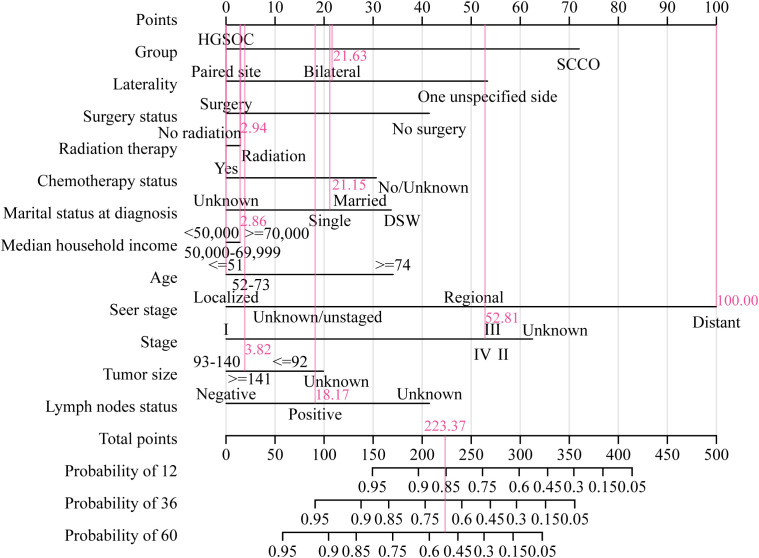
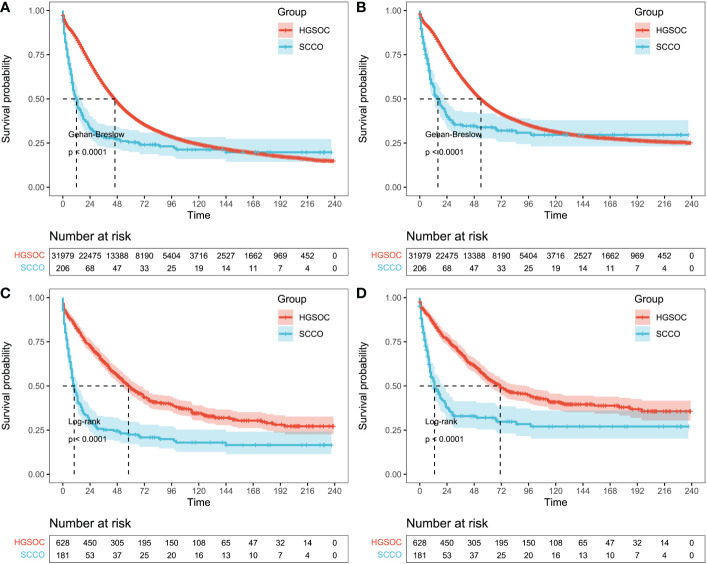
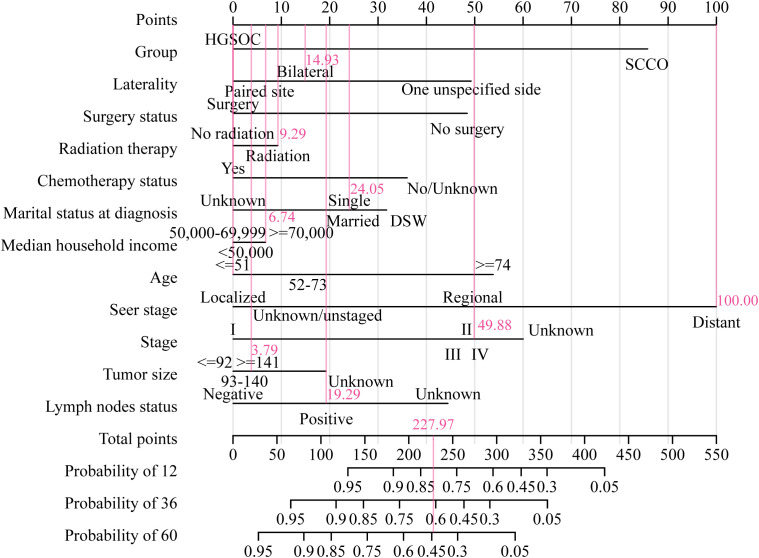
Data from the Surveillance, Epidemiology, and End Results program were analyzed for patients with SCCO or HGSOC from 2000 to 2017. Clinical, demographic, and treatment characteristics were compared between the two groups. Propensity-score matching, Cox risk regression analysis, and Kaplan-Meier survival curves were used to assess the data. Finally, a nomogram was developed to predict the patient survival time.
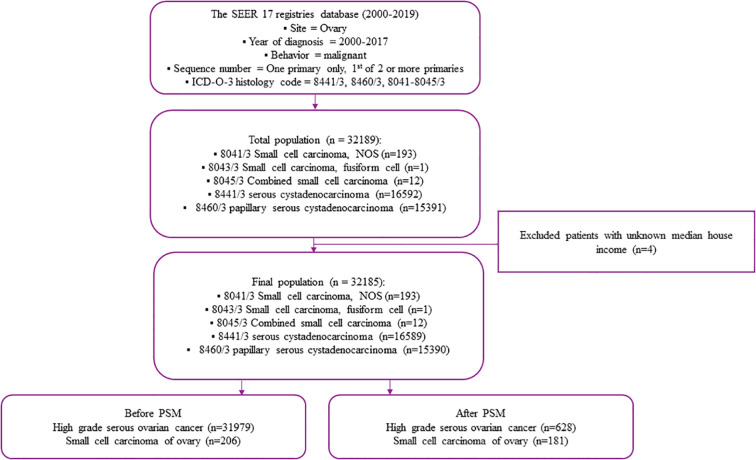
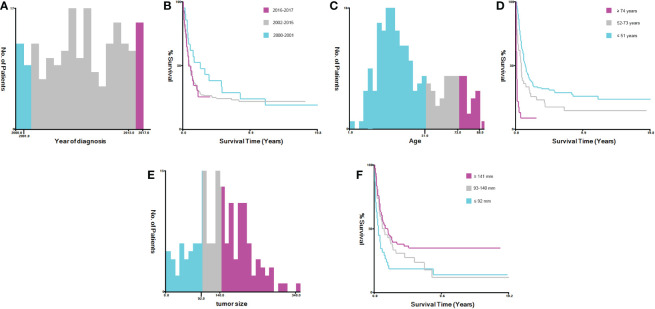
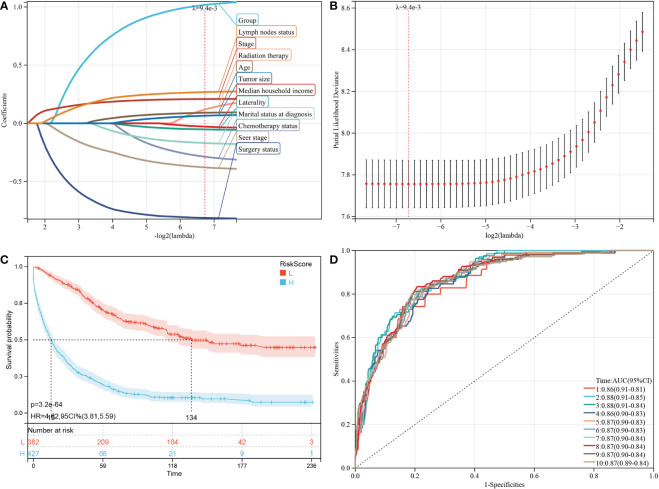
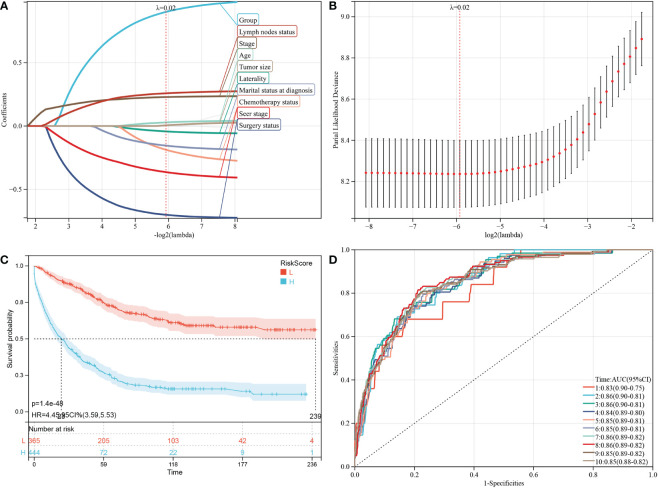
A total of 32,185 women, including 31,979 (99.4%) diagnosed with HGSOC and 206 (0.6%) diagnosed with SCCO, were identified. Age ≤ 51 years, single, median house income less than $70,000, early stage, and unilateral disease were more common characteristics of patients with SCCO than those with HGSOC. Patients with SCCO were more likely to receive radiotherapy (6.8% vs. 0.8%, p <0.001) and have tumors ≥ 141 mm (38.3% vs. 9.7%, p <0.001) than patients with HGSOC. The independent risk factors for SCCO patients included older age at diagnosis, advanced stage, surgery, radiotherapy, chemotherapy, larger tumor size, and bilateral tumor. Overall and cancer-specific survival rates were significantly lower for SCCO than more malignant HGSOC. Prognostic models and nomograms had been constructed to predict the individual survival rates of patients with SCCO and HGSOC.
Patients with SCCO presented with the early-stage disease more frequently than patients with HGSOC and had decreased overall and cancer-specific survival rates.
卵巢小细胞癌(SCCO)是一种罕见且侵袭性强的癌症,主要以病例报告的形式报道。由于基于大样本的流行病学和预后分析有限,SCCO 的预后模型和公认的一线治疗策略差异很大。本研究旨在比较 SCCO 和卵巢癌最常见亚型——高级别浆液性卵巢癌(HGSOC)的临床特征、治疗方法和预后,并为这两种亚型建立预测模型。
利用 2000 年至 2017 年监测、流行病学和最终结果(SEER)计划的数据,对 SCCO 和 HGSOC 患者进行分析。比较两组患者的临床、人口统计学和治疗特征。采用倾向评分匹配、Cox 风险回归分析和 Kaplan-Meier 生存曲线评估数据。最后,开发一个列线图来预测患者的生存时间。
共纳入 32185 名女性,其中 31979 名(99.4%)诊断为 HGSOC,206 名(0.6%)诊断为 SCCO。年龄≤51 岁、未婚、家庭中位数收入低于 70000 美元、早期分期和单侧疾病是 SCCO 患者较 HGSOC 患者更为常见的特征。与 HGSOC 患者相比,SCCO 患者更有可能接受放疗(6.8%比 0.8%,p<0.001)和肿瘤≥141mm(38.3%比 9.7%,p<0.001)。SCCO 患者的独立危险因素包括诊断时年龄较大、晚期、手术、放疗、化疗、肿瘤较大和双侧肿瘤。SCCO 患者的总生存和癌症特异性生存均显著低于更恶性的 HGSOC。已经建立了预测 SCCO 和 HGSOC 患者个体生存率的预后模型和列线图。
与 HGSOC 患者相比,SCCO 患者早期疾病更为常见,总生存和癌症特异性生存率较低。