Whitbread Trisha A, Kabuya Kathleen J, Naran Nimesh, Juggernath Amilcar M, Mathews Moushumi A, Blumberg Lucille H, Weyer Jacqueline, Essel Vivien
Outbreak Response Unit, Division of Public Health Surveillance, National Institute for Communicable Diseases, Johannesburg, South Africa.
Department of Community Health, School of Public Health, Faculty of Health Sciences, University of the Witwatersrand, Johannesburg, South Africa.
S Afr J Infect Dis. 2022 Sep 13;37(1):354. doi: 10.4102/sajid.v37i1.354. eCollection 2022.
The National Institute for Communicable Diseases (NICDs) of South Africa (SA) provides technical support to healthcare workers (HCWs) with regard to infectious diseases through the NICD clinician hotline. Queries to the hotline are often about rabies prophylaxis. An analysis of these queries may help to identify knowledge gaps amongst HCWs regarding prevention of rabies in humans in SA.
A retrospective descriptive review was conducted to analyse rabies post-exposure prophylaxis (PEP) queries received by the NICD from 01 January 2016 to 31 December 2019.
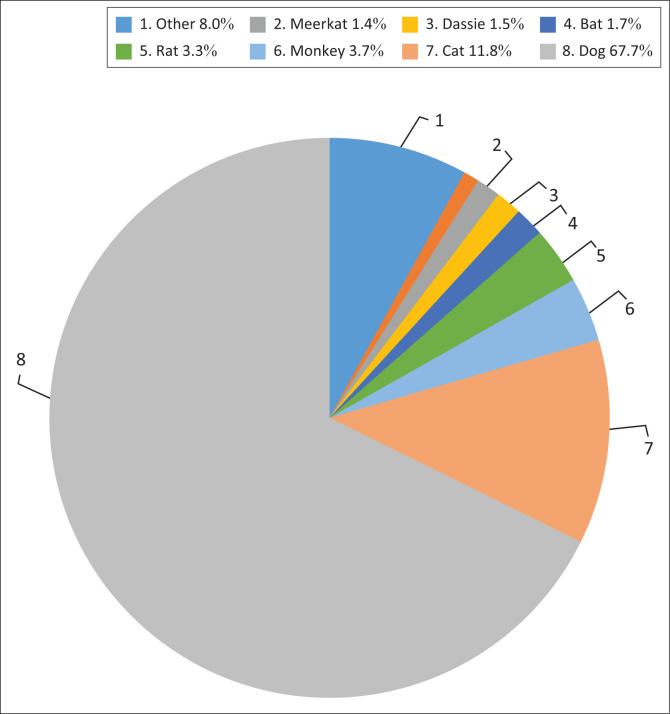
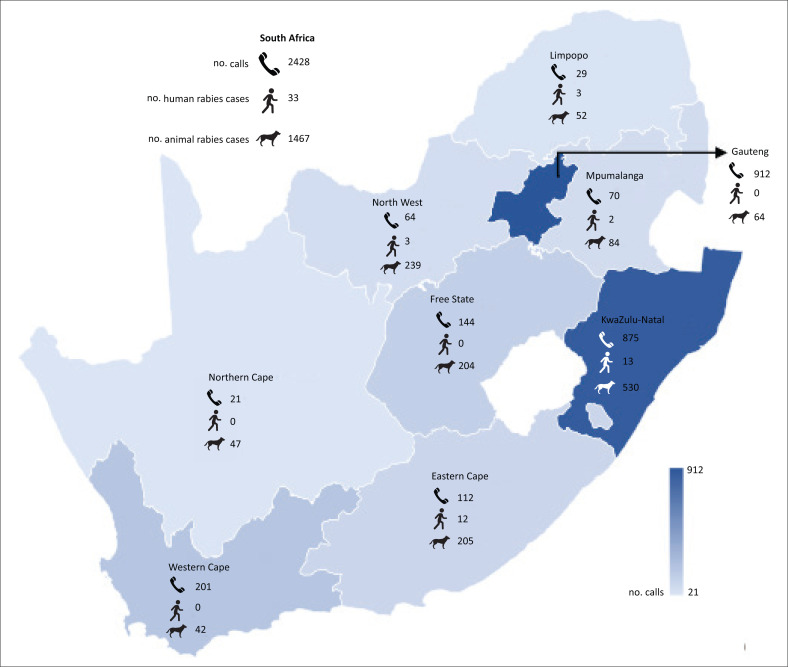
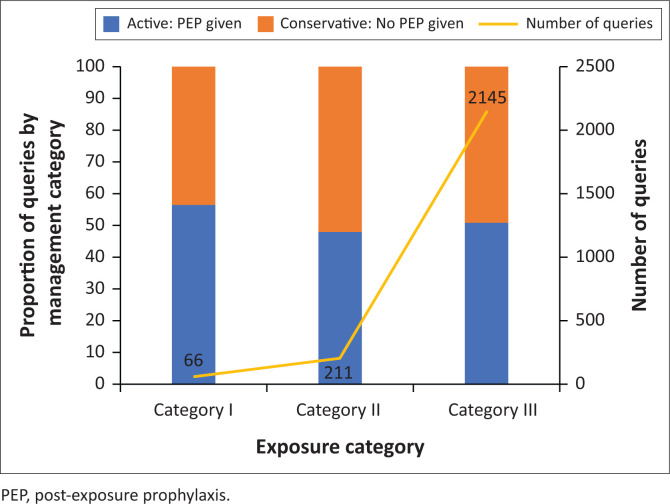
A total of 4655 queries were received by the NICD clinician hotline for the study period, of which 2461 pertained to rabies PEP (52.87%). The largest number of calls were placed by HCWs ( = 2313/2437; 94.9%). Queries originated mainly from Gauteng ( = 912/2443; 37.3%) and KwaZulu-Natal ( = 875/2443; 35.8%) provinces. A total of 50 different types of animals were related to exposures involving humans. Dogs (67.7%) and cats (11.8%) were the animals most frequently reported and exposure category III was most common (88.6%). Approximately equal numbers of callers were advised active management of administering rabies PEP and conservative management of withholding PEP. This did not seem to be affected by the exposure category related to the call.
This analysis shows the ongoing demand by HCWs for technical support regarding patient management following potential exposure to rabies. Gaps in HCWs rabies knowledge provide unique learning points on guiding training to achieve the goal of eliminating dog-mediated human rabies deaths by 2030.
南非国家传染病研究所(NICD)通过NICD临床医生热线为医护人员提供有关传染病方面的技术支持。热线咨询常常涉及狂犬病预防。对这些咨询进行分析可能有助于识别南非医护人员在人类狂犬病预防方面的知识差距。
进行了一项回顾性描述性综述,以分析NICD在2016年1月1日至2019年12月31日期间收到的狂犬病暴露后预防(PEP)咨询。
在研究期间,NICD临床医生热线共收到4655个咨询,其中2461个与狂犬病PEP有关(52.87%)。拨打热线电话最多的是医护人员(=2313/2437;94.9%)。咨询主要来自豪登省(=912/2443;37.3%)和夸祖鲁-纳塔尔省(=875/2443;35.8%)。共有50种不同类型的动物与涉及人类的暴露有关。狗(67.7%)和猫(11.8%)是最常报告的动物,暴露类别III最为常见(88.6%)。建议进行狂犬病PEP主动管理和不进行PEP保守管理的来电者数量大致相等。这似乎不受与来电相关的暴露类别的影响。
该分析表明,医护人员在潜在接触狂犬病后对患者管理的技术支持仍有持续需求。医护人员在狂犬病知识方面的差距为指导培训提供了独特的学习要点,以实现到2030年消除狗传播导致的人类狂犬病死亡这一目标。