Kuiper Jonas J W, Verhagen Fleurieke H, Hiddingh Sanne, Wennink Roos A W, Hansen Anna M, Casey Kerry A, Hoefer Imo E, Haitjema Saskia, Drylewicz Julia, Yakin Mehmet, Sen H Nida, Radstake Timothy R D J, de Boer Joke H
Department of Ophthalmology, University Medical Center Utrecht, University of Utrecht, Utrecht, The Netherlands.
Center for Translational Immunology, University Medical Center Utrecht, University of Utrecht, Utrecht, The Netherlands.
Ophthalmol Sci. 2022 May 31;2(3):100175. doi: 10.1016/j.xops.2022.100175. eCollection 2022 Sep.
Early identification of patients with noninfectious uveitis requiring steroid-sparing immunomodulatory therapy (IMT) is currently lacking in objective molecular biomarkers. We evaluated the proteomic signature of patients at the onset of disease and associated proteomic clusters with the need for IMT during the course of the disease.
Multicenter cohort study.
Two hundred thirty treatment-free patients with active noninfectious uveitis.
We used aptamer-based proteomics (n = 1305 proteins) and a bioinformatic pipeline as a molecular stratification tool to define the serum protein network of a Dutch discovery cohort (n = 78) of patients and healthy control participants and independently validated our results in another Dutch cohort (n = 111) and a United States cohort (n = 67). Multivariate Cox analysis was used to assess the relationship between the protein network and IMT use.
Serum protein levels and use of IMT.
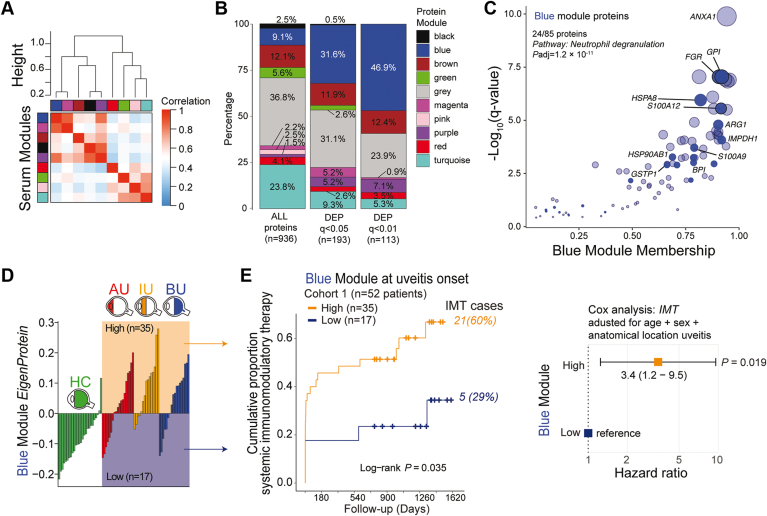
Network-based analyses revealed a tightly coexpressed serum cluster (n = 85 proteins) whose concentration was consistently low in healthy control participants (n = 26), but varied among patients with noninfectious uveitis (n = 52). Patients with high levels of the serum cluster at disease onset showed a significantly increased need for IMT during follow-up, independent of anatomic location of uveitis (hazard ratio, 3.42; 95% confidence interval, 1.22-9.5; = 0.019). The enrichment of neutrophil-associated proteins in the protein cluster led to our finding that the neutrophil count could serve as a clinical proxy for this proteomic signature (correlation: = 0.57, = 0.006). In an independent Dutch cohort (n = 111), we confirmed that patients with relatively high neutrophil count at diagnosis (> 5.2 × 10/L) had a significantly increased chance of requiring IMT during follow-up (hazard ratio, 3.2; 95% confidence interval, 1.5-6.8; = 0.002). We validated these findings in a third cohort of 67 United States patients.
A serum protein signature correlating with neutrophil levels was highly predictive for IMT use in noninfectious uveitis. We developed a routinely available tool that may serve as a novel objective biomarker to aid in clinical decision-making for noninfectious uveitis.
目前缺乏用于早期识别需要使用免疫抑制调节疗法(IMT)以减少类固醇用量的非感染性葡萄膜炎患者的客观分子生物标志物。我们评估了疾病发作时患者的蛋白质组学特征,并将蛋白质组学聚类与疾病过程中对IMT的需求相关联。
多中心队列研究。
230例未接受治疗的活动性非感染性葡萄膜炎患者。
我们使用基于适体的蛋白质组学(检测1305种蛋白质)和生物信息学流程作为分子分层工具,来定义荷兰一个由患者和健康对照参与者组成的发现队列(n = 78)的血清蛋白网络,并在另一个荷兰队列(n = 111)和一个美国队列(n = 67)中独立验证我们的结果。使用多变量Cox分析来评估蛋白质网络与IMT使用之间的关系。
血清蛋白水平和IMT的使用情况。
基于网络的分析揭示了一个紧密共表达的血清聚类(85种蛋白质),其浓度在健康对照参与者(n = 26)中始终较低,但在非感染性葡萄膜炎患者(n = 52)中有所不同。疾病发作时血清聚类水平高的患者在随访期间对IMT的需求显著增加,这与葡萄膜炎的解剖位置无关(风险比,3.42;95%置信区间,1.22 - 9.5;P = 0.019)。蛋白质聚类中与中性粒细胞相关的蛋白质富集,使我们发现中性粒细胞计数可作为这种蛋白质组学特征的临床替代指标(相关性:r = 0.57,P = 0.006)。在一个独立的荷兰队列(n = 111)中,我们证实诊断时中性粒细胞计数相对较高(> 5.2×10⁹/L)的患者在随访期间需要IMT的可能性显著增加(风险比,3.2;95%置信区间,1.5 - 6.8;P = 0.002)。我们在美国的67例患者的第三个队列中验证了这些发现。
与中性粒细胞水平相关的血清蛋白特征对非感染性葡萄膜炎中IMT的使用具有高度预测性。我们开发了一种常规可用的工具,可作为一种新型客观生物标志物,以辅助非感染性葡萄膜炎的临床决策。