Romdhani Mohamed, Souissi Nizar, Dergaa Ismail, Moussa-Chamari Imen, Chaabouni Yassine, Mahdouani Kacem, Abene Olfa, Driss Tarak, Chamari Karim, Hammouda Omar
High Institute of Sport and Physical Education of Sfax, Sfax University, Sfax, Tunisia.
Physical activity, Sport and health, UR18JS01, National Observatory of Sports, Tunis, Tunisia.
Biol Sport. 2022 Oct;39(4):1033-1042. doi: 10.5114/biolsport.2023.112088. Epub 2021 Dec 31.
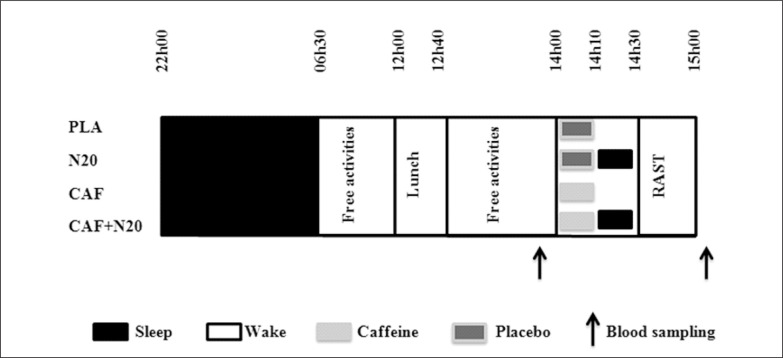
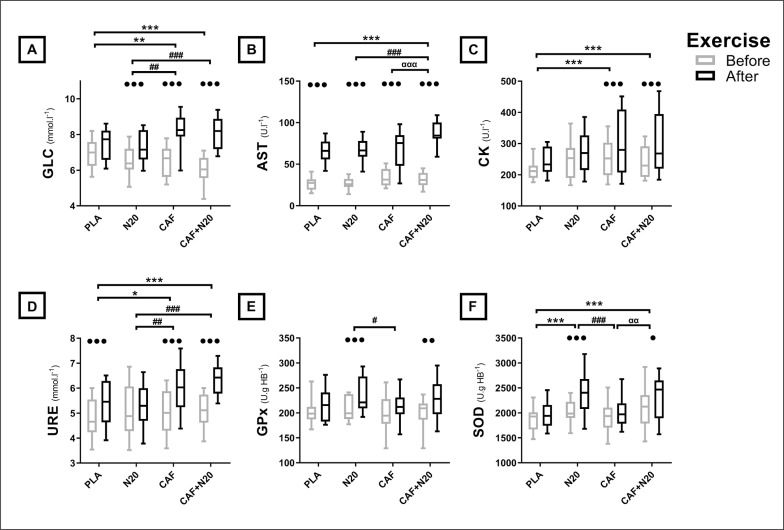
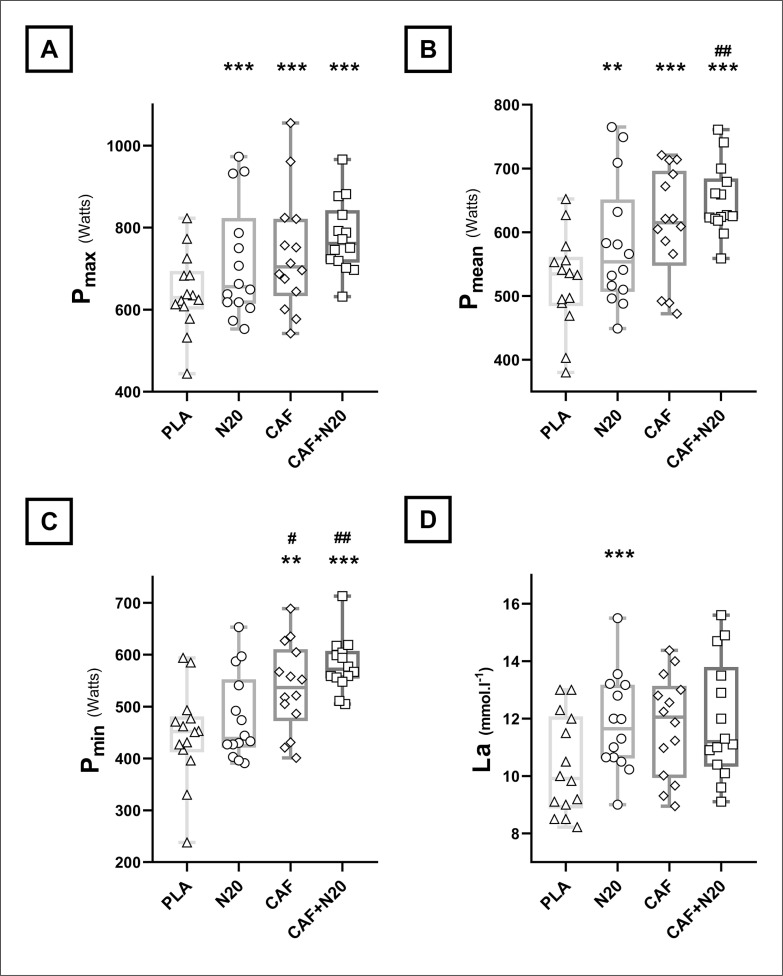
To investigate the effect of 20 min nap opportunity (N20), 5 mg · kg of caffeine (CAF) and their combination (CAF+N20) on the biochemical response (energetic biomarkers, biomarkers of muscle damage and enzymatic antioxidants) to the running-based anaerobic sprint test. Fourteen highly trained male athletes completed in a double-blind, counterbalanced and randomized order four test sessions: no nap with placebo (PLA), N20, CAF and CAF+N20. Compared to PLA, all treatments enhanced maximum and mean powers. Minimum power was higher [(mean difference) 58.6 (95% confidence interval = 1.31-116) Watts] after CAF and [102 (29.9-175) Watts] after CAF+N20 compared to N20. Also, plasma glucose was higher after CAF [0.81 (0.18-1.45) mmol · l] and CAF+N20 [1.03 (0.39-1.64) mmol · l] compared to N20. However, plasma lactate was higher [1.64 (0.23-3.03) mmol · l] only after N20 compared to pre-exercise, suggesting a higher anaerobic glycolysis during N20 compared to PLA, CAF and CAF+N20. Caffeine ingestion increased post-exercise creatine kinase with [54.3 (16.7-91.1) IU · l] or without napping [58.9 (21.3-96.5) IU · l] compared to PLA. However, superoxide dismutase was higher after napping with [339 (123-554) U · gHB] or without caffeine [410 (195-625) U · gHB] compared to PLA. Probably because of the higher aerobic glycolysis contribution in energy synthesis, caffeine ingestion resulted in better repeated sprint performance during CAF and CAF+N20 sessions compared to N20 and PLA. Caffeine ingestion resulted in higher muscle damage, and the short nap enhanced antioxidant defence with or without caffeine ingestion.
为研究20分钟午睡机会(N20)、5毫克·千克咖啡因(CAF)及其组合(CAF+N20)对基于跑步的无氧冲刺测试的生化反应(能量生物标志物、肌肉损伤生物标志物和酶促抗氧化剂)的影响。14名训练有素的男性运动员以双盲、平衡和随机顺序完成了四个测试阶段:服用安慰剂(PLA)不午睡、N20、CAF和CAF+N20。与PLA相比,所有处理均提高了最大功率和平均功率。与N20相比,CAF后最小功率更高[(平均差值)58.6(95%置信区间=1.31-116)瓦特],CAF+N20后[102(29.9-175)瓦特]。此外,与N20相比,CAF[0.81(0.18-1.45)毫摩尔·升]和CAF+N20[1.03(0.39-1.64)毫摩尔·升]后血浆葡萄糖更高。然而,与运动前相比,仅N20后血浆乳酸更高[1.64(0.23-3.03)毫摩尔·升],表明与PLA、CAF和CAF+N20相比,N20期间无氧糖酵解更高。与PLA相比,摄入咖啡因后运动后肌酸激酶升高,无论是否午睡[54.3(16.7-