Guo Zheng, Zhu Huabin, Zhang Xiufang, Huang Li, Wang Xiangcai, Shi Huaqiu, Yu Li, Qiu Yingwei, Tu Fuping
Department of Hematology and Oncology, International Cancer Center, Shenzhen Key Laboratory, Hematology Institution of Shenzhen University, Shenzhen University General Hospital, Shenzhen University Health Science Center, Shenzhen University, Shenzhen, China.
First school of clinical medicine, Gannan Medical University, Ganzhou, China.
Front Oncol. 2022 Sep 29;12:941068. doi: 10.3389/fonc.2022.941068. eCollection 2022.
We sought to evaluate the efficacy and safety of conventional transcatheter arterial chemoembolization (cTACE) sequentially combined with systemic treatment by programmed cell death protein 1 (PD-1) inhibitor and anti-angiogenesis tyrosine kinase inhibitor (Anti-angiogenesis TKI) in patients with unresectable hepatocellular carcinoma (HCC).
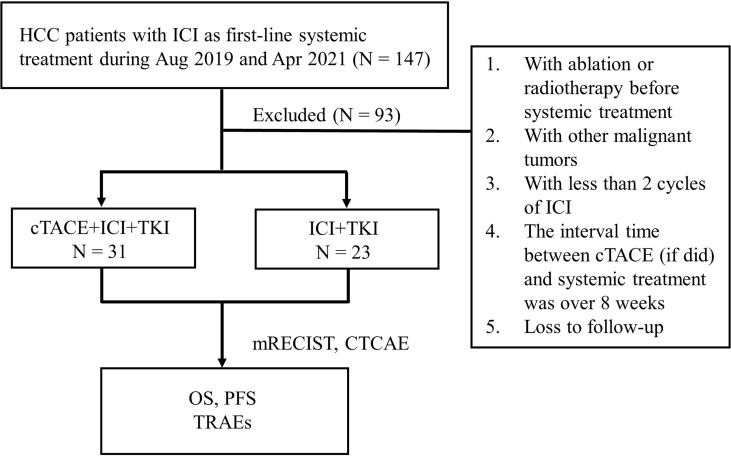
One hundred and forty-seven advanced HCC patients who received PD-1 inhibitors and TKIs as first-line systemic treatment between August 2019 and April 2021 were collected retrospectively. Fifty-four patients were finally included and divided into cTACE and no-cTACE groups, according to whether cTACE treatment was performed within 8 weeks before systemic treatment. The tumor objective response ratio (ORR), progression-free survival (PFS), overall survival (OS), and adverse events (AEs) were compared between the groups. Significant factors affecting PFS and OS were determined by Cox regression.
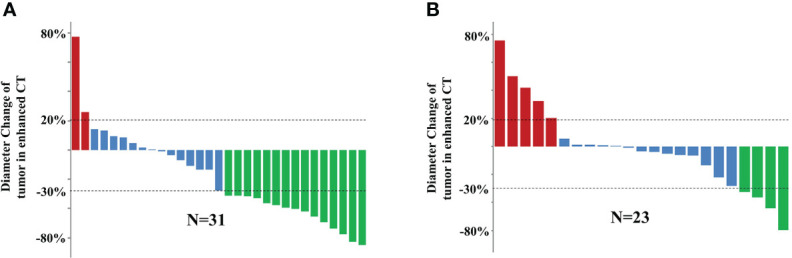
Thirty-one patients received cTACE followed by systemic treatment and 23 patients received systemic treatment only. The ORRs of the cTACE group were 48.4% (after two cycles of systemic treatment) and 51.6% (after four cycles of systemic treatment), while those of the no-cTACE group were only 17.4% and 21.7%. cTACE patients also had a longer median PFS (11.70 vs. 4.00 months, = 0.031) and median OS (19.80 vs. 11.6 months, = 0.006) than no-cTACE patients. Regression analyses indicated that cTACE therapy and Eastern Cooperative Oncology Group performance status were independent risk factors for PFS and OS. AEs by type were similar between the cTACE and no-cTACE groups, except for liver function injury, which was more common among cTACE patients. Fourteen patients suffered with grade 1-2 of rash in 21 patients with objective response, while only 10 patients suffered with rash in 33 patients without objective response, the adjusted hazard ratio (HR) was 4.382 (1.297-14.803).
The combination of cTACE and PD-1 inhibitors and anti-angiogenesis TKIs as therapy significantly improved markers of treatment efficacy, including ORR, PFS, and OS, in unresectable HCC patients, while no more serious AEs recorded in this population compared to those receiving systemic treatment alone. Skin rash might be a predict factor to the efficacy of PD-1 inhibitors and TKI treatment.
我们旨在评估传统经动脉化疗栓塞术(cTACE)序贯联合程序性死亡蛋白1(PD-1)抑制剂和抗血管生成酪氨酸激酶抑制剂(抗血管生成TKI)进行全身治疗在不可切除肝细胞癌(HCC)患者中的疗效和安全性。
回顾性收集2019年8月至2021年4月期间接受PD-1抑制剂和TKIs作为一线全身治疗的147例晚期HCC患者。最终纳入54例患者,根据在全身治疗前8周内是否进行cTACE治疗分为cTACE组和非cTACE组。比较两组的肿瘤客观缓解率(ORR)、无进展生存期(PFS)、总生存期(OS)和不良事件(AE)。通过Cox回归确定影响PFS和OS的显著因素。
31例患者接受cTACE后进行全身治疗,23例患者仅接受全身治疗。cTACE组在两个周期全身治疗后的ORR为48.4%,四个周期全身治疗后的ORR为51.6%,而非cTACE组仅为17.4%和21.7%。cTACE组患者的中位PFS(11.70个月对4.00个月,P = 0.031)和中位OS(19.80个月对11.6个月,P = 0.006)也比非cTACE组患者长。回归分析表明,cTACE治疗和东部肿瘤协作组体能状态是PFS和OS的独立危险因素。除肝功能损伤在cTACE组患者中更常见外,cTACE组和非cTACE组按类型划分的AE相似。21例有客观缓解的患者中有14例出现1 - 2级皮疹,而33例无客观缓解的患者中只有10例出现皮疹,调整后的风险比(HR)为4.382(1.297 - 14.803)。
cTACE与PD-1抑制剂和抗血管生成TKIs联合治疗显著改善了不可切除HCC患者的治疗疗效指标,包括ORR、PFS和OS,且与单独接受全身治疗的患者相比,该人群中未记录到更严重的AE。皮疹可能是PD-1抑制剂和TKI治疗疗效的预测因素。