Carlsen Tim, David Robert O
Department of Geosciences University of Oslo Oslo Norway.
Geophys Res Lett. 2022 Jul 28;49(14):e2022GL098041. doi: 10.1029/2022GL098041. Epub 2022 Jul 14.
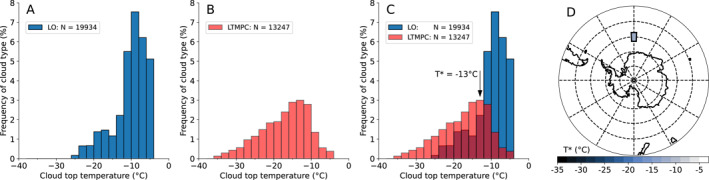
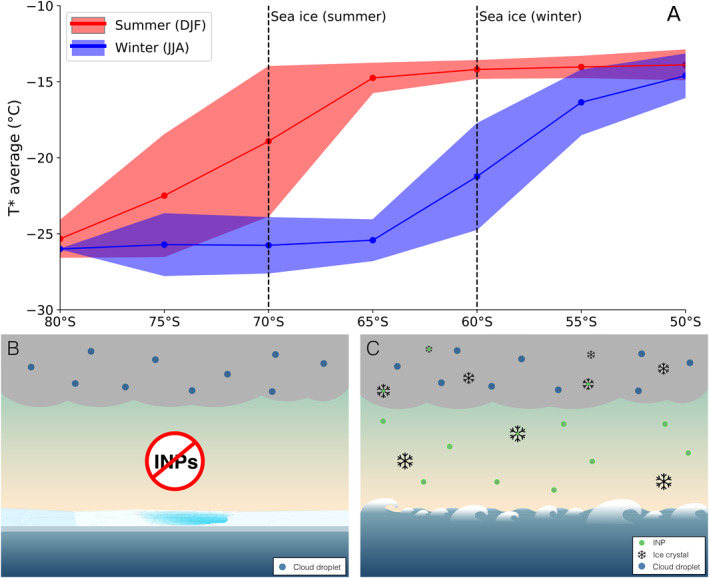
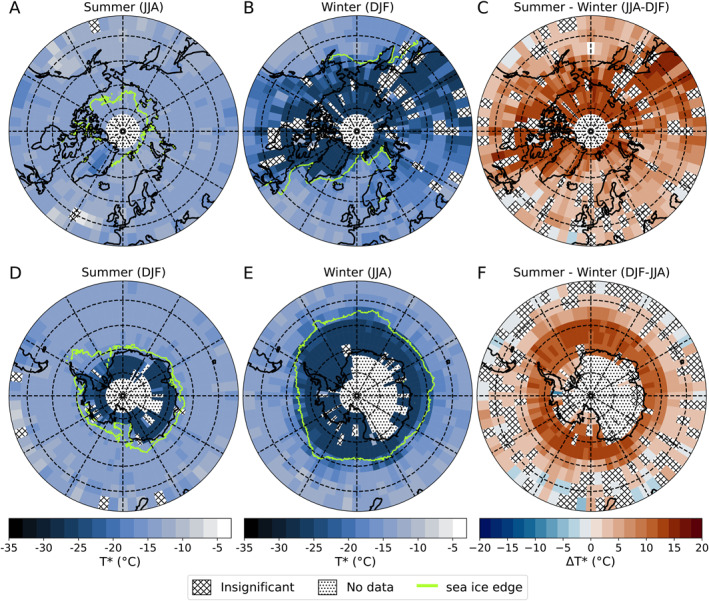
Mixed-phase clouds (MPCs), which consist of both supercooled cloud droplets and ice crystals, play an important role in the Earth's radiative energy budget and hydrological cycle. In particular, the fraction of ice crystals in MPCs determines their radiative effects, precipitation formation and lifetime. In order for ice crystals to form in MPCs, ice-nucleating particles (INPs) are required. However, a large-scale relationship between INPs and ice initiation in clouds has yet to be observed. By analyzing satellite observations of the typical transition temperature (T*) where MPCs become more frequent than liquid clouds, we constrain the importance of INPs in MPC formation. We find that over the Arctic and Southern Ocean, snow and sea ice cover significantly reduces T*. This indicates that the availability of INPs is essential in controlling cloud phase evolution and that local sources of INPs in the high-latitudes play a key role in the formation of MPCs.
混合相云(MPCs)由过冷云滴和冰晶组成,在地球辐射能量收支和水文循环中起着重要作用。特别是,混合相云中冰晶的比例决定了它们的辐射效应、降水形成和寿命。为了使混合相云中形成冰晶,需要冰核粒子(INPs)。然而,尚未观测到冰核粒子与云中冰形成之间的大规模关系。通过分析卫星对典型转变温度(T*)的观测,即混合相云比液态云更频繁出现的温度,我们确定了冰核粒子在混合相云形成中的重要性。我们发现,在北极和南大洋,积雪和海冰覆盖显著降低了T*。这表明冰核粒子的可用性对于控制云相演变至关重要,并且高纬度地区冰核粒子的本地来源在混合相云的形成中起着关键作用。