Keenan Tiarnan D L, Goldstein Michaella, Goldenberg Dafna, Zur Dinah, Shulman Shiri, Loewenstein Anat
Division of Epidemiology and Clinical Applications, National Eye Institute, National Institutes of Health, Bethesda, Maryland.
Division of Ophthalmology, Tel Aviv Sourasky Medical Center, Tel Aviv, Israel.
Ophthalmol Sci. 2021 Jun 26;1(2):100034. doi: 10.1016/j.xops.2021.100034. eCollection 2021 Jun.
To evaluate longitudinally the performance of the Notal Vision Home OCT (NVHO), comprising a spectral-domain OCT device for patient self-imaging at home, telemedicine infrastructure for automated data upload, and deep learning algorithm for automated OCT evaluation. The aims were to study the system's performance in daily image acquisition and automated analysis and to characterize the dynamics of retinal fluid exudation in neovascular age-related macular degeneration (nAMD).
Pilot prospective, observational longitudinal study.
Four individuals (mean age, 73.8 years) with nAMD (one or both eyes) undergoing anti-vascular endothelial growth factor therapy in routine clinical practice.
The participants performed daily self-imaging at home with the NVHO for 1 month. The macular cube scans were uploaded automatically to the Notal Health Cloud. They underwent evaluation separately by the Notal OCT Analyzer (NOA) and human expert graders for fluid presence, segmentation, and volume.
Daily self-imaging completion, image quality, acquisition time, agreement between automated and human grading of retinal fluid, and temporal dynamics of fluid volume.
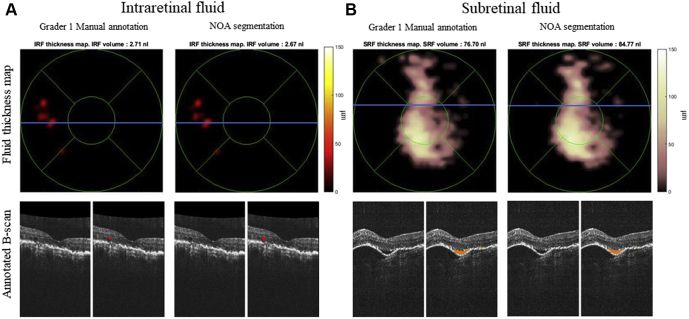
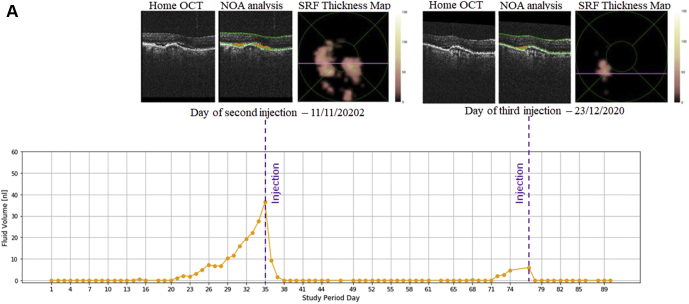
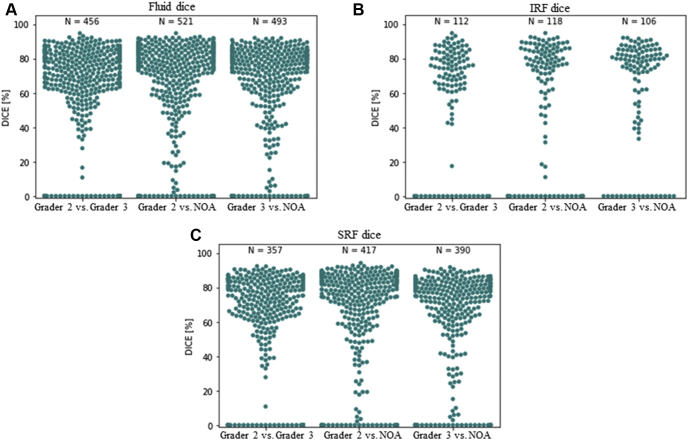
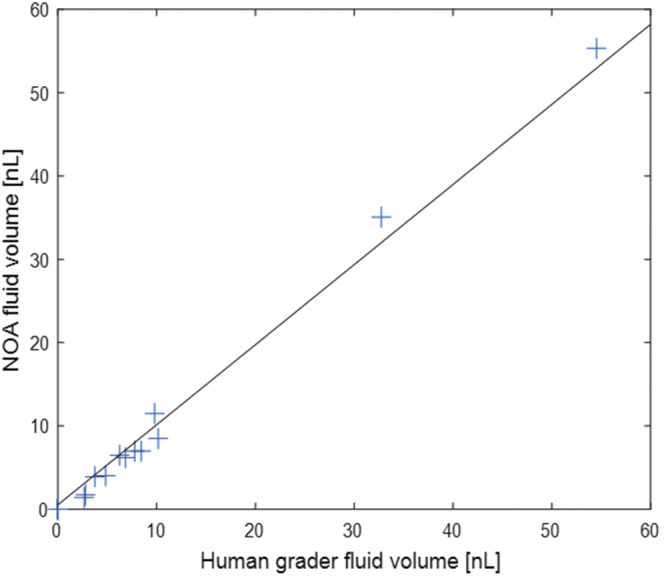
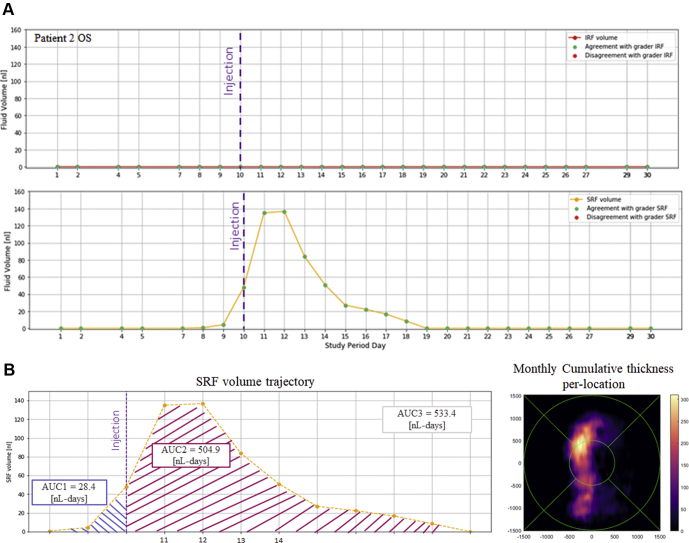
Of 240 self-imaging attempts initiated, the number successfully completed was 211 (87.9%). Of these, 97.6% had satisfactory quality. For fluid presence, the NOA agreed with human grading in 94.7% of cases. From a subset of 24 scans with fluid, for agreement between NOA and human fluid volume measurements, the correlation coefficient was 0.996 and mean absolute difference was 1.5 nl (vs. 0.995 and 1.2 nl, respectively, for interhuman agreement). Graphic plots of fluid volume revealed wide variation in the dynamics of fluid exudation and treatment response.
The participants could perform daily self-imaging at home and generate macular cube scans of satisfactory quality. Automated quantitative OCT analysis achieved high agreement with human grading. Daily self-imaging with automated OCT analysis permitted detailed characterization of the dynamics of fluid exudation and revealed wide variation between eyes. Metrics describing these dynamics may become important disease biomarkers. Home OCT telemedicine systems represent an alternative paradigm of disease monitoring; they may allow highly personalized retreatment decisions, with fewer unnecessary injections and clinic visits.
纵向评估Notal Vision家用光学相干断层扫描(NVHO)的性能,该系统包括用于患者在家中自行成像的光谱域光学相干断层扫描设备、用于自动上传数据的远程医疗基础设施以及用于自动光学相干断层扫描评估的深度学习算法。目的是研究该系统在日常图像采集和自动分析中的性能,并描述新生血管性年龄相关性黄斑变性(nAMD)中视网膜液渗出的动态变化。
前瞻性观察性纵向试点研究。
4例nAMD患者(年龄范围为73.8岁)(单眼或双眼),在常规临床实践中接受抗血管内皮生长因子治疗。
参与者在家中使用NVHO进行为期1个月的每日自行成像。黄斑区容积扫描自动上传至Notal Health Cloud。由Notal OCT分析仪(NOA)和人类专家分级员分别对图像进行液体存在情况、分割和容积的评估。
每日自行成像完成情况、图像质量、采集时间、视网膜液体自动分级与人工分级的一致性以及液体容积的时间动态变化。
在发起的240次自行成像尝试中,成功完成的有211次(87.9%)。其中,97.6%的图像质量令人满意。对于液体存在情况,NOA与人工分级在94.7%的病例中一致。在24次有液体的扫描子集中,NOA与人工液体容积测量的一致性方面,相关系数为0.996,平均绝对差为1.5 nl(人与人之间的一致性分别为0.995和1.2 nl)。液体容积的图表显示液体渗出和治疗反应的动态变化差异很大。
参与者能够在家中进行每日自行成像,并生成质量令人满意的黄斑区容积扫描。光学相干断层扫描自动定量分析与人工分级高度一致。每日自行成像及光学相干断层扫描自动分析能够详细描述液体渗出的动态变化,并显示出个体间的巨大差异。描述这些动态变化的指标可能成为重要的疾病生物标志物。家用光学相干断层扫描远程医疗系统代表了一种疾病监测的替代模式;它们可能允许做出高度个性化的再治疗决策,减少不必要的注射和门诊就诊次数。