Mansouri Hamid R, Gracia Carmona Oriol, Jodlbauer Julia, Schweiger Lorenz, Fink Michael J, Breslmayr Erik, Laurent Christophe, Feroz Saima, P Goncalves Leticia C, Rial Daniela V, Mihovilovic Marko D, Bommarius Andreas S, Ludwig Roland, Oostenbrink Chris, Rudroff Florian
Institute of Applied Synthetic Chemistry, TU Wien, Getreidemarkt 9, 1060 Vienna, Austria.
Institute of Molecular Modeling and Simulation, University of Natural Resources and Life Sciences, 1190 Vienna, Austria.
ACS Catal. 2022 Oct 7;12(19):11761-11766. doi: 10.1021/acscatal.2c03225. Epub 2022 Sep 13.
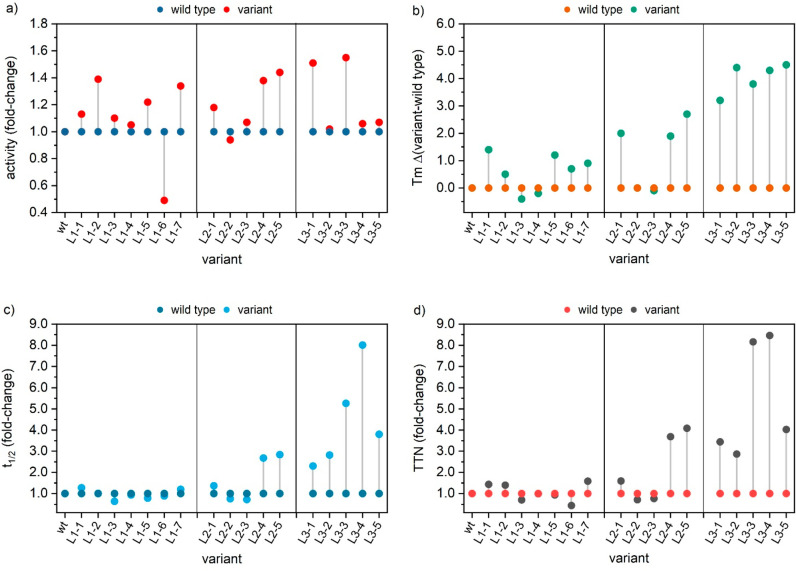
The typically low thermodynamic and kinetic stability of enzymes is a bottleneck for their application in industrial synthesis. Baeyer-Villiger monooxygenases, which oxidize ketones to lactones using aerial oxygen, among other activities, suffer particularly from these instabilities. Previous efforts in protein engineering have increased thermodynamic stability but at the price of decreased activity. Here, we solved this trade-off by introducing mutations in a cyclohexanone monooxygenase from sp., guided by a combination of rational and structure-guided consensus approaches. We developed variants with improved activity (1.5- to 2.5-fold) and increased thermodynamic (+5 °C ) and kinetic stability (8-fold). Our analysis revealed a crucial position in the cofactor binding domain, responsible for an 11-fold increase in affinity to the flavin cofactor, and explained using MD simulations. This gain in affinity was compatible with other mutations. While our study focused on a particular model enzyme, previous studies indicate that these findings are plausibly applicable to other BVMOs, and possibly to other flavin-dependent monooxygenases. These new design principles can inform the development of industrially robust, flavin-dependent biocatalysts for various oxidations.
酶通常较低的热力学和动力学稳定性是其在工业合成应用中的一个瓶颈。拜耳-维利格单加氧酶利用空气中的氧气将酮氧化为内酯,以及其他活性,尤其受到这些不稳定性的影响。以往蛋白质工程的努力提高了热力学稳定性,但以活性降低为代价。在这里,我们通过在来自sp.的环己酮单加氧酶中引入突变,结合理性和结构导向的共识方法,解决了这种权衡。我们开发了活性提高(1.5至2.5倍)、热力学稳定性提高(+5°C)和动力学稳定性提高(8倍)的变体。我们的分析揭示了辅因子结合域中的一个关键位置,该位置导致对黄素辅因子的亲和力增加了11倍,并通过分子动力学模拟进行了解释。这种亲和力的增加与其他突变兼容。虽然我们的研究集中在一种特定的模型酶上,但先前的研究表明,这些发现可能适用于其他拜耳-维利格单加氧酶,甚至可能适用于其他黄素依赖性单加氧酶。这些新的设计原则可为开发用于各种氧化反应的工业上稳健的、黄素依赖性生物催化剂提供指导。