Seidita Aurelio, Mansueto Pasquale, Giuliano Alessandra, Chiavetta Marta, Mandreucci Francesca, Soresi Maurizio, Pistone Mattia, Compagnoni Stella, Castellucci Daniele, Bisso Gianluca, Faraci Francesco, Maestri Salvatore, Disclafani Rosaria, Sapone Anna, Fasano Alessio, Carroccio Antonio
Unit of Internal Medicine, Department of Health Promotion Sciences, Maternal and Infant Care, Internal Medicine and Medical Specialties (PROMISE), University of Palermo, Palermo, Italy.
Unit of Internal Medicine, "V. Cervello" Hospital, Ospedali Riuniti "Villa Sofia-Cervello", Palermo, Italy.
Front Med (Lausanne). 2022 Sep 28;9:995019. doi: 10.3389/fmed.2022.995019. eCollection 2022.
A wheat-free diet (WFD) represents the elective treatment for Non-celiac Wheat Sensitivity (NCWS) patients. Preliminary reports have shown a possible better tolerability of ancient grains in these subjects. The aim of this observational study was to evaluate the frequency of consumption of ancient grains and its correlation with clinical manifestations in NCWS patients.
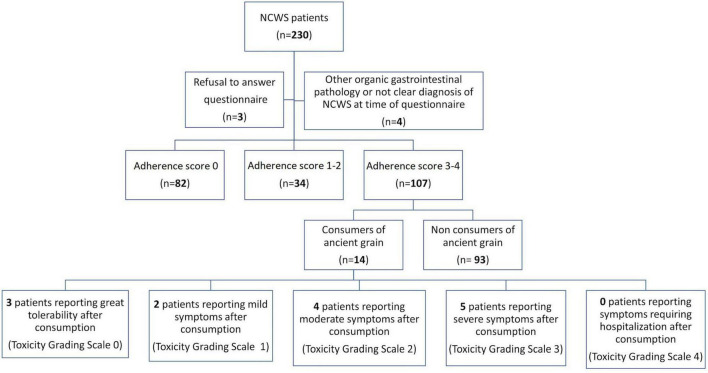
223 NCWS patients were recruited, and their consumption of ancient grains was monitored. Participants were first administered a modified version of the Pavia/Biagi questionnaire to investigate their adherence to "modern WFD." The appearance/exacerbation of symptoms after ingestion of ancient grains was then assessed with WHO toxicity grading scale.
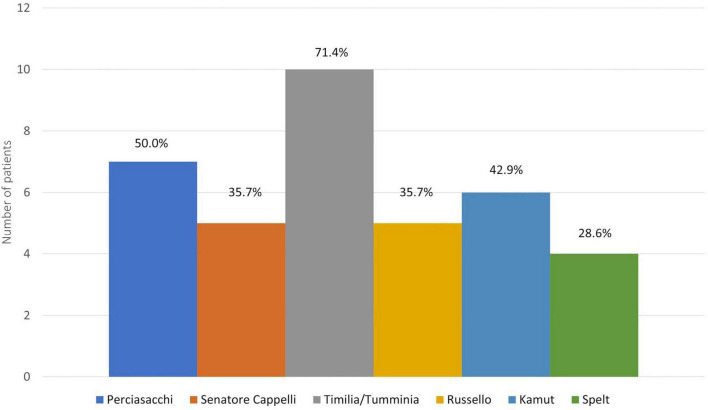
50.2% of the recruited patients reported consuming ancient grains before NCWS diagnosis; the diagnostic delay in this group was significantly higher than in non-consumers [median (range) 72 (6-612) vs. 60 months (3-684), = 0.03] and these patients reported lower frequency of constipation ( = 0.04). Of the 107 patients with optimal adherence to modern WFD, 14 reported eating ancient wheat after NCWS diagnosis. Among them, 5 reported milder symptoms than those caused by modern wheat intake and 3 had an excellent tolerability without symptoms. Timilia/Tumminia variety was the most frequently used ancient grain.
NCWS patients who consume ancient grains may receive a late diagnosis due to the possible clinical benefit (tolerability) obtained with these grains. Even after diagnosis, 10% of the patients still consumed ancient grains and had mild or no symptoms. Further studies are required to define the pathophysiological mechanism behind their putative greater tolerability.
无麸质饮食(WFD)是治疗非乳糜泻性麸质敏感(NCWS)患者的首选疗法。初步报告显示,这些患者对古代谷物可能具有更好的耐受性。本观察性研究的目的是评估NCWS患者食用古代谷物的频率及其与临床表现的相关性。
招募了223名NCWS患者,并监测他们对古代谷物的食用情况。首先让参与者填写一份经过修改的帕维亚/比亚吉问卷,以调查他们对“现代WFD”的依从性。然后使用世界卫生组织毒性分级量表评估摄入古代谷物后症状的出现/加重情况。
50.2%的入选患者报告在NCWS诊断之前食用过古代谷物;该组的诊断延迟明显高于未食用者[中位数(范围)72(6 - 612)个月 vs. 60个月(3 - 684),P = 0.03],且这些患者报告的便秘频率较低(P = 0.04)。在107名对现代WFD依从性最佳的患者中,有14名报告在NCWS诊断后食用过古代小麦。其中,5名报告症状比食用现代小麦时更轻,3名具有极佳的耐受性且无症状。蒂米利亚/图米尼亚品种是最常食用的古代谷物。
食用古代谷物的NCWS患者可能由于这些谷物带来的潜在临床益处(耐受性)而导致诊断延迟。即使在诊断之后,仍有10%的患者食用古代谷物且症状轻微或无症状。需要进一步研究来确定其假定的更高耐受性背后的病理生理机制。