Fu Clarissa Elysia, Ng Cheng Han, Chew Nicholas W S, Heng Zane En Qi, Chin Yip Han, Quek Jingxuan, Lim Wen Hui, Xiao Jieling, Chan Kai En, Tan Darren Jun Hao, Tan Caitlyn, Zhang Sitong, Koh Teng Kiat, Nah Benjamin, Dan Yock Young, Syn Nicholas, Siddiqui Mohammad Shadab, Sanyal Arun J, Noureddin Mazen, Muthiah Mark
Yong Loo Lin School of Medicine, National University of Singapore, Singapore, Singapore.
Department of Cardiology, National University Heart Centre, National University Hospital, Singapore, Singapore.
Front Med (Lausanne). 2022 Sep 28;9:977552. doi: 10.3389/fmed.2022.977552. eCollection 2022.
Non-alcoholic fatty liver disease (NAFLD) is prevalent amongst overweight and obese individuals, and weight loss remains the main mode of treatment for NAFLD patients. Weight perception plays a key role in the efficacy of such treatment. The current study aims to investigate the prevalence, associating factors and implications of poor weight perception amongst such individuals.
An analysis was done on data collected from NHANES between 1999 and 2018. Comparison was made between NAFLD individuals with and without poor weight perception in terms of prevalence, associated characteristics, and clinical outcomes. Multivariate analysis was used to compare effect size of adverse events associated with NAFLD individuals with poor weight perception.
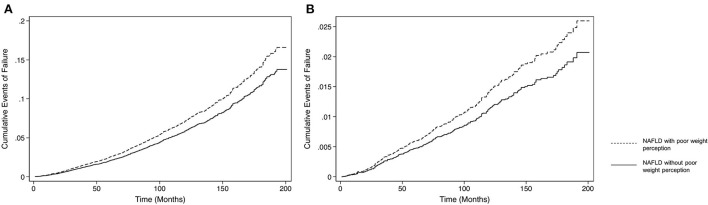
Of the 12,170 NAFLD patients, 19.2% (CI: 18.5 to 19.9%) had poor weight perception. Poor weight perception was significantly associated with lower education levels, reduced levels of exercise and unhealthier lipid profiles. There was an increased risk in all-cause mortality (HR: 1.18, CI: 1.00 to 1.38, = 0.047), cardiovascular disease mortality (SHR: 1.33, CI: 1.03 to 1.71, = 0.026), major adverse cardiovascular events (OR: 1.21 CI: 1.10 to 1.32, < 0.001), and advanced fibrosis (OR: 1.30, CI: 1.03 to 1.64, = 0.025) for individuals with poor weight perception.
This study highlights the positive association between appropriate weight perception and better outcomes in individuals with NAFLD. Poor weight perception increased the risk of adverse events and decreased inclination toward seeking weight loss treatment. Greater emphasis should be placed on dealing with weight perception in individuals with NAFLD for better treatment outcomes.
非酒精性脂肪性肝病(NAFLD)在超重和肥胖个体中普遍存在,体重减轻仍然是非酒精性脂肪性肝病患者的主要治疗方式。体重认知在这种治疗的疗效中起着关键作用。本研究旨在调查此类个体中体重认知不良的患病率、相关因素及其影响。
对1999年至2018年美国国家健康和营养检查调查(NHANES)收集的数据进行分析。比较了体重认知良好和不良的非酒精性脂肪性肝病个体在患病率、相关特征和临床结局方面的差异。采用多变量分析比较体重认知不良的非酒精性脂肪性肝病个体不良事件的效应大小。
在12170例非酒精性脂肪性肝病患者中,19.2%(95%置信区间:18.5%至19.9%)体重认知不良。体重认知不良与较低的教育水平、运动量减少和更不健康的血脂谱显著相关。体重认知不良的个体全因死亡率(风险比:1.18,95%置信区间:1.00至1.38,P = 0.047)、心血管疾病死亡率(标准化风险比:1.33,95%置信区间:1.03至1.71,P = 0.026)、主要不良心血管事件(比值比:1.21,95%置信区间:1.10至1.32,P < 0.001)和晚期肝纤维化(比值比:1.30,95%置信区间:1.03至1.64,P = 0.025)风险增加。
本研究强调了非酒精性脂肪性肝病个体中适当的体重认知与更好结局之间的正相关关系。体重认知不良增加了不良事件的风险,并降低了寻求减肥治疗的意愿。为了获得更好的治疗效果,应更加重视非酒精性脂肪性肝病个体的体重认知问题。