State Key Laboratory of Drug Research, Shanghai Institute of Materia Medica, Chinese Academy of Sciences, Shanghai, China.
University of Chinese Academy of Sciences, Beijing, China.
J Immunother Cancer. 2022 Oct;10(10). doi: 10.1136/jitc-2022-004590.
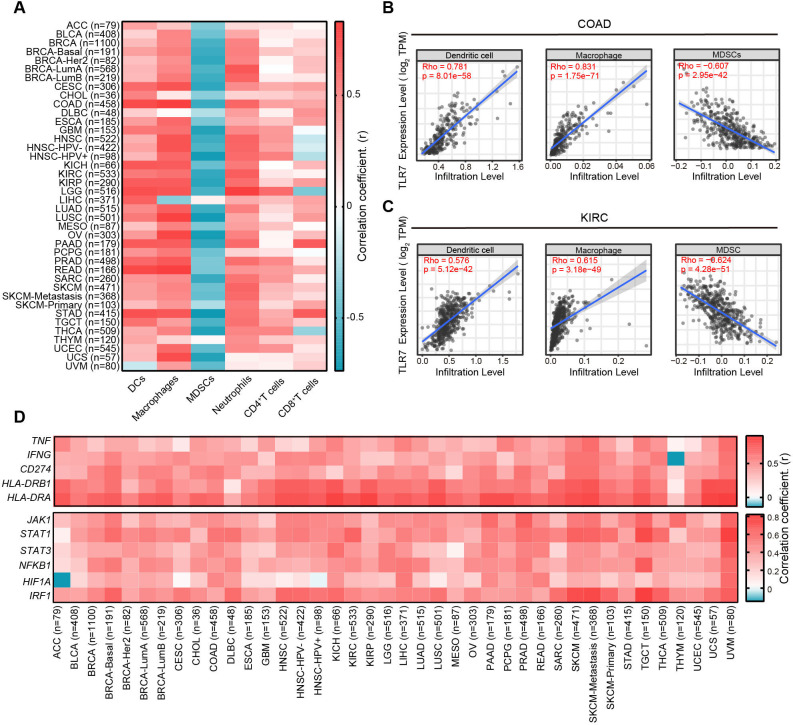
Various tumors are insensitive to immune checkpoint blockade (ICB) therapy. Toll-like receptors (TLRs) establish the link between innate and adaptive immunity, which can assist T-cell activation and serve as promising targets for combination to enhance ICB therapy. Here, we aimed to improve efficacy for anti-programmed death ligand 1 (PD-L1) therapy by developing a PD-L1/TLR7 dual-targeting nanobody-drug conjugate (NDC), based on the PD-L1 nanobodies and TLR7 agonist we developed.
PD-L1 nanobodies were obtained by phage display screening and identified through T-cell activation bioassay, in vivo imaging and quantitative biodistribution study. Immune activation and PD-L1-inducing of TLR7 agonists were evaluated in diverse innate cell models. We constructed PD-L1/TLR7 dual-targeting NDCs by chemically coupling PD-L1 nanobodies and TLR7 agonists. The antitumor effect was evaluated via several murine or humanized solid tumor models. Immunophenotyping, immune cell depletion, tumor rechallenge, RNA sequencing and PD-L1-deficient models were combined to determine the mechanism for NDCs function. The dynamics of the in vivo behaviors of NDCs were assessed based on multiorgan changes in PD-L1 levels.
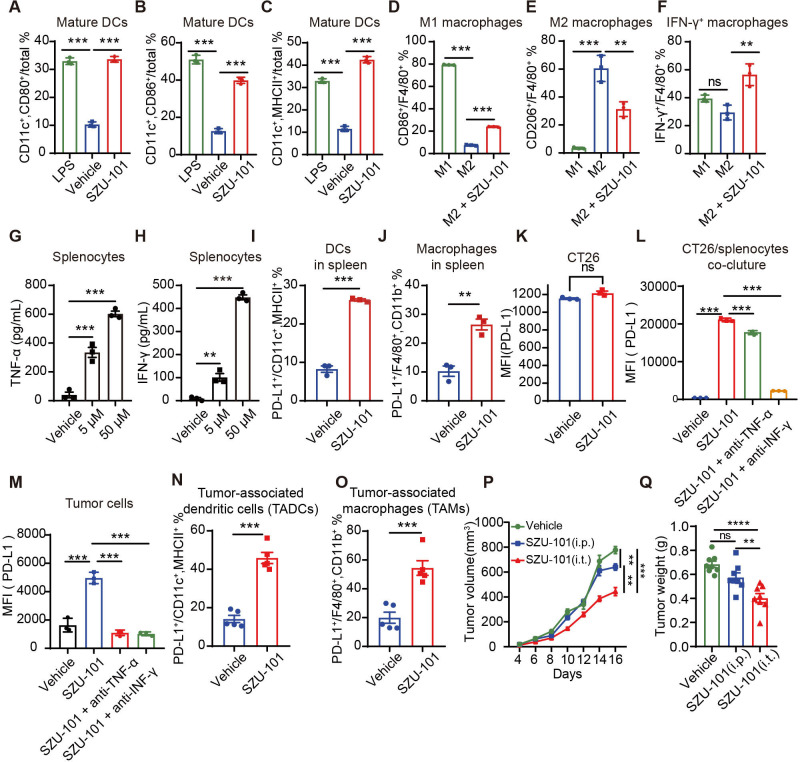
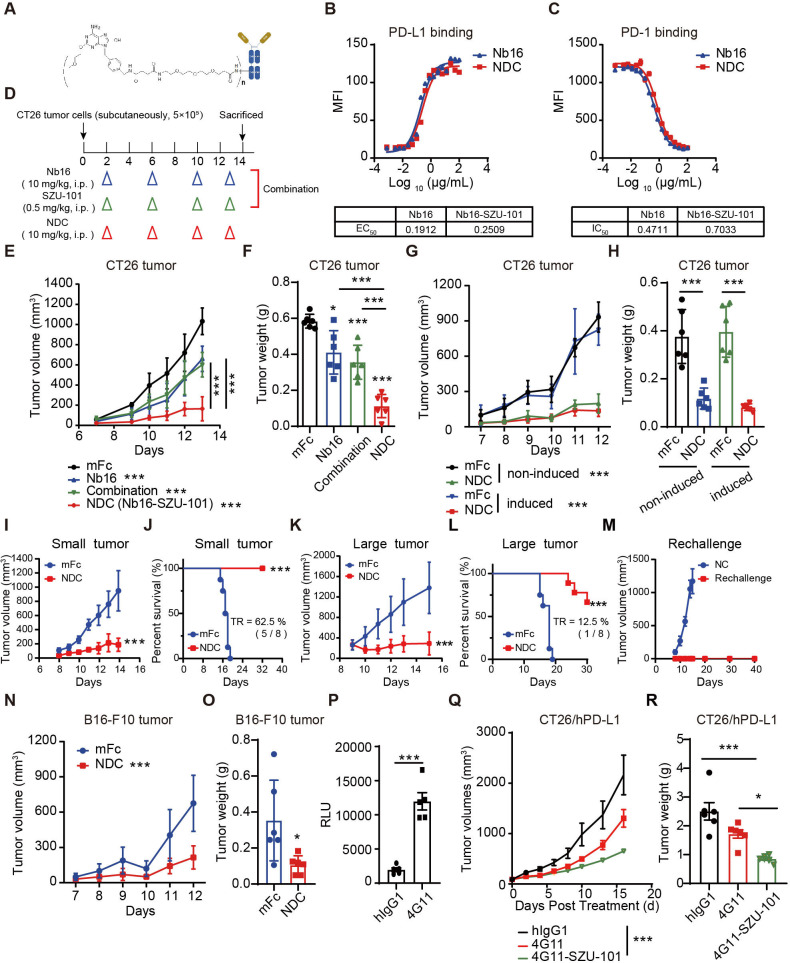
The screened PD-L1 nanobodies were characterized as tumor-targeting and alleviated T-cell immunosuppression. The TLR7 agonists induced broad innate immune responses and intratumoral PD-L1 expression on antigen-presenting cells (APCs), and its antitumor effect was dependent on intratumoral delivery. The combination of TLR7 agonists and PD-L1 nanobodies activated both innate and adaptive immunity and upregulated PD-L1-related signaling pathways. After coupling to form dual-targeting NDCs, TLR7 agonists and PD-L1 nanobodies exerted synergistic antitumor effects and safety in either 'hot' or 'cold' tumor and early or advanced tumor models, reshaped the tumor immune microenvironment and induced antitumor immune memory. CD8 T cells and natural killer cells were the main effector cells for NDCs to function. NDCs can promote PD-L1 expression on intratumoral APCs and tumor cells, and subsequently achieve targeted enrichment in tumors. Moreover, the efficacy of NDCs is biased toward dependence on host expression of PD-L1.
The novel PD-L1/TLR7 dual-targeting NDC exhibited potent efficacy against heterogeneous tumors through orchestrating innate and adaptive immunity, which could act as a promising strategy to improve ICB therapy and shows prospects for clinical development.
多种肿瘤对免疫检查点阻断(ICB)治疗不敏感。 Toll 样受体(TLR)建立了先天免疫和适应性免疫之间的联系,能够辅助 T 细胞激活,并成为增强 ICB 治疗效果的有前途的联合治疗靶点。在这里,我们旨在通过开发基于我们开发的 PD-L1 纳米抗体和 TLR7 激动剂的 PD-L1/TLR7 双靶向纳米抗体药物偶联物(NDC)来提高抗程序性死亡配体 1(PD-L1)治疗的疗效。
通过噬菌体展示筛选获得 PD-L1 纳米抗体,并通过 T 细胞激活生物测定、体内成像和定量生物分布研究进行鉴定。在不同的天然细胞模型中评估 TLR7 激动剂的免疫激活和 PD-L1 诱导作用。我们通过化学偶联 PD-L1 纳米抗体和 TLR7 激动剂构建了 PD-L1/TLR7 双靶向 NDC。通过几种鼠或人源化实体瘤模型评估抗肿瘤作用。免疫表型分析、免疫细胞耗竭、肿瘤再挑战、RNA 测序和 PD-L1 缺陷型模型相结合,以确定 NDC 功能的机制。基于 PD-L1 水平在多个器官中的变化,评估 NDC 在体内行为的动态。
筛选出的 PD-L1 纳米抗体具有肿瘤靶向性,并缓解了 T 细胞的免疫抑制作用。TLR7 激动剂诱导广泛的先天免疫反应,并在抗原呈递细胞(APC)中诱导肿瘤内 PD-L1 表达,其抗肿瘤作用依赖于肿瘤内递送。TLR7 激动剂和 PD-L1 纳米抗体的组合激活了先天免疫和适应性免疫,并上调了 PD-L1 相关信号通路。形成双靶向 NDC 后,TLR7 激动剂和 PD-L1 纳米抗体在“热”或“冷”肿瘤以及早期或晚期肿瘤模型中发挥协同抗肿瘤作用和安全性,重塑肿瘤免疫微环境并诱导抗肿瘤免疫记忆。CD8 T 细胞和自然杀伤细胞是 NDC 发挥作用的主要效应细胞。NDC 可以促进肿瘤内 APC 和肿瘤细胞上 PD-L1 的表达,并随后在肿瘤中实现靶向富集。此外,NDC 的疗效偏向于依赖宿主 PD-L1 的表达。
新型 PD-L1/TLR7 双靶向 NDC 通过协调先天免疫和适应性免疫,对异质性肿瘤表现出强大的疗效,可能成为改善 ICB 治疗的有前途的策略,并显示出临床开发的前景。