Serban Alina-Irina, Soreq Eyal, Barnaghi Payam, Daniels Sarah, Calvo Rafael A, Sharp David J
UK Dementia Research Institute, Care Research and Technology Centre, London, UK.
Dyson School of Design Engineering, Imperial College London, London, UK.
NPJ Digit Med. 2022 Oct 17;5(1):154. doi: 10.1038/s41746-022-00697-4.
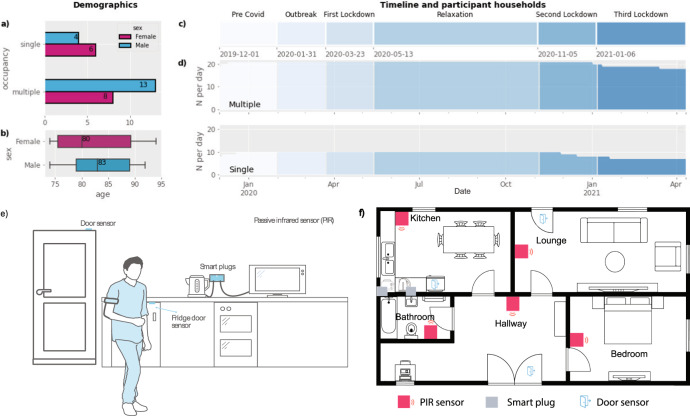
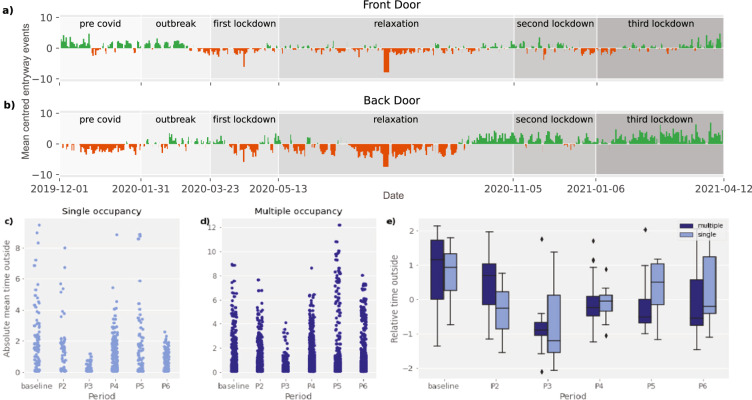
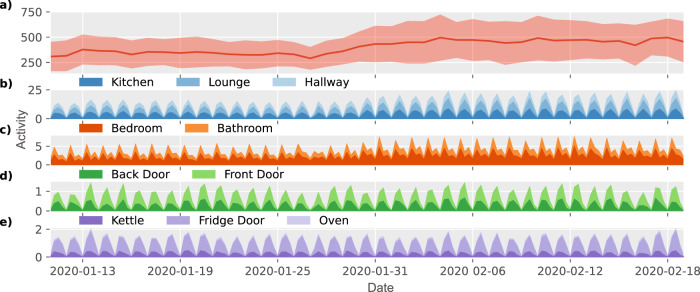
The COVID-19 pandemic has dramatically altered the behaviour of most of the world's population, particularly affecting the elderly, including people living with dementia (PLwD). Here we use remote home monitoring technology deployed into 31 homes of PLwD living in the UK to investigate the effects of COVID-19 on behaviour within the home, including social isolation. The home activity was monitored continuously using unobtrusive sensors for 498 days from 1 December 2019 to 12 April 2021. This period included six distinct pandemic phases with differing public health measures, including three periods of home 'lockdown'. Linear mixed-effects modelling is used to examine changes in the home activity of PLwD who lived alone or with others. An algorithm is developed to quantify time spent outside the home. Increased home activity is observed from very early in the pandemic, with a significant decrease in the time spent outside produced by the first lockdown. The study demonstrates the effects of COVID-19 lockdown on home behaviours in PLwD and shows how unobtrusive home monitoring can be used to track behaviours relevant to social isolation.
新冠疫情极大地改变了世界上大多数人口的行为,尤其影响了老年人,包括痴呆症患者。在此,我们利用部署在英国31户痴呆症患者家中的远程家庭监测技术,来调查新冠疫情对家庭内行为的影响,包括社交隔离情况。从2019年12月1日至2021年4月12日,使用不引人注意的传感器对家庭活动进行了498天的持续监测。这一时期包括六个不同的疫情阶段,采取了不同的公共卫生措施,其中包括三个家庭“封锁”期。采用线性混合效应模型来研究独居或与他人同住的痴呆症患者家庭活动的变化。开发了一种算法来量化在家外度过的时间。在疫情早期就观察到家庭活动增加,第一次封锁导致在家外度过的时间显著减少。该研究证明了新冠疫情封锁对痴呆症患者家庭行为的影响,并展示了如何利用不引人注意的家庭监测来跟踪与社交隔离相关的行为。