Skabeikyte-Norkiene Gabriele, Sharp Carla, Kulesz Paulina Anna, Barkauskiene Rasa
Institute of Psychology, Faculty of Philosophy, Vilnius University, Universiteto st. 9, 01513, Vilnius, Lithuania.
Department of Psychology, University of Houston, Houston, USA.
Borderline Personal Disord Emot Dysregul. 2022 Oct 19;9(1):31. doi: 10.1186/s40479-022-00202-z.
The dimensional approach to personality pathology opens up the possibility to investigate adolescence as a significant period for the development of personality pathology. Recent evidence suggests that symptoms of personality pathology may change during adolescence, but the negative consequences such as impaired social functioning persist later on in life. Thus, we think that problems in social functioning may further predict personality impairments. The current study aimed at investigating the role of relationship quality with parents and peers for the prediction of the level of personality functioning across adolescence. We hypothesized that 1) relationship quality with both parents and peers will significantly account for the level of personality functioning in adolescence and 2) the importance of relationship quality with peers for the relation to impairments in personality functioning will increase with age.
A community sample consisting of 855 adolescents aged 11-18 (M = 14.44, SD = 1.60; 62.5% female) from different regions in Lithuania participated in this study. Self-report questionnaires included the Levels of Personality Functioning Questionnaire to investigate personality impairments and the Network of Relationships Questionnaire to assess the quality of dyadic relationships.
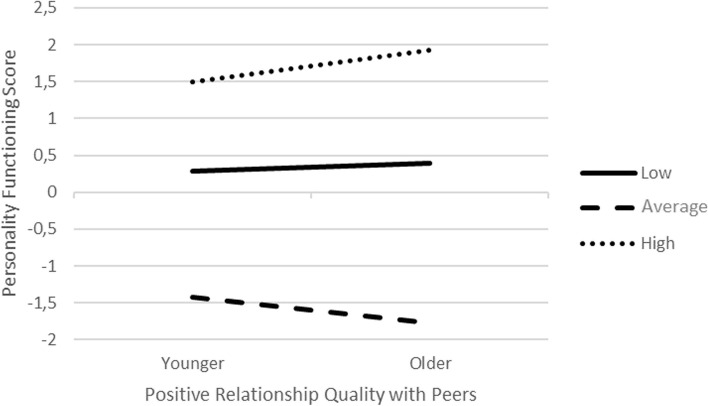
Discord in the parent, but not peer relationships, was related to a more severe level of personality functioning across adolescence. Lower levels of closeness with parents accounted for higher impairments in personality functioning. The importance of closeness with peers for the explanation of the level of personality functioning increased with age.
During the sensitive period for the development of a personality disorder, relationship quality with the closest adults and peers both remain important for the explanation of impairments in personality functioning.
人格病理学的维度方法为研究青春期作为人格病理学发展的重要时期提供了可能性。最近的证据表明,人格病理学症状在青春期可能会发生变化,但诸如社会功能受损等负面后果在以后的生活中仍然存在。因此,我们认为社会功能问题可能进一步预测人格障碍。本研究旨在调查与父母和同伴的关系质量在预测整个青春期人格功能水平方面的作用。我们假设:1)与父母和同伴的关系质量将显著解释青春期的人格功能水平;2)与同伴的关系质量对人格功能受损关系的重要性将随着年龄的增长而增加。
一个由来自立陶宛不同地区的855名11 - 18岁青少年(M = 14.44,SD = 1.60;62.5%为女性)组成的社区样本参与了本研究。自我报告问卷包括用于调查人格障碍的人格功能水平问卷和用于评估二元关系质量的人际关系网络问卷。
父母关系中的不和,而非同伴关系中的不和,与整个青春期更严重的人格功能水平相关。与父母的亲密程度较低导致人格功能受损程度更高。与同伴的亲密程度对解释人格功能水平的重要性随着年龄的增长而增加。
在人格障碍发展的敏感期,与最亲近的成年人和同伴的关系质量对于解释人格功能受损仍然都很重要。