Laboratório de Cirurgia Experimental, Departamento de Ciências Médicas Cirúrgicas, Universidade Federal do Ceará, Fortaleza, CE, Brasil.
Núcleo de Pesquisa e Desenvolvimento de Medicamentos, Departamento de Fisiologia e Farmacologia, Laboratório de Neuropsicofarmacologia, Universidade Federal do Ceará, Fortaleza, CE, Brasil.
Braz J Med Biol Res. 2022 Oct 17;55:e12195. doi: 10.1590/1414-431X2022e12195. eCollection 2022.
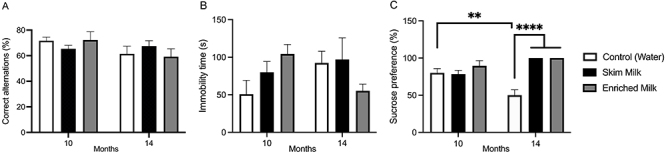
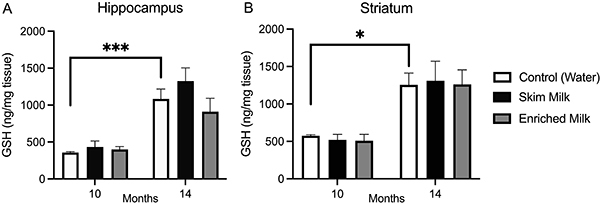
We tested the hypothesis that administration of omega (ω)-9, ω-3, and ω-6 to mice can prevent oxidative alterations responsible for behavioral and cognitive alterations related with aging. Twenty-eight-day-old mice received skim milk (SM group), SM enriched with omega oil mixture (EM group), or water (control group) for 10 and 14 months, equivalent to middle age. Mice were evaluated for behavioral alterations related to depression and memory and oxidative status [brain levels of thiobarbituric acid reactive substances (TBARS), reduced glutathione (GSH), and myeloperoxidase (MPO)]. The 10-month EM group increased immobility time during the forced swimming test compared with control, indicating increased stress response. The 14-month SM- and EM-treated groups increased sucrose consumption compared with control, showing an expanded motivational state. The 14-month SM group decreased the number of rearings compared with the 14-month control and EM groups. The number of entries and time spent in the central square of the open field was higher in the 10-month EM group than in the control, revealing an anxiolytic-like behavior. TBARS decreased in the hippocampus and striatum of the 10-month EM group compared with the control. A similar decrease was observed in the striatum of the 10-month SM group. GSH levels were higher in all 14-month treated groups compared with 10-month groups. MPO activity was higher in the 14-month EM group compared with the 14-month control and SM groups, revealing a possible pro-inflammatory status. In conclusion, omega oils induced conflicting alterations in middle-aged mice, contributing to enhanced behavior and anxiolytic and expanded motivational state, but also to increased stress response and pro-inflammatory alterations.
我们检验了这样一个假设,即给老鼠服用ω-9、ω-3 和 ω-6 可以防止与衰老相关的行为和认知改变所导致的氧化损伤。28 日龄的老鼠接受脱脂牛奶(SM 组)、富含 ω 油混合物的 SM(EM 组)或水(对照组)10 个月和 14 个月,相当于中年。通过行为改变测试评估老鼠与抑郁和记忆相关的行为改变,以及氧化状态[大脑中丙二醛(TBARS)、还原型谷胱甘肽(GSH)和髓过氧化物酶(MPO)的水平]。与对照组相比,10 个月的 EM 组在强迫游泳试验中增加了不动时间,表明应激反应增加。与对照组相比,14 个月的 SM 和 EM 处理组增加了蔗糖消耗,表明动机状态扩大。与 14 个月的对照组和 EM 组相比,14 个月的 SM 组后肢竖起次数减少。10 个月 EM 组进入开放场中央区的次数和时间多于对照组,表现出类似的焦虑样行为。与对照组相比,10 个月 EM 组海马体和纹状体中的 TBARS 减少。SM 组也观察到类似的纹状体 TBARS 减少。与 10 个月组相比,所有 14 个月治疗组的 GSH 水平均升高。与 14 个月对照组和 SM 组相比,14 个月 EM 组的 MPO 活性更高,表明可能存在促炎状态。总之,ω 油在中年老鼠中引起了相互矛盾的变化,导致行为增强、焦虑样和动机状态扩大,但也导致应激反应和促炎改变增加。