Institute of Cancer Stem Cell; Liaoning Key Laboratory of Nucleic Acid Biology, Dalian Medical University, Dalian 116044, Liaoning, China.
Department of Hematology; Liaoning Key Laboratory of Hematopoietic Stem Cell Transplantation and Translational Medicine; Liaoning Medical Center for Hematopoietic Stem Cell Transplantation; Dalian Key Laboratory of Hematology; Diamond Bay Institute of Hematology, Second Hospital of Dalian Medical University, Dalian 116044, China.
Int J Biol Sci. 2022 Sep 21;18(15):5770-5786. doi: 10.7150/ijbs.73749. eCollection 2022.
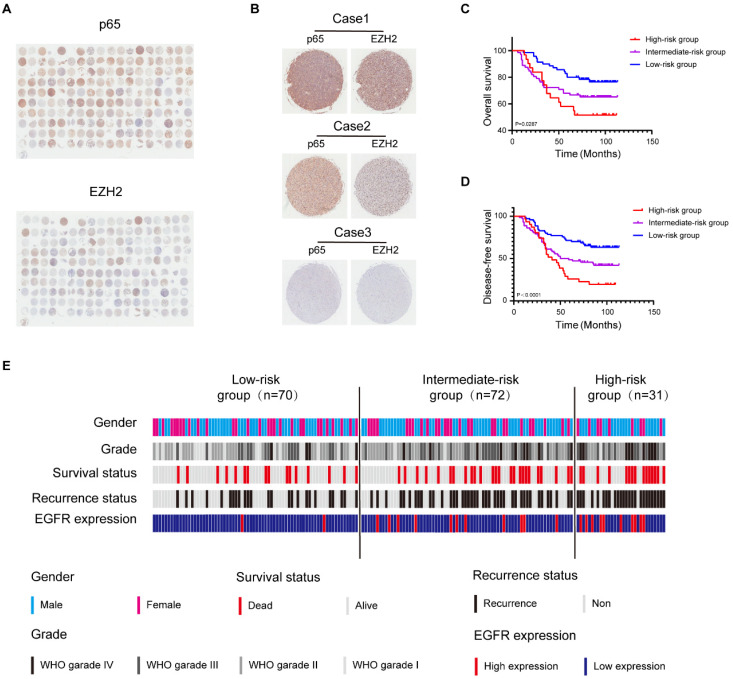
Without an effective strategy for targeted therapy, glioblastoma is still incurable with a median survival of only 15 months. Both chronic inflammation and epigenetic reprogramming are hallmarks of cancer. However, the mechanisms and consequences of their cooperation in glioblastoma remain unknown. Here, we discover that chronic inflammation governs H3K27me3 reprogramming in glioblastoma through the canonical NF-κB pathway to target EZH2. Being a crucial mediator of chronic inflammation, the canonical NF-κB signalling specifically directs the expression and redistribution of H3K27me3 but not H3K4me3, H3K9me3 and H3K36me3. Using RNA-seq screening to focus on genes encoding methyltransferases and demethylases of histone, we identify EZH2 as a key methyltransferase to control inflammation-triggered epigenetic reprogramming in gliomagenesis. Mechanistically, NF-κB selectively drives the expression of EZH2 by activating its transcription, consequently resulting in a global change in H3K27me3 expression and distribution. Furthermore, we find that co-activation of NF-κB and EZH2 confers the poorest clinical outcome, and that the risk for glioblastoma can be accurately molecularly stratified by NF-κB and EZH2. It is notable that NF-κB can potentially cooperate with EZH2 in more than one way, and most importantly, we demonstrate a Synergistic effect of cancer cells induced by combinatory inhibition of NF-κB and EZH2, which both are frequently over-activated in glioblastoma. In summary, we uncover a functional cooperation between chronic inflammation and epigenetic reprogramming in glioblastoma, combined targeting of which by inhibitors guaranteed in safety and availability furnishes a potent strategy for effective treatment of this fatal disease.
没有针对靶向治疗的有效策略,胶质母细胞瘤仍然无法治愈,中位生存期仅为 15 个月。慢性炎症和表观遗传重编程都是癌症的标志。然而,它们在胶质母细胞瘤中的合作机制和后果尚不清楚。在这里,我们发现慢性炎症通过经典的 NF-κB 途径控制胶质母细胞瘤中的 H3K27me3 重编程,以靶向 EZH2。作为慢性炎症的关键介质,经典的 NF-κB 信号专门指导 H3K27me3 的表达和重新分布,但不指导 H3K4me3、H3K9me3 和 H3K36me3。我们使用 RNA-seq 筛选来关注编码组蛋白甲基转移酶和去甲基酶的基因,鉴定 EZH2 作为一种关键的甲基转移酶,以控制炎症触发的胶质母细胞瘤发生中的表观遗传重编程。从机制上讲,NF-κB 通过激活其转录选择性驱动 EZH2 的表达,从而导致 H3K27me3 表达和分布的全局变化。此外,我们发现 NF-κB 和 EZH2 的共同激活赋予了最差的临床结局,并且可以通过 NF-κB 和 EZH2 准确地对胶质母细胞瘤进行分子分层。值得注意的是,NF-κB 可以以不止一种方式与 EZH2 合作,最重要的是,我们证明了组合抑制 NF-κB 和 EZH2 对癌细胞的协同作用,这两者在胶质母细胞瘤中经常过度激活。总之,我们揭示了慢性炎症和表观遗传重编程在胶质母细胞瘤中的功能合作,通过抑制剂联合靶向这两者提供了一种有效的治疗这种致命疾病的策略。