Scrob Teodora, Varodi Sânziana Maria, Vintilă Georgiana Alexandra, Casoni Dorina, Cimpoiu Claudia
Babes-Bolyai University, Faculty of Chemistry and Chemical Engineering, 11 Arany Janos, 400028 Cluj-Napoca, Romania.
Research Center for Advanced Chemical Analysis, Instrumentation and Chemometrics, 11 Arany Janos, 400028 Cluj-Napoca, Romania.
Food Chem X. 2022 Oct 12;16:100471. doi: 10.1016/j.fochx.2022.100471. eCollection 2022 Dec 30.
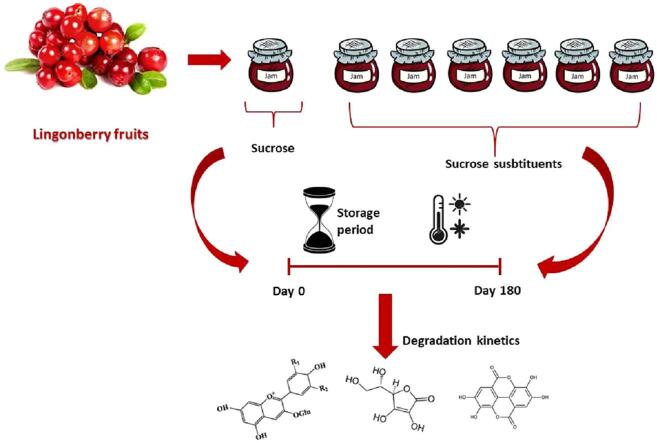
Lingonberry fruits are considered to play an important role in nutrition, as they comprise a variety of health-promoting components. Because of lingonberries seasonal availability and also due to their rapid degradation, their stability during processing is a continuous challenge for the food industry. Lingonberries are ideal fruits in making jam due to their natural deep reddish color, but recently, increased demand for low-calorie jams with alternative sweeteners has gained special attention. In this line, the objective of this study was to monitor the changes in anthocyanins, vitamin C, total phenolics, total reducing sugars and antioxidant capacity of several lingonberry jams formulated with different sweeteners (sucrose, fructose, erythritol, brown sugar, coconut sugar, stevia, saccharin). Due to the fact that storage conditions are important factors for jam quality, the jams were stored for 180 days at 4 °C and 25 °C (both under light and dark conditions). The rate constants (k) and the half time values (t) of the degradation processes were determined and degradation kinetics was studied. For all analyzed conditions, first-order reaction kinetics was established for the degradation process of anthocyanins, whereas a second-order kinetic model described the degradation of the other compounds. Kinetic parameters showed that the stability of the studied compounds was highly influenced by the type of sweetener used in jam formulation. Total phenolics and antioxidants were best preserved in the presence of stevia, coconut sugar and fructose, whereas a destabilizing effect of erythritol on vitamin C and anthocyanins content during storage was observed. Among all the studied compounds, anthocyanins presented the fastest degradation, regardless storage conditions. The stability of studied compounds was higher at lower storage temperature (4 °C), while increasing the temperature at 25 °C and exposure to light determined higher rate of the degradation processes. The results provide useful information for understanding some bioactive compounds degradation in real foods, contributing to the development of new food products and providing information of commercial importance.
越橘果实因其含有多种促进健康的成分而被认为在营养方面发挥着重要作用。由于越橘的季节性供应以及它们迅速降解的特性,其在加工过程中的稳定性对食品工业来说一直是一项持续的挑战。越橘因其天然的深红色泽,是制作果酱的理想水果,但最近,对使用替代甜味剂的低热量果酱的需求增加,这受到了特别关注。在此背景下,本研究的目的是监测用不同甜味剂(蔗糖、果糖、赤藓糖醇、红糖、椰糖、甜菊糖苷、糖精)配制的几种越橘果酱中花青素、维生素C、总酚类、总还原糖和抗氧化能力的变化。由于储存条件是影响果酱质量的重要因素,这些果酱在4℃和25℃下储存180天(包括光照和黑暗条件)。测定了降解过程的速率常数(k)和半衰期值(t),并研究了降解动力学。对于所有分析条件,花青素降解过程建立了一级反应动力学,而其他化合物的降解则由二级动力学模型描述。动力学参数表明,所研究化合物的稳定性受果酱配方中所用甜味剂类型的高度影响。总酚类和抗氧化剂在甜菊糖苷、椰糖和果糖存在下保存得最好,而在储存期间观察到赤藓糖醇对维生素C和花青素含量有去稳定作用。在所有研究的化合物中,无论储存条件如何,花青素的降解速度最快。所研究化合物在较低储存温度(4℃)下稳定性更高,而温度升至25℃并暴露于光照下会导致降解过程速率加快。这些结果为理解实际食品中一些生物活性化合物的降解提供了有用信息,有助于开发新的食品产品,并提供具有商业重要性的信息。