Rosmark Oskar, Ibáñez-Fonseca Arturo, Thorsson Johan, Dellgren Göran, Hallgren Oskar, Larsson Callerfelt Anna-Karin, Elowsson Linda, Westergren-Thorsson Gunilla
Lung Biology, Department of Experimental Medical Science, Lund University, Lund, Sweden.
Transplant Institute and Department of Cardiothoracic Surgery, Sahlgrenska University Hospital, Gothenburg, Sweden.
Front Bioeng Biotechnol. 2022 Oct 3;10:995460. doi: 10.3389/fbioe.2022.995460. eCollection 2022.
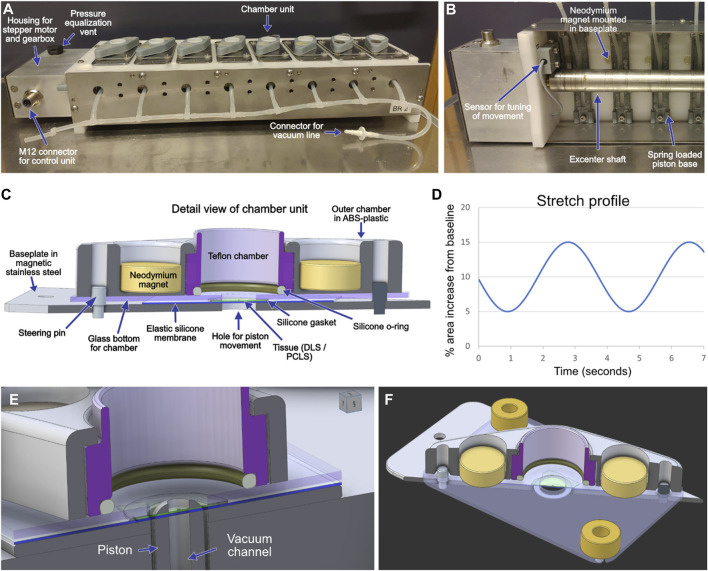
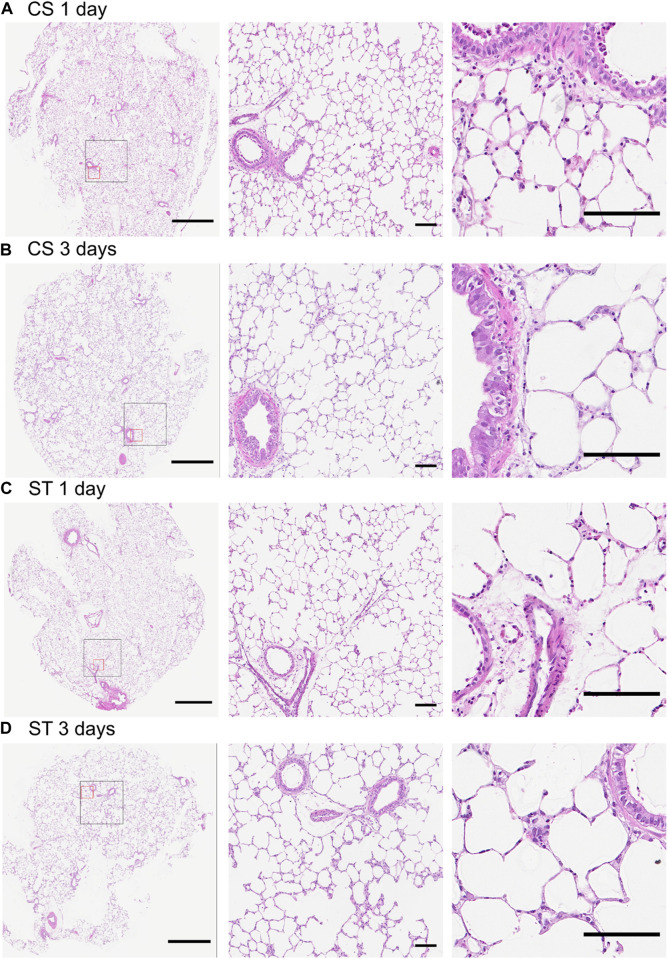
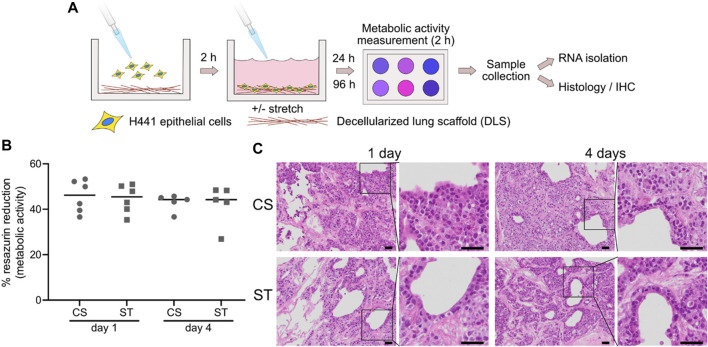
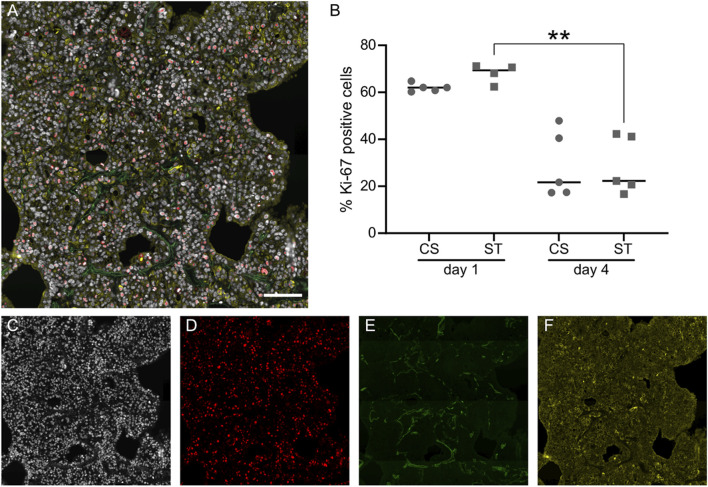
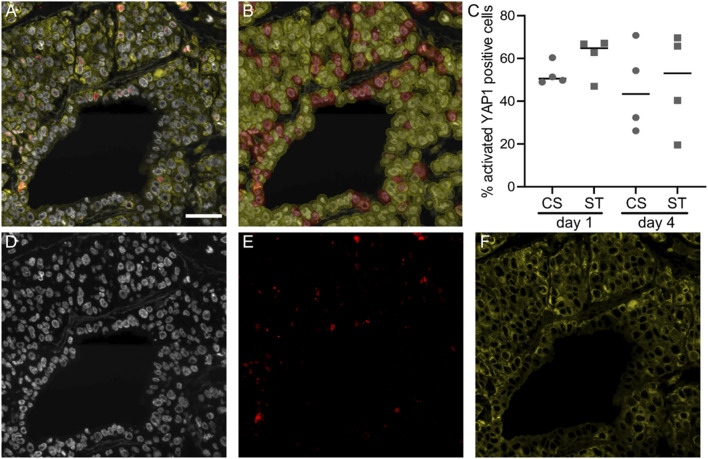
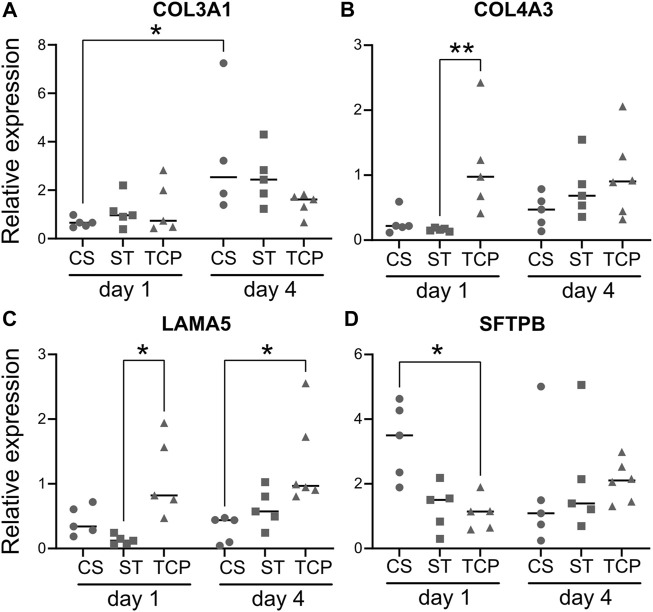
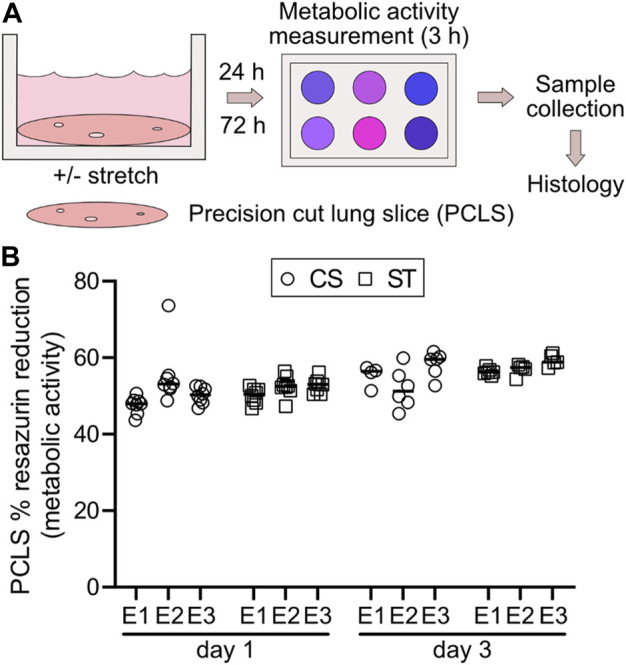
Breathing exposes lung cells to continual mechanical stimuli, which is part of the microenvironmental signals directing cellular functions together with the extracellular matrix (ECM). Therefore, developing systems that incorporate both stimuli is urgent to fully understand cell behavior. This study aims to introduce a novel culture methodology combining a cyclic stretch that simulates breathing with 3D cell culture platforms in the form of decellularized lung slices (DLS) and precision cut lung slices (PCLS). To this end, we have constructed a device that mimics the amplitudes and frequencies of distensions seen in the breathing human lung. For its validation, we cultured H441 lung epithelial cells in human DLS exposed to 16 stretch cycles per minute with a 10% stretch amplitude. Cell viability (resazurin reduction), proliferation (Ki-67) and YAP1 activation were evaluated at 24 and 96 h by immunohistochemistry, while the expression of SFTPB, COL3A1, COL4A3 and LAMA5 was evaluated by qPCR. Cyclic stretch induced an increase in SFTPB expression after 24 h without a concomitant increase in the stretch responsive gene YAP1. Moreover, the ECM milieu lowered the expression of the basement membrane protein genes COL4A3 and LAMA5 compared to tissue culture plastic control cultures, but no effect was observed by the mechanical stimuli. The device also confirmed good compatibility with PCLS culture, showing preserved morphology and metabolism in rat PCLS after 72 h of mechanical stretch. Thus, we present a novel device and methodology for the easy assembling and study of lung tissue slice cultures subjected to physiomimetic mechanical stimuli, which shows promise for future studies of cell and tissue function in a lung ECM milieu with physiological or pathological mechanical stimuli.
呼吸使肺细胞暴露于持续的机械刺激之下,这是与细胞外基质(ECM)共同指导细胞功能的微环境信号的一部分。因此,开发同时纳入这两种刺激的系统对于全面理解细胞行为至关重要。本研究旨在引入一种新颖的培养方法,将模拟呼吸的周期性拉伸与脱细胞肺切片(DLS)和精密切割肺切片(PCLS)形式的三维细胞培养平台相结合。为此,我们构建了一种装置,该装置可模拟人类呼吸时所见的扩张幅度和频率。为了验证其有效性,我们将H441肺上皮细胞培养在人DLS中,使其每分钟接受16个拉伸周期,拉伸幅度为10%。通过免疫组织化学在24小时和96小时评估细胞活力(刃天青还原)、增殖(Ki-67)和YAP1激活情况,同时通过qPCR评估SFTPB、COL3A1、COL4A3和LAMA5的表达。周期性拉伸在24小时后诱导SFTPB表达增加,而拉伸反应基因YAP1没有相应增加。此外,与组织培养塑料对照培养相比,ECM环境降低了基底膜蛋白基因COL4A3和LAMA5的表达,但机械刺激未观察到影响。该装置还证实与PCLS培养具有良好的兼容性,在机械拉伸72小时后,大鼠PCLS的形态和代谢得以保留。因此,我们提出了一种新颖的装置和方法,用于易于组装和研究经受仿生机械刺激的肺组织切片培养,这为未来在具有生理或病理机械刺激的肺ECM环境中研究细胞和组织功能显示出前景。