Department of Pathology, State Key Laboratory of Complex Severe and Rare Diseases, Molecular Pathology Research Center, Peking Union Medical College Hospital, Chinese Academy of Medical Sciences and Peking Union Medical College, Beijing, 100730, P. R. China.
Geneplus-Beijing, Beijing, 102200, P. R. China.
Cancer Commun (Lond). 2022 Dec;42(12):1367-1386. doi: 10.1002/cac2.12372. Epub 2022 Oct 20.
Neuroendocrine carcinomas of the gastrointestinal tract (GI-NECs) remain a disease of grim prognosis with limited therapeutic options. Their molecular characteristics are still undefined. This study aimed to explore the underlying genetic basis and heterogeneity of GI-NECs.
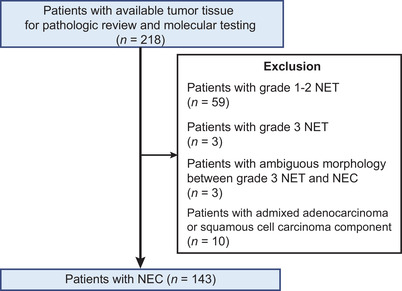
Comprehensive genomic analysis using whole-exome sequencing was performed on 143 formalin-fixed, paraffin-embedded samples of surgically resected GI-NEC with a thorough histological evaluation. Mutational signatures, somatic mutations, and copy number aberrations were analyzed and compared across anatomic locations and histological subtypes. Survival analysis was conducted to identify the independent factors.
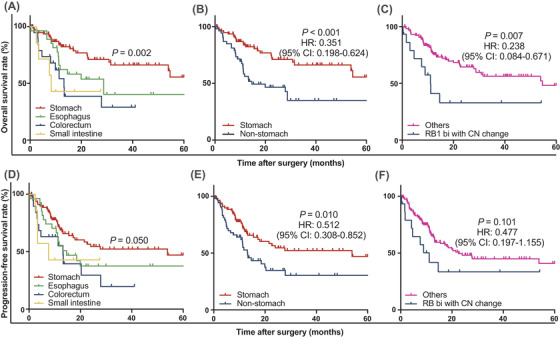
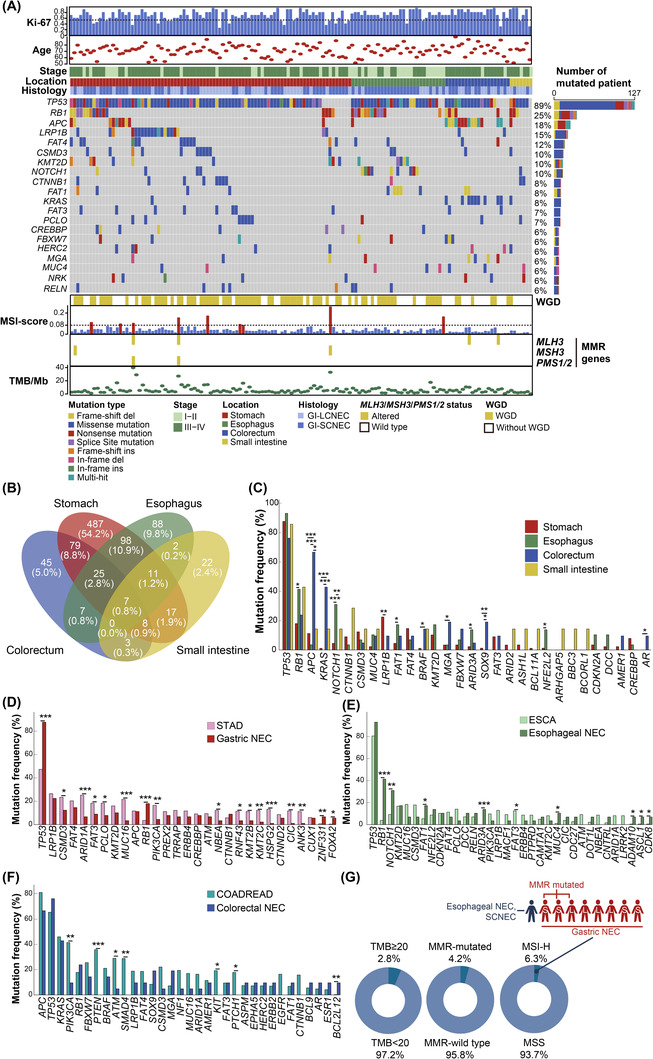
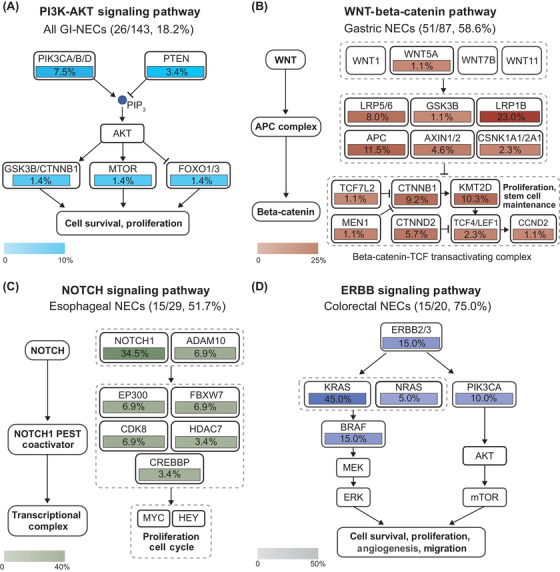
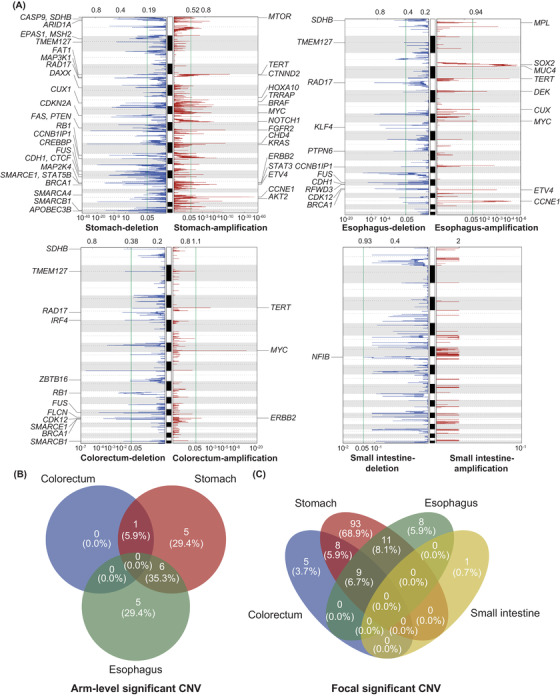
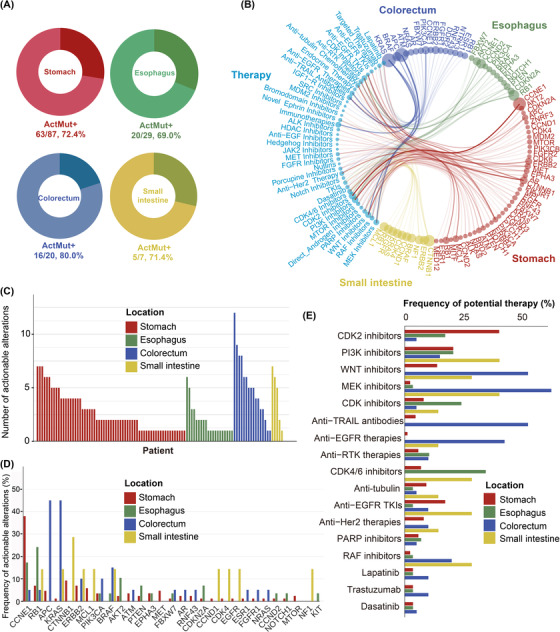
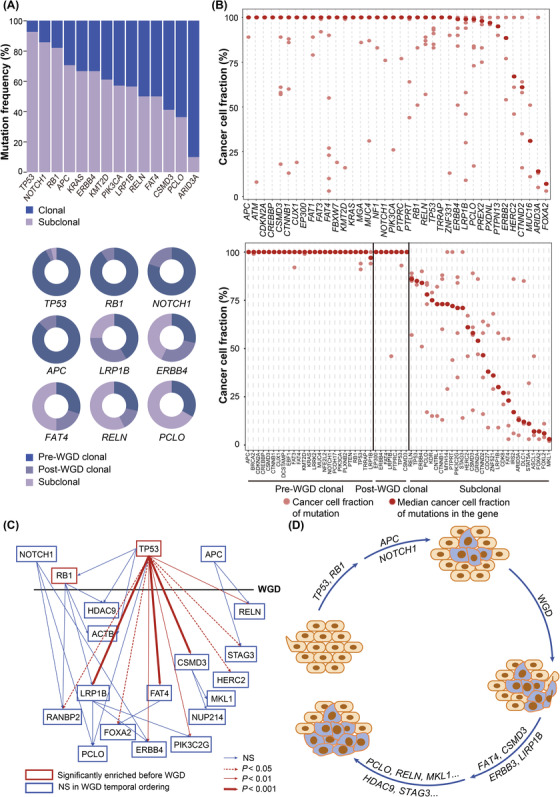
In total, 143 GI-NECs were examined: the stomach, 87 cases (60.8%); the esophagus, 29 cases (20.3%); the colorectum, 20 cases (14.0%); and the small intestine, 7 cases (4.9%). Eighty-three (58.0%) and 60 (42.0%) cases were subclassified into small cell and large cell subtypes, respectively. GI-NECs showed distinct genetic alterations from their lung counterparts and non-neuroendocrine carcinomas in the same locations. Obvious heterogeneity of mutational signatures, somatic mutations, and copy number variations was revealed across anatomic locations rather than histological subtypes. Except for tumor protein p53 (TP53) and retinoblastoma 1 (RB1), the most frequently mutated genes in the stomach, esophagus, colorectum, and small intestine were low-density lipoprotein receptor-related protein 1B (LRP1B), notch receptor 1 (NOTCH1), adenomatosis polyposis coli (APC), catenin beta 1 (CTNNB1), respectively. Mutations in the WNT-β-catenin, NOTCH and erythroblastic leukemia viral oncogene B (ERBB) pathways were prevalently identified in gastric, esophageal, and colorectal NECs, respectively. Importantly, 104 (72.7%) GI-NECs harbored putative clinically relevant alterations, and non-gastric location and RB1 bi-allelic inactivation with copy number alterations were identified as two independent poor prognostic factors. Furthermore, we found that tumor cells in GI-NECs first gain clonal mutations in TP53, RB1, NOTCH1 and APC, followed by subsequent whole-genome doubling (WGD) and post-WGD clonal mutations in LRP1B, CUB and Sushi multiple domains 3 (CSMD3), FAT tumor suppressor homolog 4 (FAT4) and erb-b2 receptor tyrosine kinase 4 (ERBB4), and finally develop subclonal mutations.
GI-NECs harbor distinct genomic landscapes and demonstrate significant genetic heterogeneity across different anatomic locations. Moreover, potentially actionable alterations and prognostic factors were revealed for GI-NECs.
胃肠道神经内分泌癌(GI-NEC)的预后仍然很差,治疗选择有限。其分子特征仍未确定。本研究旨在探讨 GI-NEC 的潜在遗传基础和异质性。
对 143 例经手术切除的福尔马林固定、石蜡包埋的胃肠道神经内分泌癌进行全外显子组测序的全面基因组分析,并进行了彻底的组织学评估。分析并比较了不同解剖部位和组织学亚型的突变特征、体细胞突变和拷贝数异常。进行生存分析以确定独立因素。
共检查了 143 例 GI-NEC:胃 87 例(60.8%);食管 29 例(20.3%);结直肠 20 例(14.0%);小肠 7 例(4.9%)。83 例(58.0%)和 60 例(42.0%)分为小细胞和大细胞亚型。GI-NEC 与肺神经内分泌癌和同一部位的非神经内分泌癌具有明显不同的遗传改变。在解剖部位而非组织学亚型上,明显存在突变特征、体细胞突变和拷贝数变化的异质性。除肿瘤蛋白 p53(TP53)和视网膜母细胞瘤 1(RB1)外,胃、食管、结直肠和小肠中最常突变的基因分别为低密度脂蛋白受体相关蛋白 1B(LRP1B)、NOTCH 受体 1(NOTCH1)、腺瘤性结肠息肉病(APC)、连环蛋白β 1(CTNNB1)。WNT-β-连环蛋白、NOTCH 和红细胞生成性白血病病毒致癌基因 B(ERBB)通路的突变在胃、食管和结直肠 NEC 中普遍存在。重要的是,104 例(72.7%)GI-NEC 存在潜在的临床相关改变,非胃部位和 RB1 双等位基因失活伴拷贝数改变被确定为两个独立的不良预后因素。此外,我们发现 GI-NEC 中的肿瘤细胞首先在 TP53、RB1、NOTCH1 和 APC 中获得克隆性突变,随后在全基因组加倍(WGD)和 WGD 后在 LRP1B、CUB 和 Sushi 多个结构域 3(CSMD3)、FAT 肿瘤抑制因子同源物 4(FAT4)和 erb-b2 受体酪氨酸激酶 4(ERBB4)中获得克隆性突变,最后发展为亚克隆突变。
GI-NEC 具有独特的基因组景观,并在不同解剖部位表现出显著的遗传异质性。此外,还揭示了 GI-NEC 的潜在可操作改变和预后因素。