Yale School of Medicine, New Haven, USA.
Douala Military Hospital, Douala, Cameroon.
Malar J. 2022 Oct 22;21(1):298. doi: 10.1186/s12936-022-04315-2.
Urban malaria has received insufficient attention in the literature. The prevalence and clinical characteristics of Plasmodium falciparum infection amongst patients presenting with suspected malaria were investigated at a major urban hospital in Douala, Cameroon with a particular focus on anaemia.
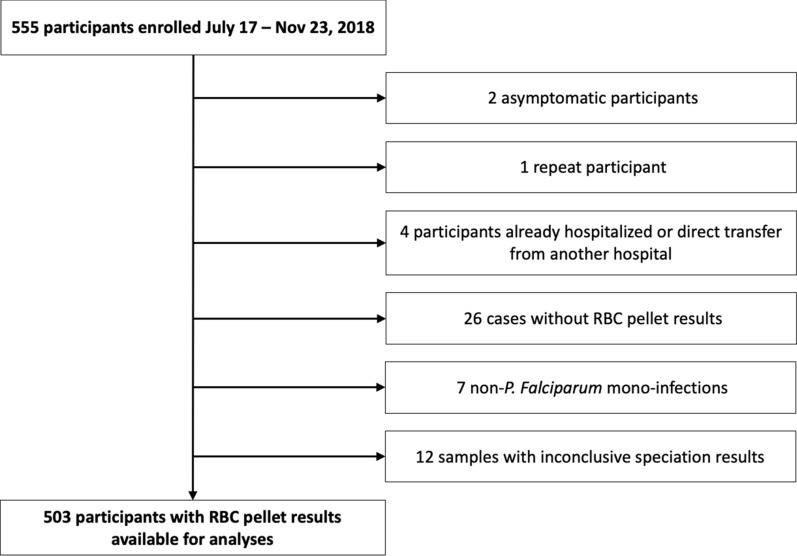
A cross-sectional, 18-week demographic and clinical survey was conducted of patients presenting to the Emergency Department of Douala Military Hospital with suspected malaria, largely defined by the presence or recent history of fever. Venous samples were tested for P. falciparum using rapid diagnostic tests and PCR, and anaemia was defined by haemoglobin level according to WHO definitions. Likelihood ratios (LR), odds ratios (OR), and population attributable risk percent (PARP) were calculated.
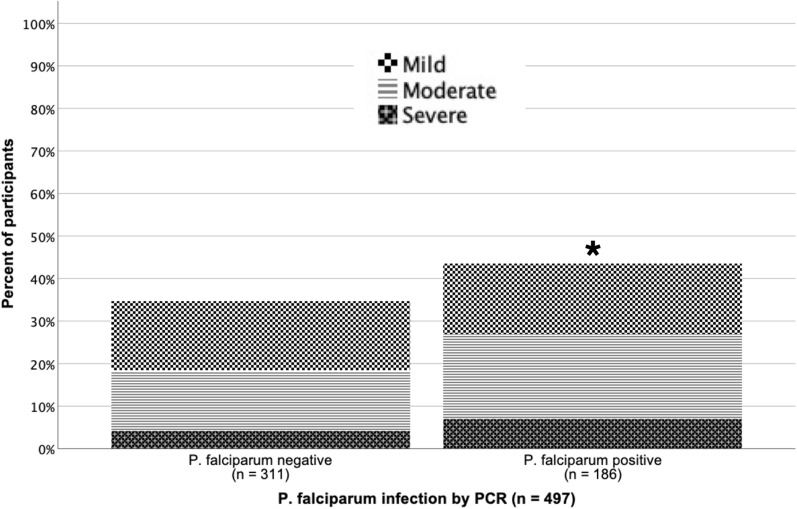
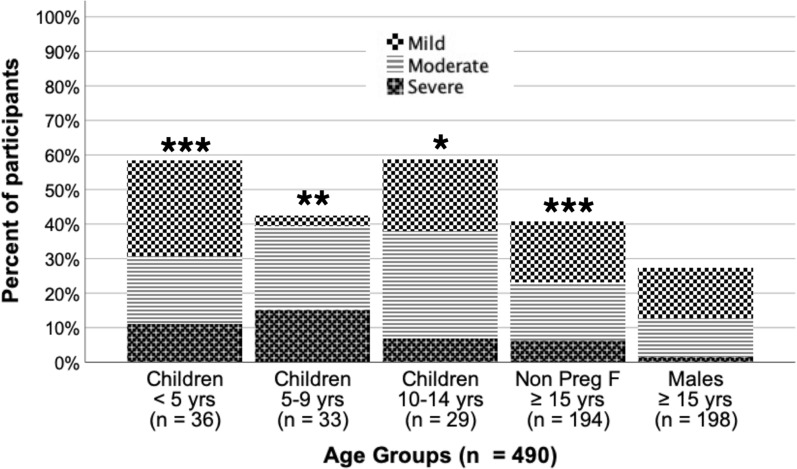
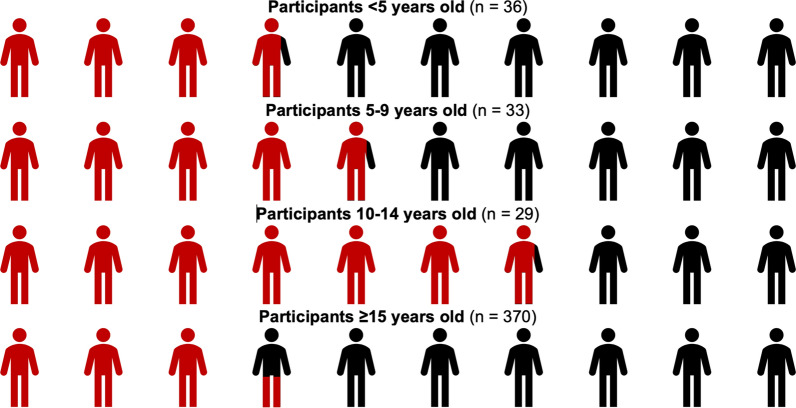
Participants were ages 8 months to 86 years, 51% were women (257/503), and all districts of Douala were represented. Overall, 38.0% (n = 189/497) were anaemic, including 5.2% (n = 26/497) with severe anaemia. Anaemia prevalence was significantly higher (OR: 2.20, 95% CI 1.41-3.45) among children < 15 years (53.1%, n = 52/98) compared to adults (34%, n = 133/392). Plasmodium falciparum was detected in 37.2% by nested PCR. Among all participants, several factors were associated with clinically significant LR for P. falciparum infection, including age 10-14 years (positive LR: 3.73), living in the island district of Douala VI (positive LR: 3.41), travel to any of three northern regions (positive LR: 5.11), and high fever > 40 °C at presentation (positive LR: 4.83). Among all participants, 8.7% of anaemia was associated with P. falciparum infection, while the PARP was 33.2% among those < 15 years of age and 81.0% among 10-14-year-olds.
The prevalence of P. falciparum infection in the urban hospital was high. Mirroring trends in many rural African settings, older children had the highest positivity rate for P. falciparum infection. Anaemia was also common in all age groups, and for those 10-14 years of age, 80% of the risk for anaemia was associated with P. falciparum infection. Malaria rates in major urban population centres can be high, and more research into the multifactorial causes of anaemia across the age spectrum are needed.
城市疟疾在文献中受到的关注不足。本研究在喀麦隆杜阿拉的一家主要城市医院中调查了疑似疟疾患者中恶性疟原虫感染的流行率和临床特征,尤其关注贫血。
采用横断面研究,对杜阿拉军事医院急诊科就诊的疑似疟疾患者进行为期 18 周的人口统计学和临床调查,主要通过发热的存在或近期病史来定义。使用快速诊断检测和 PCR 对静脉样本进行恶性疟原虫检测,根据世界卫生组织的定义,贫血定义为血红蛋白水平。计算比值比(OR)、优势比(LR)和人群归因风险百分比(PARP)。
参与者年龄 8 个月至 86 岁,51%为女性(257/503),代表了杜阿拉的所有地区。总体而言,38.0%(n=189/497)有贫血,包括 5.2%(n=26/497)有严重贫血。10-14 岁儿童(53.1%,n=52/98)的贫血患病率显著高于成年人(34%,n=133/392)(OR:2.20,95%CI 1.41-3.45)。巢式 PCR 检测到 37.2%的恶性疟原虫。在所有参与者中,以下因素与恶性疟原虫感染的临床显著 LR 相关,包括 10-14 岁(阳性 LR:3.73)、居住在杜阿拉六岛区(阳性 LR:3.41)、到三个北部地区旅行(阳性 LR:5.11)和就诊时高热(阳性 LR:4.83)。在所有参与者中,8.7%的贫血与恶性疟原虫感染有关,而 10-14 岁儿童的 PARP 为 33.2%,10-14 岁儿童的 PARP 为 81.0%。
城市医院恶性疟原虫感染的流行率较高。与许多非洲农村地区的趋势类似,年龄较大的儿童恶性疟原虫感染的阳性率最高。所有年龄组均常见贫血,而 10-14 岁儿童 80%的贫血风险与恶性疟原虫感染有关。主要城市人口中心的疟疾发病率可能很高,需要进一步研究各年龄段贫血的多因素病因。