Khoonkari Mohammad, Liang Dong, Kamperman Marleen, Kruyt Frank A E, van Rijn Patrick
Department of Medical Oncology, University of Groningen, University Medical Center Groningen, Hanzeplein 1, 9713 GZ Groningen, The Netherlands.
Polymer Science, Zernike Institute for Advanced Materials, University of Groningen, Nijenborgh 4, 9747 AG Groningen, The Netherlands.
Pharmaceutics. 2022 May 10;14(5):1031. doi: 10.3390/pharmaceutics14051031.
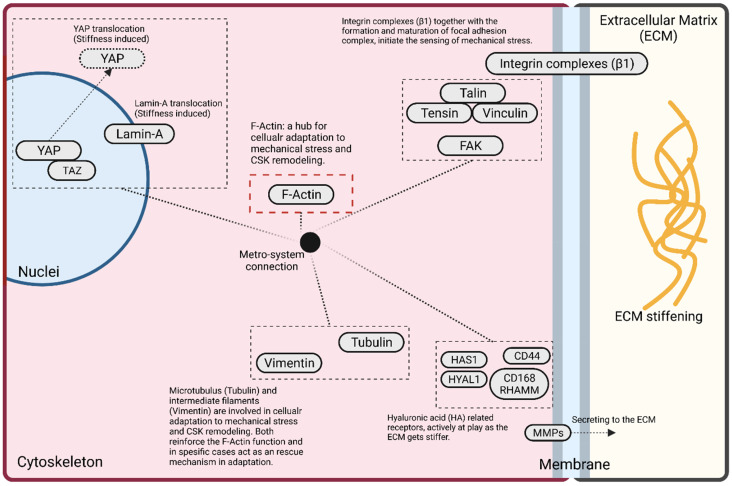
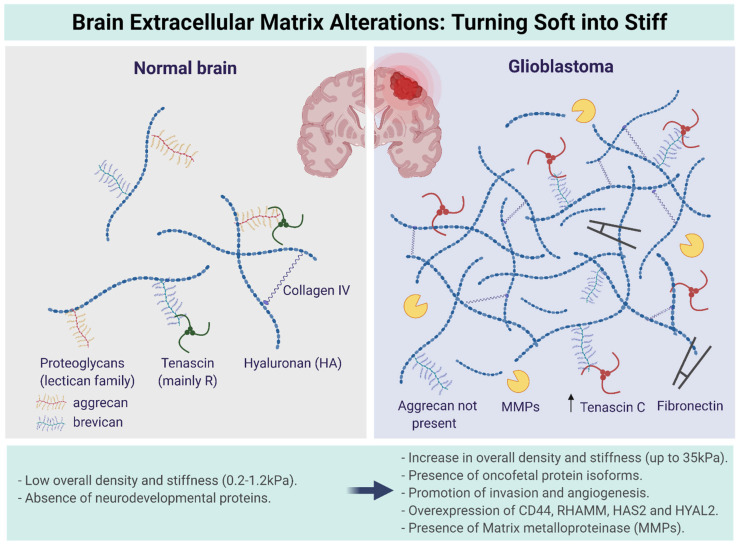
The biology and physics underlying glioblastoma is not yet completely understood, resulting in the limited efficacy of current clinical therapy. Recent studies have indicated the importance of mechanical stress on the development and malignancy of cancer. Various types of mechanical stress activate adaptive tumor cell responses that include alterations in the extracellular matrix (ECM) which have an impact on tumor malignancy. In this review, we describe and discuss the current knowledge of the effects of ECM alterations and mechanical stress on GBM aggressiveness. Gradual changes in the brain ECM have been connected to the biological and physical alterations of GBM cells. For example, increased expression of several ECM components such as glycosaminoglycans (GAGs), hyaluronic acid (HA), proteoglycans and fibrous proteins result in stiffening of the brain ECM, which alters inter- and intracellular signaling activity. Several mechanosensing signaling pathways have been identified that orchestrate adaptive responses, such as Hippo/YAP, CD44, and actin skeleton signaling, which remodel the cytoskeleton and affect cellular properties such as cell-cell/ECM interactions, growth, and migration/invasion of GBM cells. In vitro, hydrogels are used as a model to mimic the stiffening of the brain ECM and reconstruct its mechanics, which we also discuss. Overall, we provide an overview of the tumor microenvironmental landscape of GBM with a focus on ECM stiffening and its associated adaptive cellular signaling pathways and their possible therapeutic exploitation.
胶质母细胞瘤背后的生物学和物理学机制尚未完全明确,这导致当前临床治疗的疗效有限。最近的研究表明机械应力在癌症发生发展和恶性程度方面具有重要作用。各种类型的机械应力会激活肿瘤细胞的适应性反应,其中包括细胞外基质(ECM)的改变,而这会影响肿瘤的恶性程度。在这篇综述中,我们描述并讨论了目前关于ECM改变和机械应力对胶质母细胞瘤侵袭性影响的认识。脑ECM的逐渐变化与胶质母细胞瘤细胞的生物学和物理学改变相关。例如,几种ECM成分如糖胺聚糖(GAGs)、透明质酸(HA)、蛋白聚糖和纤维蛋白的表达增加会导致脑ECM变硬,这会改变细胞间和细胞内的信号传导活性。已经确定了几种机械传感信号通路,它们协调适应性反应,如Hippo/YAP、CD44和肌动蛋白骨架信号传导,这些通路会重塑细胞骨架并影响细胞特性,如胶质母细胞瘤细胞的细胞间/ECM相互作用、生长以及迁移/侵袭。在体外,水凝胶被用作模拟脑ECM变硬并重建其力学特性的模型,我们也将对此进行讨论。总体而言,我们概述了胶质母细胞瘤的肿瘤微环境格局,重点关注ECM硬化及其相关的适应性细胞信号通路以及它们可能的治疗应用。