São Paulo State University (Unesp), Postgraduate Program on Tocogynecology, Botucatu Medical School, Botucatu, Brazil.
Human Development and Technologies, Institute of Biosciences, São Paulo State University (UNESP), Rio Claro, Brazil.
Front Endocrinol (Lausanne). 2022 Oct 6;13:958909. doi: 10.3389/fendo.2022.958909. eCollection 2022.
Gestational diabetes mellitus (GDM) is a comorbidity which may cause acute and lifelong disorders to mother and child. Alterations in muscular and connective tissues have been associated with GDM in translation studies, characterizing gestational diabetic myopathy. Pregnancy-specific urinary incontinence and sexual disabilities, disorders that depend on the pelvic floor muscle (PFM) integrity, are also associated with GDM both during and after pregnancy. The aim was to compare PFM activation patterns between GDM and non-GDM women from 24-30 gestational weeks to 18-24 months postpartum during a standard clinical test during gestation and postpartum.
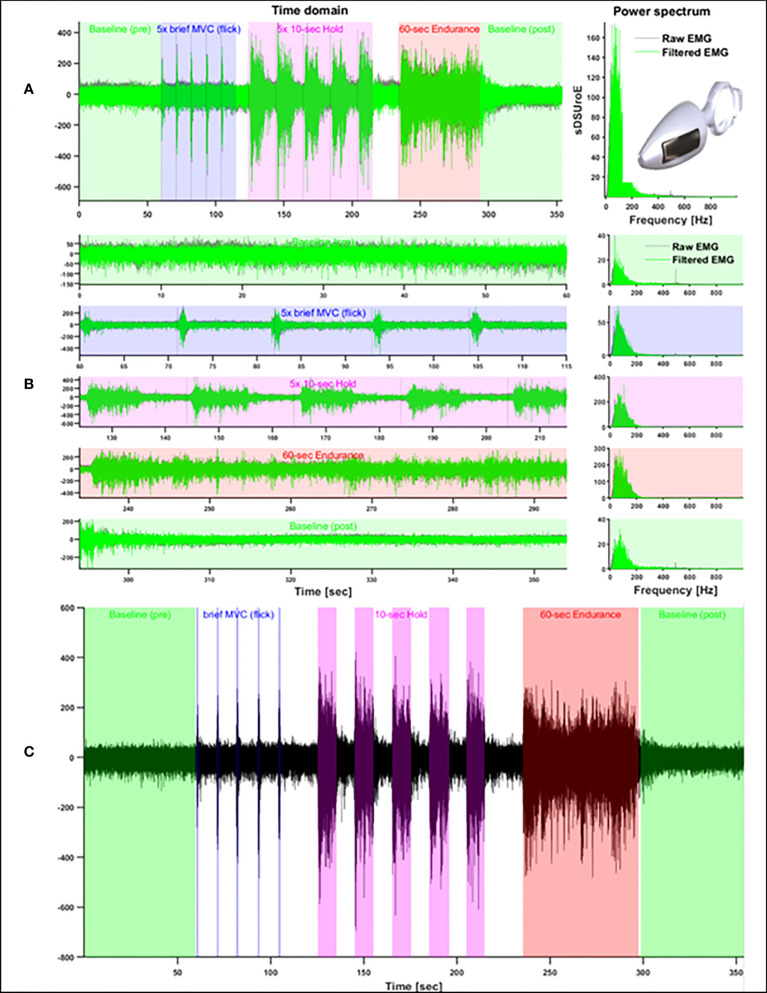
We conducted a prospective three-time-point cohort study from gestation (24-30 weeks-T1, and 36-38 weeks-T2) to 18-24 months postpartum (T3). PFM electromyography was recorded in primigravida or primiparous women with one previous elective c-section with or without the diagnosis of GDM according to the American Diabetes Association criteria. A careful explanation of the muscle anatomy and functionality of the PFM was given to participants before EMG assessment. The outcome measures were PFM activation patterns assessed during pregnancy and postpartum, comparing intra and between groups. PFM activation patterns were assessed by normalized electromyography signal at rest and during 1-second (sec) phasic, 10-sec hold, and 60-sec sustained contractions.
Demographic and obstetric data showed homogeneity between groups. The GDM group achieved peak PFM EMG amplitudes similarly to the non-GDM group, but they took longer to return to baseline levels during the ~1-sec contraction (flicks). During 10-sec hold contractions, the GDM group sustained lower levels of PFM activation than the non-GDM group at both 36-38 weeks of gestation and 18-24 months postpartum when compared to the non-GDM group.
The results suggest that GDM impaired PFM control mainly on 1-sec flicks and 10-sec hold contraction, which appears to develop during late pregnancy and extends long-term postpartum. This motor behavior may play a role on pelvic floor dysfunctions.
妊娠糖尿病(GDM)是一种合并症,可导致母婴的急性和终身疾病。在翻译研究中,肌肉和结缔组织的改变与 GDM 相关,其特征为妊娠糖尿病性肌病。妊娠特异性尿失禁和性功能障碍,取决于骨盆底肌肉(PFM)的完整性,在妊娠期间和之后也与 GDM 相关。目的是在妊娠期间和之后,比较 GDM 和非 GDM 女性在 24-30 孕周和 18-24 个月产后期之间,在标准临床测试期间,PFM 激活模式。
我们进行了一项前瞻性的三次时间点队列研究,从妊娠(24-30 周-T1,36-38 周-T2)到 18-24 个月产后期(T3)。根据美国糖尿病协会的标准,在单胎初产妇或初产妇中,有或没有 GDM 的先前选择性剖宫产术,记录 PFM 肌电图。在 EMG 评估之前,向参与者仔细解释了 PFM 的肌肉解剖结构和功能。主要结局指标是在妊娠和产后期间评估的 PFM 激活模式,比较组内和组间的差异。通过在休息时和 1 秒(sec)相性收缩、10 秒保持收缩和 60 秒持续收缩时的正常化肌电图信号评估 PFM 激活模式。
人口统计学和产科数据显示组间具有同质性。GDM 组获得的 PFM EMG 振幅与非 GDM 组相似,但在 1 秒(flicks)收缩期间恢复到基线水平的时间更长。在 10 秒保持收缩期间,与非 GDM 组相比,GDM 组在妊娠 36-38 周和 18-24 个月产后期时,PFM 激活水平较低。
结果表明,GDM 主要损害 PFM 控制在 1 秒 flick 和 10 秒保持收缩上,这似乎在妊娠晚期发展,并在产后长期存在。这种运动行为可能在骨盆底功能障碍中起作用。