Luperto Marta, Zafrani Lara
Human Immunology and Immunopathology, INSERM U 976, University Paris Cite, 75010, Paris, France.
Medical Intensive Care , Unit, Assistance Publique Des Hôpitaux de Paris, Saint Louis Hospital, 1, Avenue Claude Vellefaux, 75010, Paris, France.
Intensive Care Med Exp. 2022 Oct 24;10(1):43. doi: 10.1186/s40635-022-00471-6.
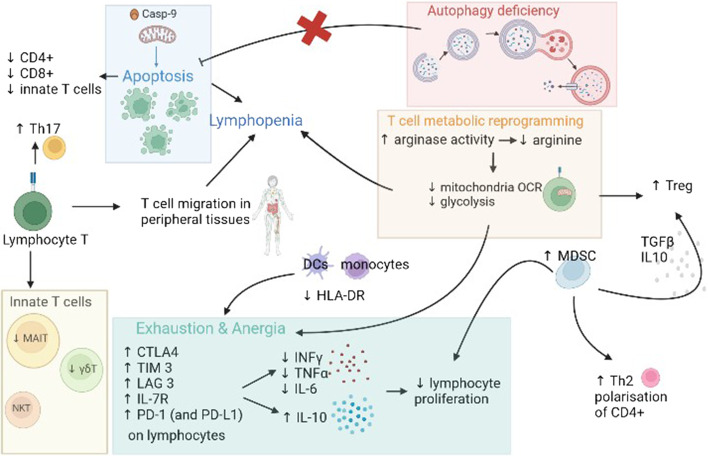
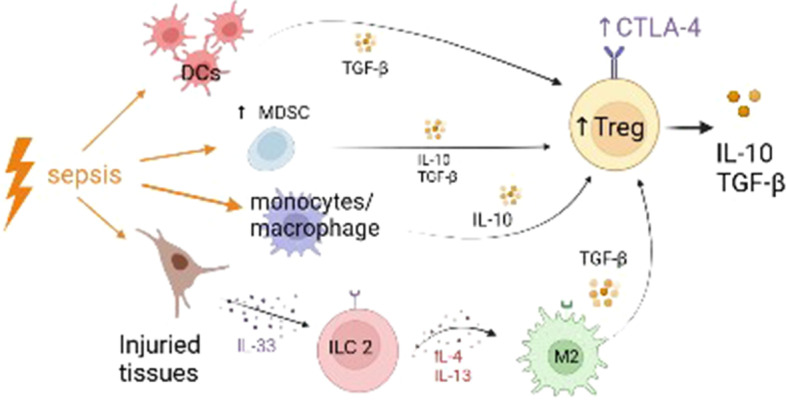
Severe inflammatory diseases, including sepsis, are characterized by an impaired host adaptive and innate immunity which results in immunosuppression, responsible for secondary infections and increased morbidity and mortality in critically ill patients. T cells are major actors of the immune system. During post-aggressive immunosuppression, lymphopenia, reduction of innate T cells, changes in T helper cell polarization and regulatory T cell increase are observed. The main mechanisms involved in T cell dysregulation are T cell apoptosis, autophagy deficiency, T cell anergy, T cell exhaustion and T cell metabolic reprogramming. In this review, we describe the alterations of T cell regulation, their mechanisms, and their association with clinical outcomes in severe inflammatory diseases, foremost of which is the sepsis.
包括脓毒症在内的严重炎症性疾病的特征是宿主适应性免疫和固有免疫受损,这会导致免疫抑制,进而引发重症患者的继发感染,并增加发病率和死亡率。T细胞是免疫系统的主要参与者。在侵袭后免疫抑制期间,可观察到淋巴细胞减少、固有T细胞数量减少、辅助性T细胞极化改变以及调节性T细胞增加。T细胞失调涉及的主要机制包括T细胞凋亡、自噬缺陷、T细胞无反应性、T细胞耗竭和T细胞代谢重编程。在本综述中,我们描述了严重炎症性疾病(其中最主要的是脓毒症)中T细胞调节的改变、其机制及其与临床结局的关联。