Hamdy Rehab M, Osama Hend, Fereig Hanaa M
Department of Cardiology, Faculty of Medicine (for girls), Al-Azhar University, Cairo, Egypt.
J Cardiovasc Imaging. 2022 Oct;30(4):307-319. doi: 10.4250/jcvi.2022.0061.
Current guidelines indicate electrical dyssynchrony as the major criteria for selecting patients for cardiac resynchronization therapy, and 25-35% of patients exhibit unfavorable responses to cardiac resynchronization therapy (CRT). We aimed to evaluate different cardiac mechanical dyssynchrony parameters in heart failure patients using current echo-Doppler modalities and we analyzed their association with electrical dyssynchrony.
The study included 120 heart failure with reduced ejection fraction (HFrEF) who underwent assessments for left ventricular mechanical dyssynchrony (LVMD) and interventricular mechanical dyssynchrony (IVMD).
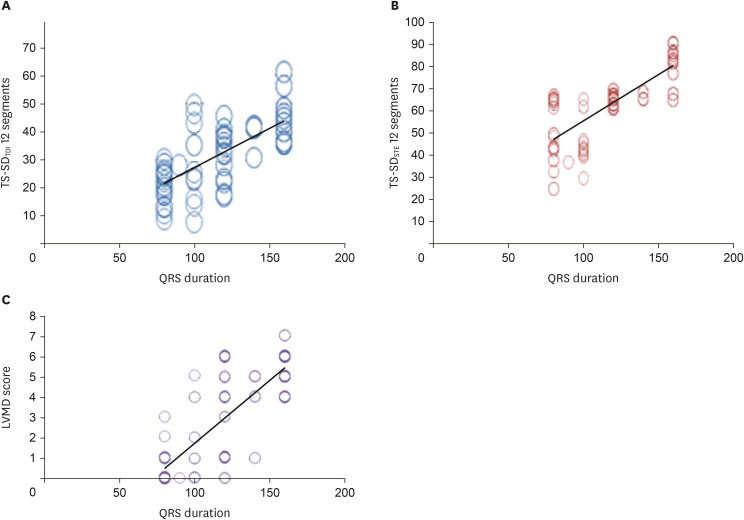
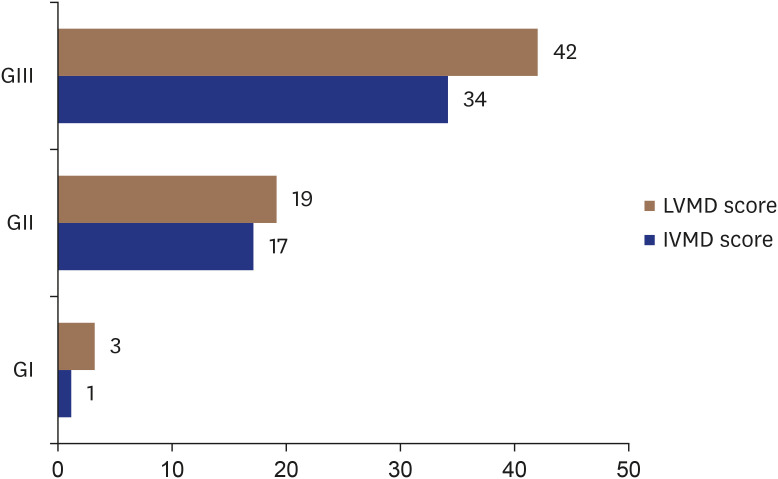
Patients were classified according to QRS duration: group I with QRS < 120 ms, group II with QRS 120-149 ms, and group III with QRS ≥ 150 ms. Group III had significantly higher IVMD, LVMD indices, TS-SD speckle-tracking echocardiography (STE) 12 segments (standard deviation of time to peak longitudinal strain speckle tracking echocardiography in 12 LV-segments), and LVMD score compared with group I and group II. Group II and group III were classified according to QRS morphology into left bundle branch block (LBBB) and non-LBBB subgroups. LVMD score, TS-SD 12 TDI, and TS-SD 12 STE had good correlations with QRS duration.
HFrEF patients with wide QRS duration (> 150 ms) had more evident LVMD compared with patients with narrow or intermediate QRS. Those patients with intermediate QRS duration (120-150 ms) had substantial LVMD assessed by both TDI and 2D STE, regardless of QRS morphology. Subsequently, we suggest that LVMD indices might be employed as additive criteria to predict CRT response in that patient subgroup. Electrical and mechanical dyssynchrony were strongly correlated in HFrEF patients.
当前指南指出电活动不同步是选择心脏再同步治疗患者的主要标准,且25% - 35%的患者对心脏再同步治疗(CRT)反应不佳。我们旨在使用当前的超声多普勒方法评估心力衰竭患者不同的心脏机械不同步参数,并分析它们与电活动不同步的关联。
本研究纳入了120例射血分数降低的心力衰竭(HFrEF)患者,这些患者接受了左心室机械不同步(LVMD)和心室间机械不同步(IVMD)评估。
根据QRS波时限对患者进行分类:I组QRS波时限<120毫秒,II组QRS波时限为120 - 149毫秒,III组QRS波时限≥150毫秒。与I组和II组相比,III组的IVMD、LVMD指数、基于斑点追踪超声心动图(STE)的12节段心肌速度标准差(TS - SD,12个左心室节段纵向应变峰值时间的标准差)以及LVMD评分显著更高。II组和III组根据QRS波形态分为左束支传导阻滞(LBBB)和非LBBB亚组。LVMD评分、基于组织多普勒成像(TDI)的12节段TS - SD以及基于STE的12节段TS - SD与QRS波时限具有良好的相关性。
与QRS波时限窄或中等的患者相比,QRS波时限宽(>150毫秒)的HFrEF患者LVMD更明显。QRS波时限中等(120 - 150毫秒)的患者,无论QRS波形态如何,通过TDI和二维STE评估均有显著的LVMD。随后,我们建议LVMD指数可作为预测该亚组患者CRT反应的附加标准。HFrEF患者的电活动和机械不同步密切相关。